
USDJPY at its peak: the market ignores central bank signals
The USDJPY pair rose to 160.59, with the price likely to reach a nearly two-year high again. Discover more in our analysis for 30 April 2026.
USDJPY forecast: key takeaways
- The USDJPY pair maintains its overall uptrend
- The market clearly does not believe either in support from the Bank of Japan or in interventions
- USDJPY forecast for 30 April 2026: 160.70
Fundamental analysis
The USDJPY rate surged to 160.59 on Thursday, with the Japanese yen hitting its lowest level since July 2024, the period when the authorities last conducted currency interventions.
Investors are actively increasing short positions in the yen, betting that neither further rate hikes nor possible interventions will provide significant support in the near term.
Last week, the Bank of Japan kept the rate at 0.75% in an effort to balance inflation risks against an economic slowdown amid the conflict in the Middle East. At the same time, three out of nine board members supported a rate hike, while Governor Kazuo Ueda confirmed the course towards gradual policy tightening.
Despite this, the yen continues to weaken. Verbal interventions have also had no effect: Finance Minister Satsuki Katayama stated that the authorities are ready to intervene at any moment, but the market is not yet treating these signals as sufficient to reverse the trend.
The USDJPY forecast is positive.
Technical outlook
The USDJPY H4 chart shows that after a prolonged sideways phase in the range of roughly 158.90–159.80, the pair broke upwards and moved into sustained growth. The latest candlesticks are forming a series of higher lows and highs, indicating stronger upward momentum. The price confidently broke through the 160.00 zone and is now testing the 160.50–160.60 area – these are new local highs.
Bollinger Bands are widening, confirming rising volatility amid the upward move. The price has consolidated above the middle line and is moving along the upper boundary, signalling buyer dominance. At the same time, the 159.40–159.50 level is now acting as the nearest support, where the acceleration of growth began, while the 160.60–160.70 zone is acting as current resistance.
The structure appears overbought in the short term: a sharp upward momentum suggests a correction or a pause. However, while the price remains above 160.00, the overall trend remains upward. A breakout of this level may lead to a pullback into the 159.50 area, while consolidation above 160.70 would open the way to further growth.
USDJPY overview
- Asset: USDJPY
- Timeframe: H4 (Intraday)
- Trend: upward
- Key resistance levels: 160.70 and 161.20
- Key support levels: 160.00 and 159.50
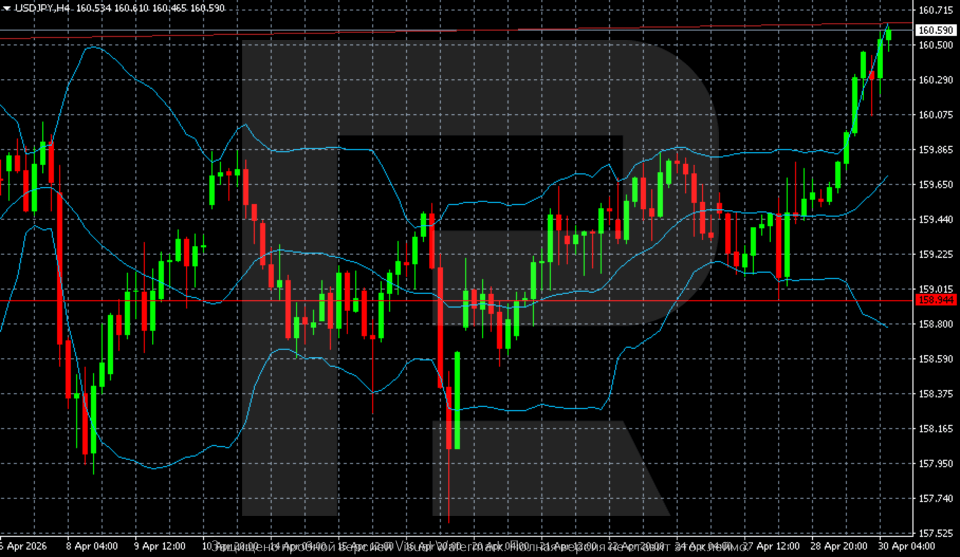
USDJPY trading scenarios for today
Main scenario (Buy Stop)
Consolidation above 160.70 would confirm continued upward momentum amid yen weakness and the market’s lack of reaction to Bank of Japan signals. In this case, the pair may move towards 161.20.
- Take Profit: 161.20
- Stop Loss: 160.10
Alternative scenario (Sell Stop)
A breakout below 160.00 would strengthen corrective pressure after overbought conditions. The move may develop towards 159.50 amid profit-taking and rising expectations of interventions.
- Take Profit: 159.50
- Stop Loss: 160.80
Risk factors
The key risks to growth are linked to possible currency interventions by the Japanese authorities and stronger rhetoric from the Bank of Japan. However, for now, the market is ignoring these factors, and the uptrend continues.
Summary
The USDJPY pair is rising quickly. The USDJPY forecast for today, 30 April 2026, suggests attempts to move towards 160.70.
Editors’ picks
 EURUSD 2026-2027 forecast: key market trends and future predictions
This article provides the EURUSD forecast for 2026 and 2027 and highlights the main factors determining the direction of the pair’s movements. We will apply technical analysis, take into account the opinions of leading experts, large banks, and financial institutions, and study AI-based forecasts. This comprehensive insight into EURUSD predictions should help investors and traders make informed decisions.
 Gold (XAUUSD) forecast 2026 and beyond: expert insights, price predictions, and analysis
Dive deep into the Gold (XAUUSD) price outlook for 2026 and beyond, combining technical analysis, expert forecasts, and key macroeconomic factors. It explains the drivers behind gold’s recent surge, explores potential scenarios including a move toward 4,500 to 5,000 USD per ounce, and highlights why the metal remains a strong hedge during global uncertainty.
Forecasts presented in this section only reflect the author’s private opinion and should not be considered as guidance for trading. RoboForex bears no responsibility for trading results based on trading recommendations described in these analytical reviews.