
USDJPY is gearing up for a comeback: the market is already bracing for another push towards 160.00
After intervention by the Japanese government, the yen may lose ground again, and the USDJPY rate may head towards 160.00. Find out more in our analysis for 4 May 2026.
USDJPY forecast: key takeaways
- Japan conducted an intervention
- The actions of the Japanese authorities triggered a 3% decline in the USDJPY rate in one day
- Former Minneapolis Fed President Neil Kashkari raised the issue of a possible Fed rate hike
- USDJPY forecast for 4 May 2026: 160.70
Fundamental analysis
Fundamental analysis for 4 May 2026 shows that the pair is entering the new trading week in a state of fragile equilibrium, caught between Japanese currency intervention and geopolitical pressure pushing the dollar higher. On Monday morning, quotes are consolidating around 156.75 after the pair surged to 160.71 last week and then collapsed below 155.50.
At the end of last week, when the USDJPY pair broke above the psychological 160.00 level, Japan carried out an intervention, which is preliminarily estimated at 34–35 billion USD. These actions by the Japanese authorities triggered a 3% fall in the USDJPY rate in one day.
The largest investment banks are unanimous in their verdict – the effect of the intervention will be temporary. Barclays notes that in the past, the yen’s appreciation following interventions reversed within two days on average, and warns that if the USDJPY pair rises rapidly towards the 160.00 level, the authorities may intervene again. ING adds that the intervention merely bought time – similar actions in 2024 pushed the pair down to 152.00, but new highs were reached just two months later.
Former Minneapolis Fed President Neil Kashkari stated on Sunday that the prolonged conflict in the Strait of Hormuz carries risks of accelerating inflation, and raised the issue of a possible Fed rate hike. This is the strongest hawkish signal in recent times, completely dashing hopes for rate cuts in 2026.
Japan is in a paradoxical situation: the yen is weak, but this is one of the few drivers of local inflation, and the Bank of Japan is signalling readiness to raise the rate as early as June.
The USDJPY forecast for today takes into account that the situation remains volatile. If the conflict in the Strait of Hormuz continues to intensify, and the Federal Reserve continues to send hawkish signals, any attempts by the Japanese authorities to strengthen the yen are doomed to be short-lived, with the pair likely to return to the 160.00 level faster than optimists expect.
Technical outlook
On the H4 chart, the USDJPY pair formed a Hammer reversal pattern near the lower Bollinger Band, trading around 156.70. Since the price remains within an ascending channel after the decline, it may form an upward wave following the pattern signal, with the upside target at 158.00.
At the same time, the USDJPY forecast also takes into account another market scenario, in which the USDJPY rate may continue the downward wave and test the 156.00 support level.
USDJPY overview
- Asset: USDJPY
- Timeframe: H4 (Intraday)
- Trend: upward
- Key resistance levels: 158.00 and 160.00
- Key support levels: 156.00 and 154.20
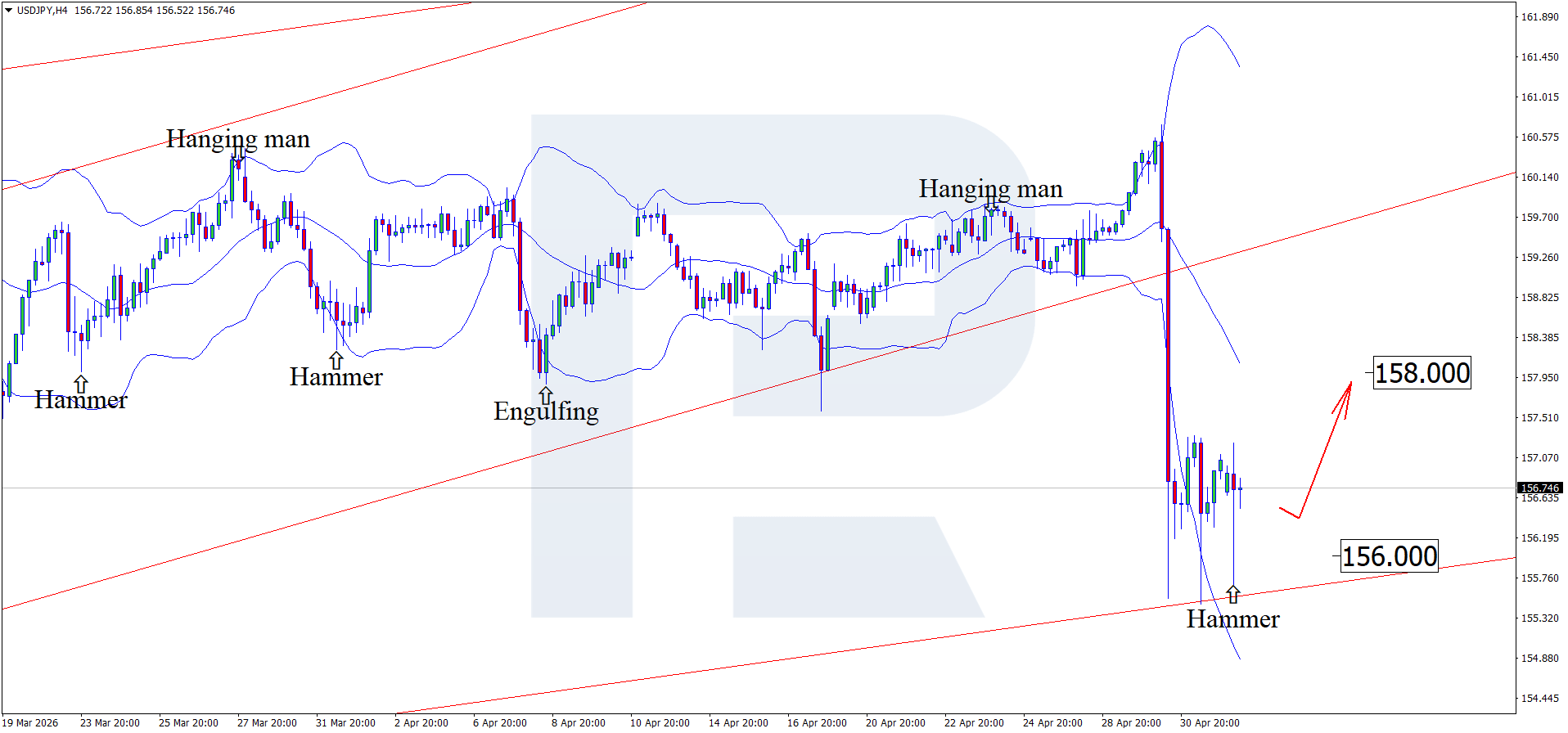
USDJPY trading scenarios for today
Main scenario (Buy Stop)
Consolidation above 158.00 would confirm another upward momentum amid a weakening yen despite the intervention. In this case, the pair could again head towards 160.00.
- Take Profit: 160.00
- Stop Loss: 157.70
Alternative scenario (Sell Stop)
A breakout below the 156.00 support level would strengthen pressure after overbought conditions and the market reaction to the actions of the Japanese government. The move could extend to 154.20 amid profit-taking and rising expectations of repeated intervention.
- Take Profit: 154.20
- Stop Loss: 156.30
Risk factors
The key risks to growth are linked to a possible repeated currency intervention by the Japanese authorities, as well as stronger rhetoric from the Bank of Japan. An additional factor may be easing geopolitical tensions in the Middle East, which will weaken the USD.
Summary
Intervention by the Japanese government is providing temporary support to the yen, but the situation may change at any moment. USDJPY technical analysis suggests growth towards 158.00 after the correction.
Editors’ picks
 EURUSD 2026-2027 forecast: key market trends and future predictions
This article provides the EURUSD forecast for 2026 and 2027 and highlights the main factors determining the direction of the pair’s movements. We will apply technical analysis, take into account the opinions of leading experts, large banks, and financial institutions, and study AI-based forecasts. This comprehensive insight into EURUSD predictions should help investors and traders make informed decisions.
 Gold (XAUUSD) forecast 2026 and beyond: expert insights, price predictions, and analysis
Dive deep into the Gold (XAUUSD) price outlook for 2026 and beyond, combining technical analysis, expert forecasts, and key macroeconomic factors. It explains the drivers behind gold’s recent surge, explores potential scenarios including a move toward 4,500 to 5,000 USD per ounce, and highlights why the metal remains a strong hedge during global uncertainty.
Forecasts presented in this section only reflect the author’s private opinion and should not be considered as guidance for trading. RoboForex bears no responsibility for trading results based on trading recommendations described in these analytical reviews.