
USDJPY remains below 157.35 amid selling pressure
The USDJPY rate remains under pressure after a sharp decline, while the market is closely watching the risks of new currency interventions from Japan. The rate currently stands at 157.18. Discover more in our analysis for 5 May 2026.
USDJPY forecast: key takeaways
- Japan confirmed its intervention in the currency market last week
- Japan’s Finance Minister issued a warning against speculative activity in the currency market
- Market participants continue to assess the likelihood of new currency interventions
- USDJPY forecast for 5 May 2026: 154.65
Fundamental analysis
The USDJPY rate has been correcting for the third consecutive trading session after the sharp decline on Thursday. Despite recovery attempts, sellers continue to hold the key resistance level at 157.35, preventing a breakout.
Earlier, Japan’s Finance Minister issued a warning against speculative activity in the currency market. His statement followed a short-term strengthening of the yen, which increased expectations of possible currency intervention from Tokyo. He stressed the authorities’ readiness to take decisive measures against speculative moves, but refrained from disclosing specific details.
Japan has already confirmed its intervention last week to support the national currency. According to money market estimates, around 35 billion USD was spent on the intervention, prompting the yen to rise by about 3% during the day.
Market participants are currently assessing the likelihood of new interventions. Experience shows that Tokyo often takes advantage of periods of lower liquidity, including public holidays, and may conduct a series of consecutive yen-buying operations to amplify the effect.
Technical outlook
The USDJPY pair continues to actively test the key resistance level at 157.35, but sellers are confidently restraining growth and preventing consolidation above this level. The USDJPY forecast for today suggests a downward move with a target at 154.65.
The technical picture remains bearish. The Stochastic Oscillator is in overbought territory and is setting the stage for a bearish crossover, signalling a strengthening downward momentum. Consolidation below the 156.55 level would confirm the downside scenario.
An alternative scenario suggests renewed growth if the upper boundary of the current resistance is broken and the price consolidates above 157.65. In this case, the likelihood of a deeper bullish correction will increase.
USDJPY overview
- Asset: USDJPY
- Timeframe: H1 (Intraday)
- Trend: downward
- Key resistance levels: 157.35 and 158.45
- Key support levels: 156.55 and 154.45
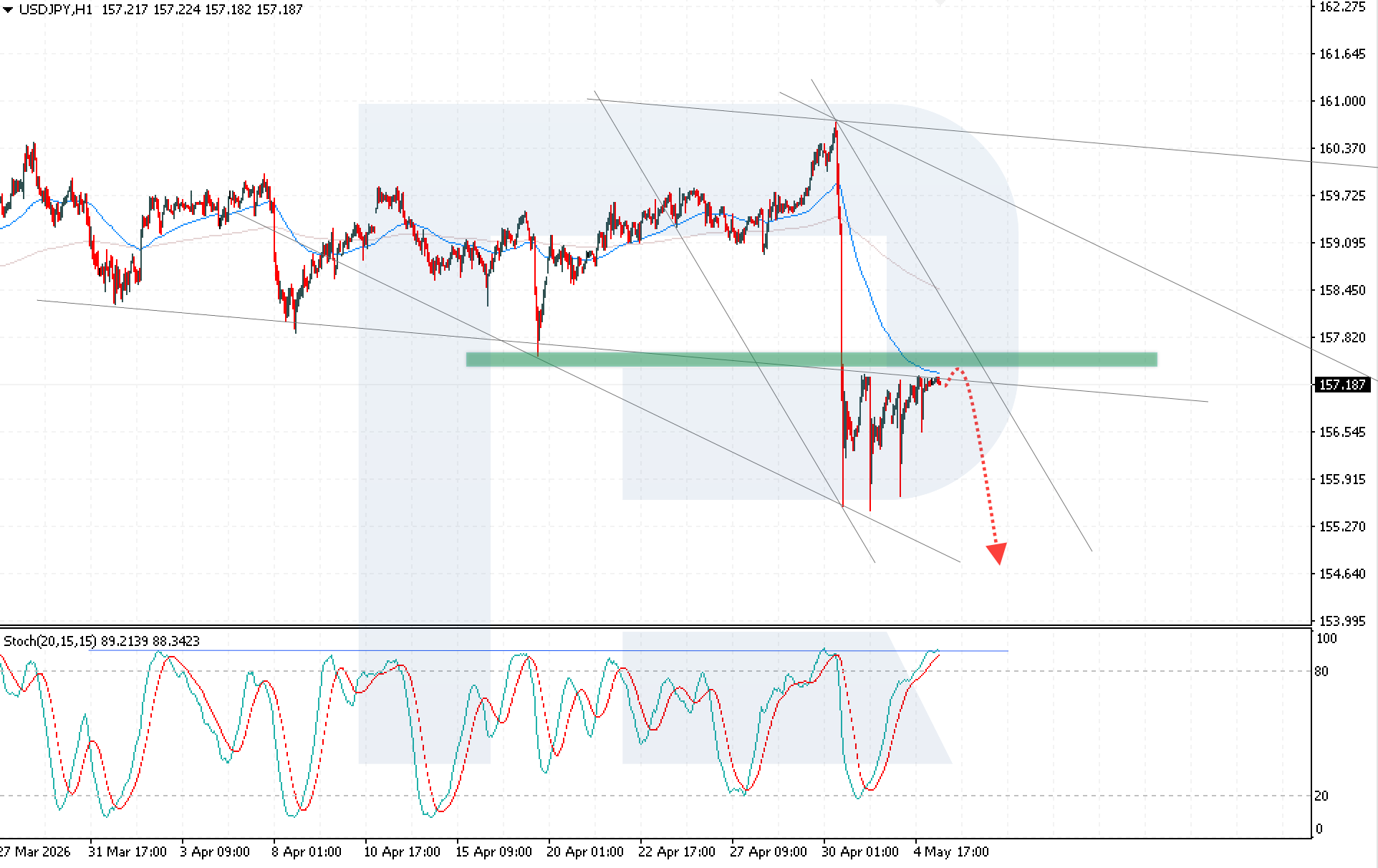
USDJPY trading scenarios for today
Main scenario (Sell Stop)
A confident rebound from the 157.35 level would signal short positions.
- Take Profit: 154.65
- Stop Loss: 158.05
Alternative scenario (Buy Stop)
A breakout and consolidation above the key resistance level at 157.35 would strengthen bullish pressure and indicate a bullish correction.
- Take Profit: 158.45
- Stop Loss: 156.75
Risk factors
A confident breakout of the 157.35 level and consolidation above 157.65 will increase the risks to the downside scenario, indicating a breakout of the current seller resistance. Further support for growth could come from fundamental factors, including reduced expectations of further currency interventions by Japan or a strengthening of the US dollar amid US macroeconomic data.
Summary
The USDJPY pair remains under pressure, while the risk of repeated currency interventions from Japan continues to limit the pair’s upside potential. USDJPY technical analysis suggests a bearish scenario, with a downside target at 154.65.
Editors’ picks
 EURUSD 2026-2027 forecast: key market trends and future predictions
This article provides the EURUSD forecast for 2026 and 2027 and highlights the main factors determining the direction of the pair’s movements. We will apply technical analysis, take into account the opinions of leading experts, large banks, and financial institutions, and study AI-based forecasts. This comprehensive insight into EURUSD predictions should help investors and traders make informed decisions.
 Gold (XAUUSD) forecast 2026 and beyond: expert insights, price predictions, and analysis
Dive deep into the Gold (XAUUSD) price outlook for 2026 and beyond, combining technical analysis, expert forecasts, and key macroeconomic factors. It explains the drivers behind gold’s recent surge, explores potential scenarios including a move toward 4,500 to 5,000 USD per ounce, and highlights why the metal remains a strong hedge during global uncertainty.
Forecasts presented in this section only reflect the author’s private opinion and should not be considered as guidance for trading. RoboForex bears no responsibility for trading results based on trading recommendations described in these analytical reviews.