
USDJPY halts its rise: the external backdrop is improving
The USDJPY pair stalled near 157.81. Geopolitics is improving market sentiment. Discover more in our analysis for 6 May 2026.
USDJPY forecast: key takeaways
- The USDJPY pair paused its rise after three days of gains
- The market is factoring in improving global sentiment, but the risks for the yen remain high
- USDJPY forecast for 6 May 2026: 158.50
Fundamental analysis
The USDJPY rate reached 157.81 midweek, ending the Japanese yen's three-day decline. The currency received support from a weaker US dollar and lower oil prices amid signs of de-escalation in the Middle East.
The US confirmed that the ceasefire remains in place, that offensive operations have ended, and announced a pause in efforts to remove ships from the Strait of Hormuz. This is intended to buy time for a possible resumption of negotiations with Iran.
The yen remains especially sensitive to the situation in the region because Japan depends heavily on oil imports from Persian Gulf countries.
In addition, the market is factoring in the risk of new interventions. Last week, Japan’s authorities may have directed about 35 billion USD to support the currency, according to estimates, although no official confirmation followed.
At the same time, the current dynamics show that without new action from the regulator, the yen is not yet showing signs of a sustained strengthening.
The USDJPY forecast is cautious.
Technical outlook
The USDJPY H4 chart shows that after a prolonged sideways movement in the 158.50–160.50 range, the market initially advanced towards the 160.50–161.00 zone, and then sharply reversed downwards. The fall was fast and impulsive, with long bearish candlesticks, suggesting strong selling pressure and, likely, external factors – such moves are rarely purely technical.
After plummeting, the price found support in the 155.50–156.00 area and began to recover. However, the rise is developing gradually and unevenly, with lower highs forming compared to the previous peak, indicating weakness among the bulls. The pair is now trading near 157.80–158.00, where intermediate resistance lies – this zone previously acted as support and is now capping the rise.
Bollinger Bands indicate a contraction following a sharp rise, signalling that the market is entering a consolidation phase. The price is moving closer to the middle line, and volatility is declining. Overall, the structure looks like a corrective recovery after a strong fall: the market is stabilising, but to resume growth it needs to consolidate confidently above 158.50–159.00; otherwise, the risk of renewed downward pressure remains.
USDJPY overview
- Asset: USDJPY
- Timeframe: H4 (Intraday)
- Trend: corrective (after the decline)
- Key resistance levels: 158.50 and 159.00
- Key support levels: 156.50 and 155.50
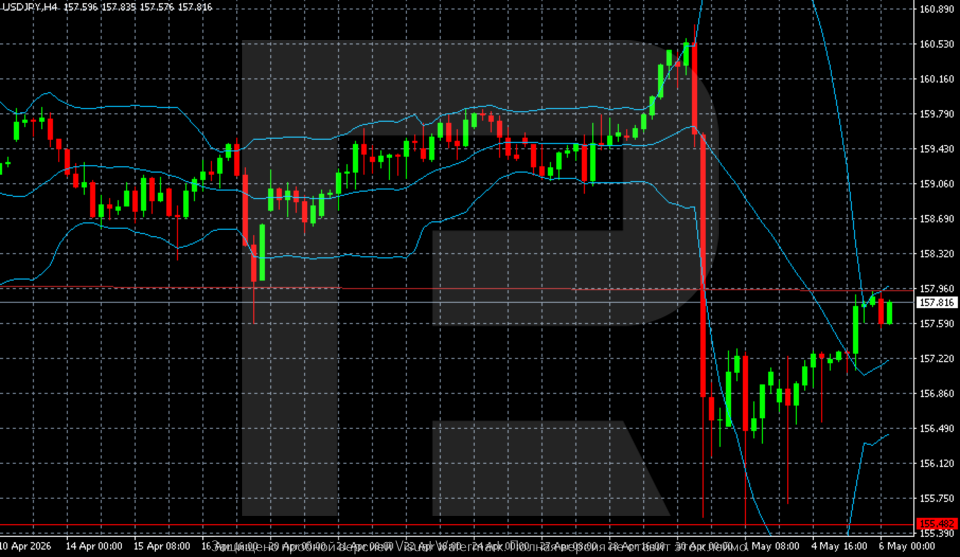
USDJPY trading scenarios for today
Main scenario (Sell Stop)
A rebound from the 158.50 level would confirm the weakness of the recovery and indicate continued selling pressure. In this case, the move could resume towards 156.50 and lower.
- Take Profit: 155.50
- Stop Loss: 159.10
Alternative scenario (Buy Stop)
A breakout and consolidation above 158.50 would strengthen the corrective rise and open the way to 159.00.
- Take Profit: 159.50
- Stop Loss: 157.20
Risk factors
Risks to the downside are linked to a further improvement in the geopolitical backdrop and a weaker dollar, which could support the yen. Meanwhile, expectations of possible Japanese interventions and high sensitivity to oil are keeping volatility high and limiting any sustained strengthening of the JPY.
Summary
The USDJPY pair has paused its rise. The USDJPY forecast for today, 6 May 2026, suggests the upward wave could continue towards 158.50.
Editors’ picks
 EURUSD 2026-2027 forecast: key market trends and future predictions
This article provides the EURUSD forecast for 2026 and 2027 and highlights the main factors determining the direction of the pair’s movements. We will apply technical analysis, take into account the opinions of leading experts, large banks, and financial institutions, and study AI-based forecasts. This comprehensive insight into EURUSD predictions should help investors and traders make informed decisions.
 Gold (XAUUSD) forecast 2026 and beyond: expert insights, price predictions, and analysis
Dive deep into the Gold (XAUUSD) price outlook for 2026 and beyond, combining technical analysis, expert forecasts, and key macroeconomic factors. It explains the drivers behind gold’s recent surge, explores potential scenarios including a move toward 4,500 to 5,000 USD per ounce, and highlights why the metal remains a strong hedge during global uncertainty.
Forecasts presented in this section only reflect the author’s private opinion and should not be considered as guidance for trading. RoboForex bears no responsibility for trading results based on trading recommendations described in these analytical reviews.