
USDJPY is on the rise: geopolitics and inflation are not improving sentiment towards the yen
The USDJPY pair rose to 157.62, with inflation risks and Japanese interventions in focus. Find more details in our analysis for 12 May 2026.
USDJPY forecast: key takeaways
- The USDJPY pair is rising while the market is full of emotion and nervousness
- Upside momentum remains moderate, according to technical signals
- USDJPY forecast for 12 May 2026: 157.90
Fundamental analysis
The USDJPY rate rose to 157.62 on Tuesday. The yen is falling for the second consecutive day amid a stronger US currency. Pressure on the yen increased after US President Donald Trump cast doubt on the durability of the ceasefire between the US and Iran, once again shifting market attention to inflation risks.
At the same time, Japan and the US confirmed close coordination on currency policy issues after a meeting between Japanese Finance Minister Satsuki Katayama and US Treasury Secretary Scott Bessent.
According to market estimates, Tokyo may have spent more than 63 billion USD on currency interventions to support the yen. It should be noted that the Japanese authorities have not officially confirmed this.
The outcome of the Bank of Japan’s April meeting also drew additional investor attention. The published summary of opinions noted that the regulator is considering a possible interest rate hike as early as the next meeting, as rising oil prices are increasing inflationary pressure in the country.
The USDJPY forecast is positive.
Technical outlook
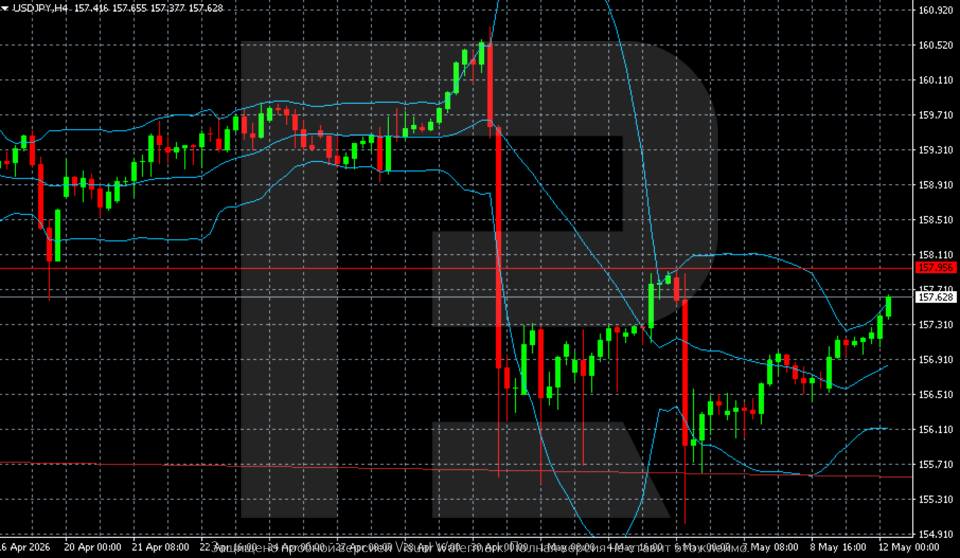
On the H4 chart, the USDJPY pair remains in a recovery phase after the sharp decline in late April. After an unsuccessful attempt to consolidate above 160.50, quotes experienced a strong sell-off and quickly fell to the 155.50 area. This move was accompanied by high volatility and long impulsive candlesticks, indicating aggressive closing of long dollar positions.
In early May, the market gradually stabilised. The pair formed a local base in the 155.70–156.10 range, after which it began a smooth recovery. The USDJPY pair is now trading around 157.60, approaching the upper boundary of the short-term range and the middle Bollinger Band. At the same time, upside momentum remains moderate, without a sharp acceleration in buying.
The nearest resistance level for the pair is located in the 157.90–158.10 area. Consolidation above this area may open the way for further recovery towards 158.90. Support is located in the 156.90–156.50 zone, with a stronger level remaining around 155.70, where active buying rebounds were previously observed.
USDJPY overview
- Asset: USDJPY
- Timeframe: H4 (Intraday)
- Trend: moderately upward
- Key resistance levels: 157.90 and 158.90
- Key support levels: 156.90 and 155.70
USDJPY trading scenarios for today
Main scenario (Buy Stop)
A breakout and consolidation above the 157.90 resistance level would confirm continued demand for the dollar as a safe-haven asset and open the way for growth towards 158.90.
- Take Profit: 158.90
- Stop Loss: 157.40
Alternative scenario (Sell Stop)
A breakout below the 156.90 support level would indicate weakening upward momentum and increase the risks of a correction towards 155.70.
- Take Profit: 155.70
- Stop Loss: 157.30
Risk factors
Risks to further USDJPY growth remain amid geopolitical tensions and high oil prices, which support the dollar and increase inflation expectations. At the same time, pressure on the pair could increase in the event of new currency interventions by Japan or signs of de-escalation of the conflict in the Middle East.
Summary
The USDJPY pair is in positive territory due to the strengthening of the dollar as a safe-haven asset. The USDJPY forecast for today, 12 May 2026, does not rule out further growth towards 157.90.
Editors’ picks
 EURUSD 2026-2027 forecast: key market trends and future predictions
This article provides the EURUSD forecast for 2026 and 2027 and highlights the main factors determining the direction of the pair’s movements. We will apply technical analysis, take into account the opinions of leading experts, large banks, and financial institutions, and study AI-based forecasts. This comprehensive insight into EURUSD predictions should help investors and traders make informed decisions.
 Gold (XAUUSD) forecast 2026 and beyond: expert insights, price predictions, and analysis
Dive deep into the Gold (XAUUSD) price outlook for 2026 and beyond, combining technical analysis, expert forecasts, and key macroeconomic factors. It explains the drivers behind gold’s recent surge, explores potential scenarios including a move toward 4,500 to 5,000 USD per ounce, and highlights why the metal remains a strong hedge during global uncertainty.
Forecasts presented in this section only reflect the author’s private opinion and should not be considered as guidance for trading. RoboForex bears no responsibility for trading results based on trading recommendations described in these analytical reviews.