
USDJPY reacts to geopolitics: it seems to be getting warmer
The USDJPY pair fell to 158.86 at the start of the week. The improvement in the external backdrop immediately supported the Japanese yen. More details are in our analysis for 25 May 2026.
USDJPY forecast: key takeaways
- The USDJPY pair declined, but there is no new wave of selling yet
- The external backdrop is working in favour of the yen through lower oil prices and a weaker US dollar
- USDJPY forecast for 25 May 2026: 157.30 or 159.30
Fundamental analysis
The USDJPY rate fell to 158.86 on Monday. The yen is recovering after another test of local lows. Lower oil prices and a weaker dollar, against the backdrop of signs that the US and Iran are moving closer to an agreement on the Strait of Hormuz, supported the Japanese currency.
A full restoration of shipping through the Strait of Hormuz would become a positive factor for the largest Asian economies, which depend heavily on supplies of Middle Eastern oil.
Data published last week showed that core inflation in Japan slowed in April to the lowest level in four years. This reduced pressure on the Bank of Japan and lowered expectations of a near-term rate increase.
Nevertheless, the market does not rule out further BoJ policy tightening, as the Japanese economy still looks resilient.
The risks of currency intervention remain an additional market factor. The yen is still trading not far from the 160 per dollar level. It was this mark that triggered intervention by the Japanese authorities in late April and early May.
The forecast for USDJPY is mixed.
Technical outlook
On the H4 chart, USDJPY remains in a phase of broad sideways consolidation after recovering from the May lows in the 155.00–156.00 area. After strong growth in the middle of the month, the pair managed to consolidate above 158.50 and moved closer to resistance around 159.30–159.35, but there has not yet been any further acceleration upwards.
Quotes are now holding around 158.85 and are trading close to the middle Bollinger Band. The latest sessions have been moving within a narrow range, while volatility is gradually declining. This points to the market moving into an accumulation phase after the previous upward impulse. A series of higher lows is still in place, which formally leaves the advantage on the side of buyers.
The technical picture looks neutral to positive. The pair is holding above support at 157.30–157.35, while the nearest resistance is located around 159.30–159.35. Consolidation above this zone may return the market to movement towards 160.00. Loss of support at 158.50–157.30 will increase the risks of a deeper correction.
USDJPY overview
- Asset: USDJPY
- Timeframe: H4 (Intraday)
- Trend: sideways with a moderately upward bias
- Key resistance levels: 159.30 and 160.00
- Key support levels: 158.50 and 157.30
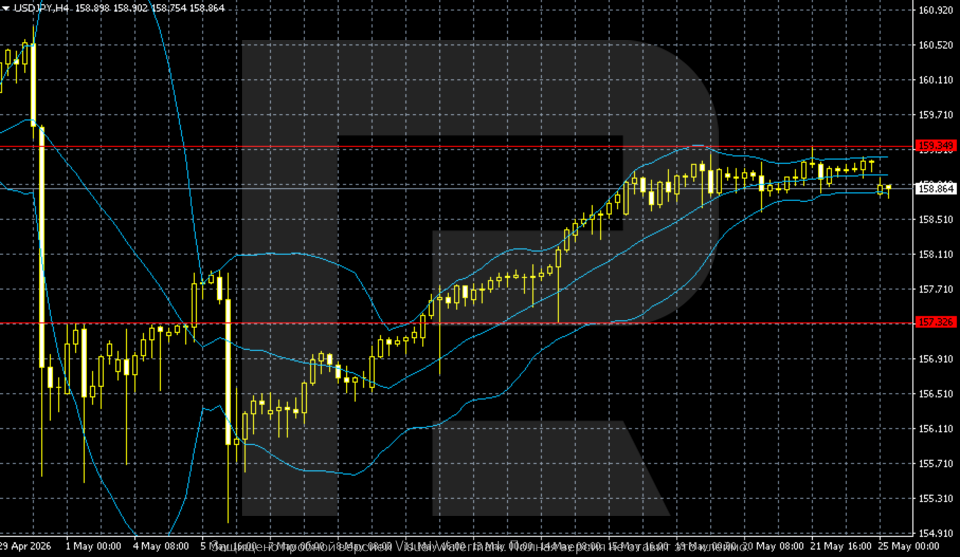
USDJPY trading scenarios for today
Main scenario (Buy Stop)
A breakout of resistance at 159.30 with consolidation above it will confirm that buyers remain in control and will create conditions for movement towards 160.00.
- Take Profit: 160.00
- Stop Loss: 158.90
Alternative scenario (Sell Stop)
A breakout of support at 158.50 will increase pressure on USDJPY and will indicate the development of a deeper correction towards 157.30.
- Take Profit: 157.30
- Stop Loss: 158.95
Risk factors
The main risks to the USDJPY growth scenario remain possible currency interventions by the Japanese authorities near the 160.00 level, as well as a further decline in oil prices and a weaker US dollar against the backdrop of progress in negotiations between the US and Iran. Expectations of a Bank of Japan rate increase may become an additional supporting factor for the yen.
Summary
The USDJPY pair declined, and investors are looking around cautiously. The forecast for USDJPY for today, 25 May 2026, does not rule out continued sideways movement within the 157.30–159.30 range.
Editors’ picks
 EURUSD 2026-2027 forecast: key market trends and future predictions
This article provides the EURUSD forecast for 2026 and 2027 and highlights the main factors determining the direction of the pair’s movements. We will apply technical analysis, take into account the opinions of leading experts, large banks, and financial institutions, and study AI-based forecasts. This comprehensive insight into EURUSD predictions should help investors and traders make informed decisions.
 Gold (XAUUSD) forecast 2026 and beyond: expert insights, price predictions, and analysis
Dive deep into the Gold (XAUUSD) price outlook for 2026 and beyond, combining technical analysis, expert forecasts, and key macroeconomic factors. It explains the drivers behind gold’s recent surge, explores potential scenarios including a move toward 4,500 to 5,000 USD per ounce, and highlights why the metal remains a strong hedge during global uncertainty.
Forecasts presented in this section only reflect the author’s private opinion and should not be considered as guidance for trading. RoboForex bears no responsibility for trading results based on trading recommendations described in these analytical reviews.