
USDJPY falls 5% since the start of the week as the market takes a breather
The USDJPY pair paused near 157.72. Following the interventions and recent news, the yen needs a break. Find out more in our analysis for 6 August 2026.
USDJPY forecast: key takeaways
- The USDJPY pair has stopped falling and is consolidating, with a slight decline remaining possible
- The yen has gained almost 5% since the start of the week
- USDJPY forecast for 6 August 2026: 157.35 or 158.03
Fundamental analysis
The USDJPY rate halted at 157.72 on Thursday, with the Japanese yen pausing its recent strengthening. Earlier, US Treasury Secretary Scott Bessent reiterated Washington’s support for Japan following a large-scale joint currency intervention.
The yen gained almost 5% over three sessions following coordinated purchases by Tokyo and Washington, which were the largest in several decades. Both countries also stated their readiness to intervene in the market again if necessary.
According to the Bank of Japan, Tokyo spent about 5.33 trillion yen to support the national currency on Friday. A day earlier, media reports put the intervention volume at a record 8.45 trillion yen.
Last month, the yen fell to a four-decade low due to rising energy prices, fiscal risks, and a wide interest rate differential. At the same time, real wages in Japan rose for the sixth consecutive month in June, strengthening the case for further rate hikes by the Bank of Japan.
The USDJPY forecast remains cautious.
Technical outlook
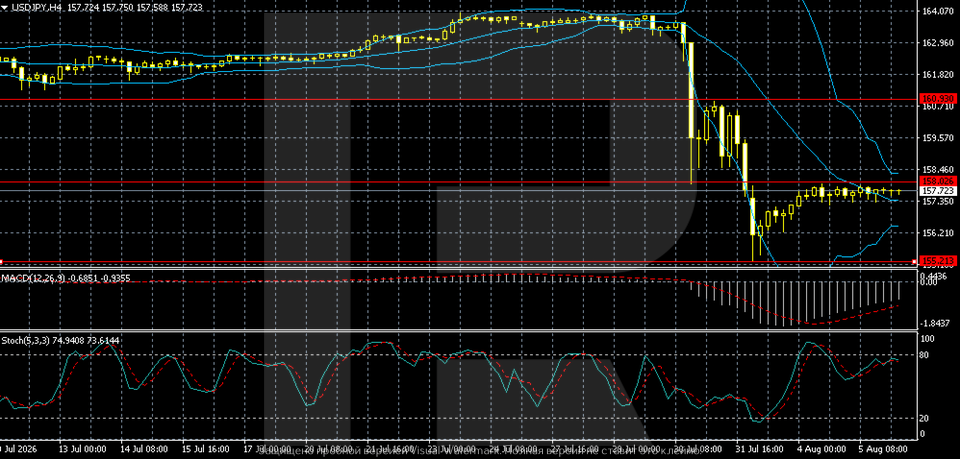
On the H4 chart, the USDJPY pair maintains a bearish structure after plummeting from the 164.00 area to 155.20. The subsequent rebound stalled near 158.00, with the pair currently consolidating around 157.72. The price remains below the middle Bollinger Band, so the current recovery still appears corrective.
The nearest resistance level is located at 158.03. A breakout above this mark would allow the pair to continue its recovery towards 158.46–159.57, while 160.93 remains the key level for changing the short-term outlook. Support levels are located at 157.35 and 156.21, with the key level at 155.21. A breakout below this area would confirm a renewed decline.
MACD remains in negative territory, although bearish momentum is gradually weakening. The Stochastic Oscillator has risen to 74, indicating continued buying activity, although its approach to overbought territory limits the rebound potential. The baseline scenario remains movement within the 157.35–158.03 range with a neutral-to-bearish bias.
USDJPY overview
- Asset: USDJPY
- Timeframe: H4 (intraday)
- Trend: range with a neutral-to-bearish bias
- Key resistance levels: 158.03 and 159.57
- Key support levels: 157.35 and 156.21
USDJPY trading scenarios for today
Main scenario (Sell Stop)
A breakout below the 157.35 support level, followed by consolidation below it, would indicate the end of the consolidation phase and a renewed USDJPY decline.
- Take Profit: 156.21
- Stop Loss: 157.70
Alternative scenario (Buy Stop)
A breakout and consolidation above the 158.03 resistance level would confirm a corrective recovery after the pair’s sharp decline.
- Take Profit: 159.57
- Stop Loss: 157.70
Risk factors
The main risk to the USDJPY downside scenario is the end of interventions and a recovery in demand for the US dollar amid the wide interest rate differential between the US and Japan. Rising energy prices and reduced expectations of further Bank of Japan rate hikes could provide additional support for the pair. As long as quotes remain below 158.03, sellers have the upper hand.
Summary
The USDJPY pair has paused after its recent sharp moves. The USDJPY forecast for today, 6 August 2026, suggests minor fluctuations within the 157.35–158.03 range, with a possibility of a slight decline.
Editors’ picks
 EURUSD forecast 2026–2027: technical analysis, price levels & predictions
EURUSD has pulled back from the 2026 high of 1.1915 and is now trading near 1.1450 — below both EMA65 and EMA200 — with the active scenario shifting from bullish to bearish. The ECB raised rates to 2.40%, but the Fed holds at 3.75%, and US inflation (3.5%) continues to outpace the eurozone (2.8%). A confirmed break below 1.1280 opens the next downward wave toward 1.1080. We break down the key levels, three trading scenarios with entry triggers, and what Deutsche Bank, Morgan Stanley and UBS are forecasting for EURUSD in 2026.
 Gold (XAUUSD) forecast 2026: predictions based on fundamental and technical analysis
Gold has corrected over 25% from its all-time high of 5,597 USD and is now trading near 4,100 USD — testing a critical support zone. Is this the bottom, or will the downtrend continue? We break down the key levels (support 3,920 USD, breakout trigger 4,500 USD), three trading scenarios with entry levels, and what J.P. Morgan, Goldman Sachs and Deutsche Bank are forecasting for gold in 2026.
Forecasts presented in this section only reflect the author’s private opinion and should not be considered as guidance for trading. RoboForex bears no responsibility for trading results based on trading recommendations described in these analytical reviews.