
Yen loses ground after intervention: USDJPY pushes towards 160 again
The yen has lost almost all of the gains from the intervention and continues to weaken. The rate currently stands at 159.30. Discover more in our analysis for 11 August 2026.
USDJPY forecast: key takeaways
- Japanese authorities have once again demonstrated their willingness to use foreign exchange reserves to prop up the yen
- The main macroeconomic event this week is the US CPI
- USDJPY forecast for 11 August 2026: 160.65 or 158.50
Fundamental analysis
Fundamental analysis for 11 August 2026 shows that the yen continues to lose ground after the Japanese government’s intervention and is testing the 159.30 level.
Following the sharp strengthening of the yen in early August, the effect of the joint US-Japan intervention is gradually fading. Today, the market has again approached 160.00 yen per US dollar. One reason for the yen’s weakness is that, without a change in the fundamental interest rate differential between the US and Japan, intervention alone is unlikely to ensure a sustained strengthening of the JPY.
Japanese authorities have once again demonstrated their willingness to use foreign exchange reserves to support the yen. Therefore, the risk of another intervention remains a significant factor for market participants, especially if the Japanese currency weakens sharply again.
The main macroeconomic event this week is the US CPI. High inflation could reduce expectations of Federal Reserve rate cuts and support the dollar, while weak data would increase the likelihood of a more accommodative monetary policy and could provide additional fundamental support for the yen.
Today’s USDJPY forecast takes into account that the USD remains bolstered by the US interest rate advantage, while the yen received a boost from unprecedented coordination between Washington and Tokyo. The main question now is whether Japan can sustain the effect of the intervention, while the key near-term catalyst will be the US CPI.
Technical outlook
On the H4 chart, the USDJPY pair has formed a Hanging Man reversal pattern near the upper Bollinger Band and is trading around 159.30. Since the price has broken out of the ascending channel, it may form a corrective wave as the pattern signal plays out, with the first target for the pullback at 158.50.
At the same time, the USDJPY forecast also takes into account another market scenario, in which the USDJPY rate may continue its upward momentum and head towards 160.65 without testing the support level.
USDJPY overview
- Asset: USDJPY
- Timeframe: H4 (intraday)
- Trend: bullish
- Key resistance levels: 160.65 and 162.70
- Key support levels: 158.50 and 157.80
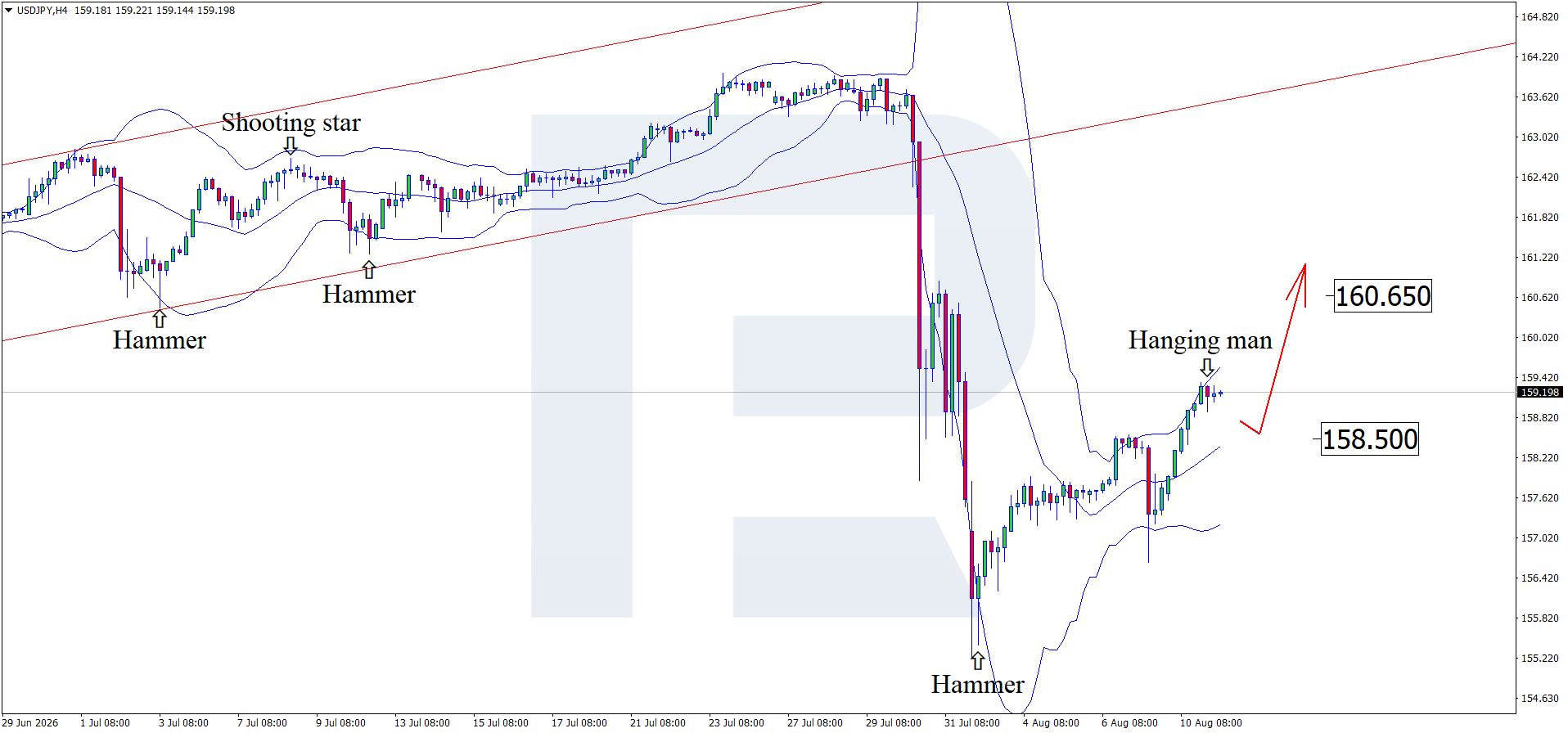
USDJPY trading scenarios for today
Main scenario (Buy Stop)
A breakout and consolidation above the 160.65 resistance level would confirm buyers’ strength and signal an opportunity to open long positions.
- Take Profit: 162.70
- Stop Loss: 160.35
Alternative scenario (Buy Limit)
A breakout below the support level and consolidation below 158.50 would confirm a continued correction and signal an opportunity to open short positions.
- Take Profit: 157.80
- Stop Loss: 158.70
Risk factors
The main risk factor for further USDJPY growth remains another currency intervention. After the yen fell to multi-year lows, Japan and the US conducted a joint intervention to prop up the Japanese currency and stated their readiness to take action for as long as necessary to support the JPY exchange rate.
Summary
The yen continues to lose ground despite the Japanese government’s attempts to keep it afloat. The key trigger this week will be the release of US CPI data. USDJPY technical analysis suggests a correction towards the 158.50 level before growth.
Editors’ picks
 EURUSD forecast 2026–2027: technical analysis, price levels & predictions
EURUSD has pulled back from the 2026 high of 1.1915 and is now trading near 1.1450 — below both EMA65 and EMA200 — with the active scenario shifting from bullish to bearish. The ECB raised rates to 2.40%, but the Fed holds at 3.75%, and US inflation (3.5%) continues to outpace the eurozone (2.8%). A confirmed break below 1.1280 opens the next downward wave toward 1.1080. We break down the key levels, three trading scenarios with entry triggers, and what Deutsche Bank, Morgan Stanley and UBS are forecasting for EURUSD in 2026.
 Gold (XAUUSD) forecast 2026: predictions based on fundamental and technical analysis
Gold has corrected over 25% from its all-time high of 5,597 USD and is now trading near 4,100 USD — testing a critical support zone. Is this the bottom, or will the downtrend continue? We break down the key levels (support 3,920 USD, breakout trigger 4,500 USD), three trading scenarios with entry levels, and what J.P. Morgan, Goldman Sachs and Deutsche Bank are forecasting for gold in 2026.
Forecasts presented in this section only reflect the author’s private opinion and should not be considered as guidance for trading. RoboForex bears no responsibility for trading results based on trading recommendations described in these analytical reviews.