
Yen under threat again: USDJPY poised for another surge
The release of US and Japanese data had no significant impact on the USDJPY rate, with the pair continuing to trade sideways. The rate currently stands at 159.30. Find out more in our analysis for 13 August 2026.
USDJPY forecast: key takeaways
- Japan’s producer prices rose by 7.2% in July
- The US CPI rose by 0.1% in July
- The risk of intervention remains
- USDJPY forecast for 13 August 2026: 160.65
Fundamental analysis
Fundamental analysis for 13 August 2026 shows that the yen is trading within a sideways channel, awaiting a catalyst for further movement and testing the 159.30 level.
Published data shows that Japan’s producer prices rose by 7.2% in July. The figure slowed slightly from the previous 7.3% but remains very high. This fuels expectations that the Bank of Japan may raise its interest rate in September from the current 1.0% to 1.25%.
Following large-scale yen purchases by the Japanese government in late July, the USDJPY rate is once again approaching 159.40. The market is now assessing how willing the authorities are to intervene again if pressure on the JPY intensifies.
The US CPI for July came broadly in line with expectations, rising by 0.1%. Following the release, the market reduced the likelihood of a Federal Reserve rate hike in September from around 54% to 40%. This narrows the dollar’s interest rate advantage while simultaneously creating room for yen appreciation.
The USDJPY forecast for 13 August 2026 is neutral for the yen. On the one hand, the dollar is supported by a substantial interest rate differential. On the other hand, accelerating inflation in Japan increases the likelihood of a September BoJ rate hike, while moderate US CPI has reduced expectations of tighter Federal Reserve policy. Washington and Tokyo’s readiness for another currency intervention remains an additional risk for the dollar.
Technical outlook
On the H4 chart, the USDJPY pair has formed a Shooting Star reversal pattern near the upper Bollinger Band and is trading around 159.30. Since the price is moving within a horizontal range, it may form a corrective wave as the pattern signal plays out, with the first target for the pullback at 158.60.
At the same time, the USDJPY forecast also suggests another market scenario, in which the pair may continue its uptrend and head towards 160.65 without testing the support level.
USDJPY overview
- Asset: USDJPY
- Timeframe: H4 (intraday)
- Trend: bullish
- Key resistance levels: 160.65 and 161.50
- Key support levels: 158.60 and 157.30
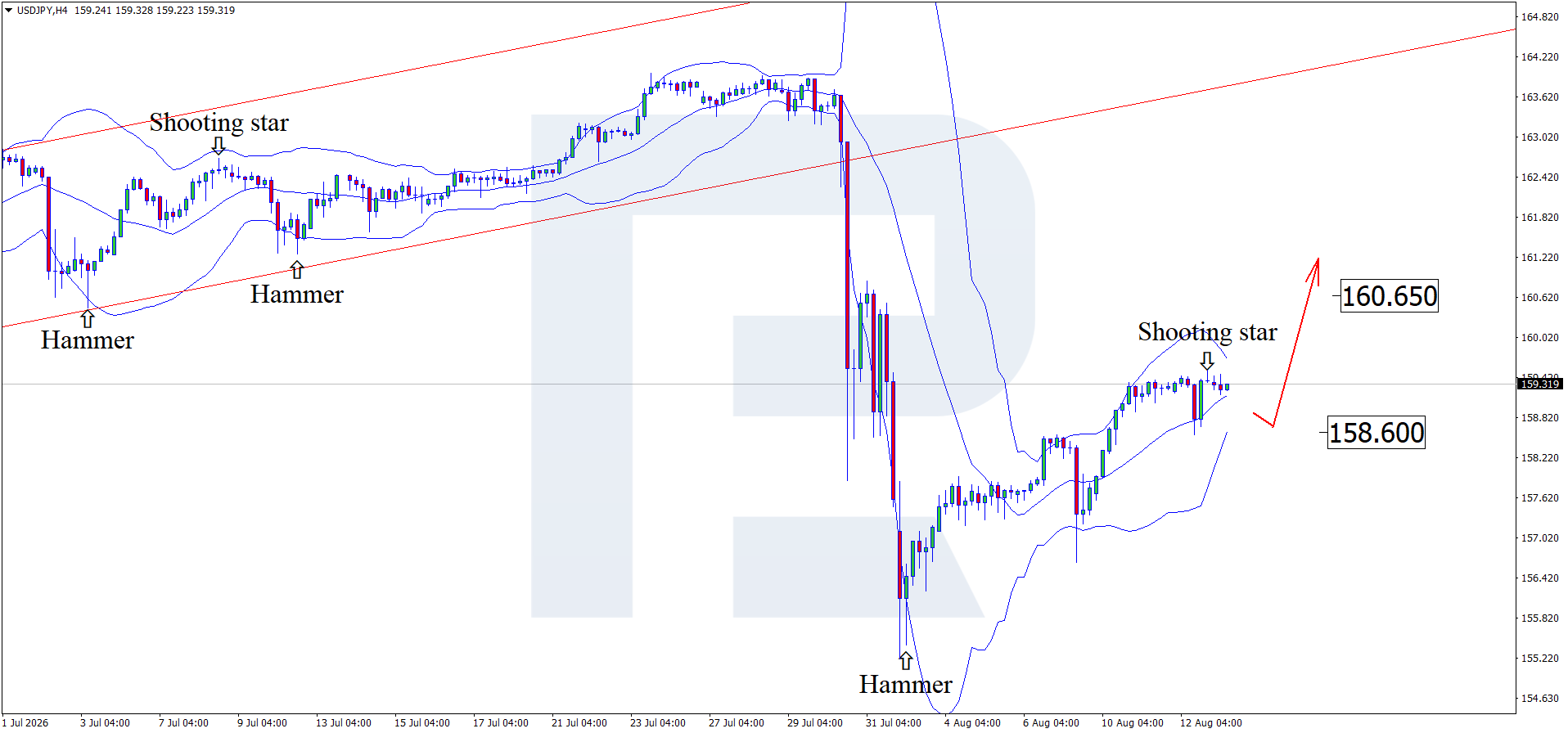
USDJPY trading scenarios for today
Main scenario (Buy Stop)
A breakout and consolidation above the 160.65 resistance level would confirm buyers’ strength and signal continued upward momentum.
- Take Profit: 161.50
- Stop Loss: 160.35
Alternative scenario (Sell Limit)
A test of the 158.60 support level followed by a breakout would indicate a deeper correction and create conditions for opening short positions.
- Take Profit: 157.30
- Stop Loss: 158.90
Risk factors
The USDJPY pair retains upside potential despite the recent currency intervention and signals from the Bank of Japan about further rate hikes. At the same time, the risk of renewed intervention by the authorities remains high.
Summary
The yen continues to trade sideways despite fundamental factors. USDJPY technical analysis suggests a correction towards 158.60.
Editors’ picks
 EURUSD forecast 2026–2027: technical analysis, price levels & predictions
EURUSD has pulled back from the 2026 high of 1.1915 and is now trading near 1.1450 — below both EMA65 and EMA200 — with the active scenario shifting from bullish to bearish. The ECB raised rates to 2.40%, but the Fed holds at 3.75%, and US inflation (3.5%) continues to outpace the eurozone (2.8%). A confirmed break below 1.1280 opens the next downward wave toward 1.1080. We break down the key levels, three trading scenarios with entry triggers, and what Deutsche Bank, Morgan Stanley and UBS are forecasting for EURUSD in 2026.
 Gold (XAUUSD) forecast 2026: predictions based on fundamental and technical analysis
Gold has corrected over 25% from its all-time high of 5,597 USD and is now trading near 4,100 USD — testing a critical support zone. Is this the bottom, or will the downtrend continue? We break down the key levels (support 3,920 USD, breakout trigger 4,500 USD), three trading scenarios with entry levels, and what J.P. Morgan, Goldman Sachs and Deutsche Bank are forecasting for gold in 2026.
Forecasts presented in this section only reflect the author’s private opinion and should not be considered as guidance for trading. RoboForex bears no responsibility for trading results based on trading recommendations described in these analytical reviews.