
USDJPY poised to jump: it only needs a catalyst
The USDJPY pair opens the week near 158.97. Investors do not rule out a BoJ rate hike in September. Find out more in our analysis for 24 August 2026.
USDJPY forecast: key takeaways
- The USDJPY pair is poised to rise if the 159.54 resistance level gives way
- External factors are limiting the yen's appreciation
- USDJPY forecast for 24 August 2026: 160.68
Fundamental analysis
The USDJPY rate starts near 158.97, with the fundamental backdrop for the Japanese yen remaining mixed. Recent inflation data previously supported the yen: price growth accelerated for the second consecutive month, increasing expectations of an imminent Bank of Japan rate hike. The market is increasingly viewing September as a possible window for the next move. This is particularly relevant after Kazuo Ueda signalled that policy normalisation could accelerate.
The key event in the new week will be a speech by Bank of Japan Deputy Governor Ryozo Himino. Investors will look for confirmation of how concerned policymakers are about upside inflation risks amid weak GDP growth in Q2. More hawkish rhetoric would fuel expectations of a September rate hike and could support the yen.
At the same time, external factors continue to limit its appreciation. In the middle of last week, the yen rose by almost 1% after the US Treasury decided to increase the volume of bond buybacks. The news pushed US Treasury yields and the dollar lower, but the JPY gave back more than half of the gains the following day.
Over the longer term, the wide interest rate differential with the US, fiscal risks, and high energy and import costs continue to weigh on the Japanese currency. The yen's baseline fundamental outlook remains neutral, with moderate appreciation potential if the Bank of Japan sends more hawkish signals.
The USDJPY forecast is moderate.
Technical outlook
On the H4 chart, the USDJPY pair has begun to recover after a sharp fall from 164 to 155.10 and is now consolidating around 158.97. The price has returned to the middle Bollinger Band after recently testing the lower band, but there has not yet been a sustained breakout from the sideways range. The short-term structure appears neutral to positive, although the key 159.54 resistance level continues to restrain buyers.
A consolidation above 159.54 would confirm renewed upward momentum and open the way to 160.68 and then 161.79. The nearest support level is in the 158.45–158.50 area, followed by 157.32 and the key 156.73 level. MACD remains slightly below zero, but bearish momentum has weakened. The Stochastic Oscillator has turned upwards and risen above the midpoint of its range, supporting the likelihood of another resistance test.
The main trading idea is to buy after a consolidation above 159.54, with a buy stop at 159.55, a take profit at 160.68, and a stop loss at 158.90. Potential profit is around 113 pips with a risk of 65 pips, giving a risk-to-reward ratio of approximately 1:1.7. The idea remains valid until 25 August 2026, provided the USDJPY rate does not consolidate below 158.45.
USDJPY overview
- Asset: USDJPY
- Timeframe: H4 (intraday)
- Trend: neutral-to-positive
- Key resistance levels: 159.54 and 160.68
- Key support levels: 158.45 and 157.32
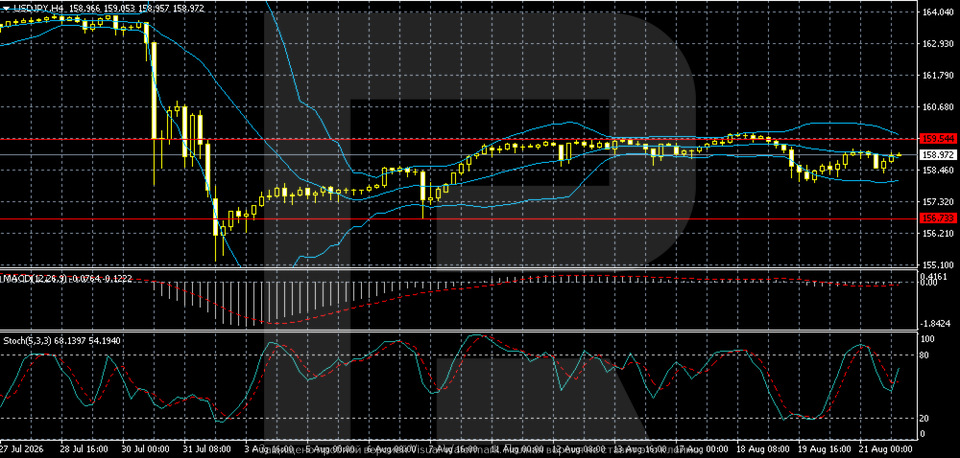
USDJPY trading scenarios for today
Main scenario (Buy Stop)
A consolidation above the 159.54 resistance level would confirm renewed upward momentum and create conditions for further USDJPY growth.
- Take profit: 160.68
- Stop loss: 158.90
- Risk-to-reward ratio: approximately 1:1.7
- Trade idea validity: until 25 August 2026
Alternative scenario (Sell Stop)
A breakout and consolidation below the 158.45 support level would indicate a stronger yen and create conditions for a decline in the USDJPY rate.
- Take profit: 157.32
- Stop loss: 158.90
- Risk-to-reward ratio: approximately 1:2.5
- Trade idea validity: until 25 August 2026
Risk factors
The main risks to further USDJPY growth are linked to more hawkish signals from the Bank of Japan and stronger expectations of a September rate hike, which could support the yen. A decline in US Treasury yields and renewed currency intervention could add to pressure on the pair. At the same time, the wide interest rate differential, Japan's fiscal risks, and high energy costs continue to limit the yen's potential to strengthen.
Summary
The USDJPY pair has undergone a correction and is now consolidating. The USDJPY forecast for today, 24 August 2026, does not rule out a rise towards 160.68.
Editors’ picks
 EURUSD forecast 2026–2027: technical analysis, price levels & predictions
EURUSD has pulled back from the 2026 high of 1.1915 and is now trading near 1.1450 — below both EMA65 and EMA200 — with the active scenario shifting from bullish to bearish. The ECB raised rates to 2.40%, but the Fed holds at 3.75%, and US inflation (3.5%) continues to outpace the eurozone (2.8%). A confirmed break below 1.1280 opens the next downward wave toward 1.1080. We break down the key levels, three trading scenarios with entry triggers, and what Deutsche Bank, Morgan Stanley and UBS are forecasting for EURUSD in 2026.
 Gold (XAUUSD) forecast 2026: predictions based on fundamental and technical analysis
Gold has corrected over 25% from its all-time high of 5,597 USD and is now trading near 4,100 USD — testing a critical support zone. Is this the bottom, or will the downtrend continue? We break down the key levels (support 3,920 USD, breakout trigger 4,500 USD), three trading scenarios with entry levels, and what J.P. Morgan, Goldman Sachs and Deutsche Bank are forecasting for gold in 2026.
Forecasts presented in this section only reflect the author’s private opinion and should not be considered as guidance for trading. RoboForex bears no responsibility for trading results based on trading recommendations described in these analytical reviews.