
The yen attempts to reverse USDJPY after three weeks of pressure
The USDJPY pair is trading near 157.82 after the yen strengthened moderately amid accelerating inflation in Tokyo. However, less hawkish-than-expected signals from the Bank of Japan and the wide interest rate differential between the US and Japan continue to support the US dollar. Find out more in our analysis for 5 October 2026.
USDJPY forecast: key takeaways
- Tokyo core inflation accelerated to 2.7%, exceeding the Bank of Japan’s 2% target for the first time in nine months
- The outcome of the BoJ’s September meeting pointed to the possibility of another rate hike this year but provided no clear signals on the timing
- USDJPY forecast for 5 October 2026: 158.36 and 159.03
Fundamental analysis
The USDJPY pair fell slightly below 158.00 following the release of new inflation data. Tokyo core inflation accelerated to 2.7% in September, exceeding the Bank of Japan’s 2% target for the first time in nine months. The data supported expectations of further monetary policy tightening.
However, the published summary of opinions from the Bank of Japan’s September meeting was less hawkish than expected. The regulator is increasingly focused on the risk of inflation remaining persistently above its target. This leaves room for another rate hike before the end of the year, yet no specific guidance was provided on the timing of the next move.
As a result, the yen remained under pressure and posted its third consecutive weekly decline. The US dollar is bolstered by high US Treasury yields and expectations that the Federal Reserve will need to continue raising interest rates to combat inflation, which is being fuelled by high energy prices.
Thus, the divergence between the Fed and the Bank of Japan’s interest rate trajectories remains the main fundamental factor for the USDJPY rate. As long as the US regulator tightens policy faster than the BoJ, the potential for sustained yen appreciation remains limited.
The USDJPY outlook is cautious.
Technical outlook
On the H4 timeframe, the USDJPY pair is consolidating after recovering from the 156.37 support level. Recent price movements have largely remained within the 156.83–158.36 range, with the price currently hovering near the middle Bollinger Band. The medium-term structure following the September recovery still favours buyers.
MACD remains slightly above zero, although the indicator line is below the signal line, indicating that the previous bullish momentum is weakening. The Stochastic Oscillator, by contrast, is generating a recovery signal.
For the USDJPY rate to continue its upward trajectory, the price needs to consolidate above the local resistance level at 158.36. In this case, the next target will be the key 159.03 mark. A decline below 156.83 would increase pressure on the pair again and raise the likelihood of a retest of the 156.37 support level.
USDJPY overview
- Asset: USDJPY
- Timeframe: H4 (Intraday)
- Trend: moderately bullish
- Key resistance levels: 158.36 and 159.03
- Key support levels: 156.83 and 156.37
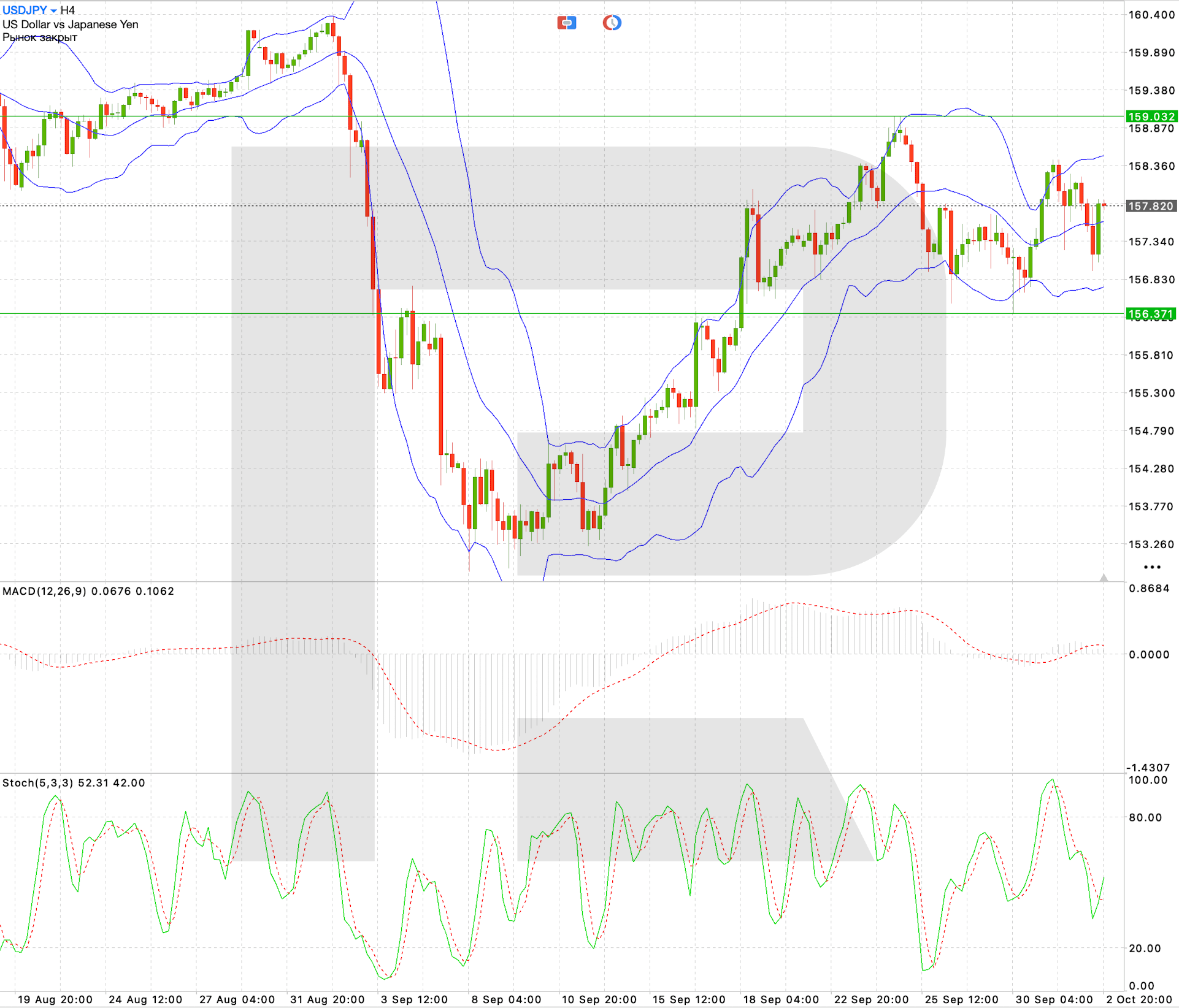
USDJPY trading scenario for today
Trading scenario (Buy Stop)
If the USDJPY pair consolidates above the local resistance level at 158.36, it will confirm the return of buyers after the correction and create conditions for further growth towards the September high.
- Current price: 157.82
- Entry level: 158.38
- Take profit: 159.03
- Stop loss: 158.03
- Risk-to-reward ratio: 1:1.86
The trade idea is valid until 8:00 AM on 6 October 2026 (server time, UTC+3).
Risk factors
The main risk to the bullish USDJPY scenario would be growing expectations of an imminent rate hike by the Bank of Japan. Hawkish signals from the regulator would support the yen and push the pair lower again. Another risk is a potential decline in US Treasury yields if expectations of further Fed tightening weaken. A fall below 156.83 would worsen the short-term technical outlook and open the way towards 156.37.
Summary
The USDJPY pair is consolidating following a correction, but the wide interest rate differential between the US and Japan maintains the potential for further gains. The USDJPY forecast for today, 5 October 2026, does not rule out a rise towards 158.36 and then 159.03.
Editors’ picks
 EURUSD forecast 2026–2027: technical analysis, price levels & predictions
The EURUSD outlook for 2026 and 2027: key levels on the daily chart, three trading scenarios and the policy gap between the Fed and the ECB that drives the pair.
 Gold (XAUUSD) forecast 2026: technical analysis, price levels & predictions
Where gold could trade in 2026: key levels, three trading scenarios with entry triggers and the forecasts from J.P. Morgan, Deutsche Bank and Goldman Sachs.
Forecasts presented in this section only reflect the author’s private opinion and should not be considered as guidance for trading. RoboForex bears no responsibility for trading results based on trading recommendations described in these analytical reviews.