
USDJPY remains under pressure from currency intervention risks
The USDJPY pair is showing subdued movement amid shifting expectations for Federal Reserve interest rates and the prospect of tighter BoJ policy. The rate currently stands at 158.13. For more details, see our analysis for 19 October 2026.
USDJPY forecast: key takeaways
- The risk of currency intervention by Japanese authorities is increasing as the USDJPY pair approaches 159.00
- The likelihood of a Federal Reserve rate hike in October has fallen to 14%, down from 47%, following the release of US CPI data
- USDJPY forecast for 19 October 2026: 156.65
Fundamental analysis
The USDJPY pair is edging higher, but trading activity remains subdued, and the pair's volatility has declined markedly. Pressure on the dollar increased after the probability of another Fed interest rate hike in October fell to 14%, down from 47% immediately after the release of higher-than-expected US Consumer Price Index data. This shift in investor expectations is limiting the potential for further gains of the US currency.
Comments by Bank of Japan Governor Kazuo Ueda on Monday drew market attention to the prospect of further rate hikes. He noted that Japan's economy continues to recover amid rising wages and prices, while core inflation remains close to the 2% target. This could strengthen expectations of further monetary tightening and limit gains in the currency pair.
Another factor restraining USDJPY buyers is the risk of currency intervention by Japanese authorities. As the price approaches 159.00, market participants may be wary of fresh exchange rate checks, which are often viewed as a warning of possible intervention. This increases the risk of a sharp appreciation of the yen and discourages traders from opening new long positions in the dollar.
The USDJPY forecast for 19 October 2026 remains bearish.
Technical outlook
The USDJPY pair is undergoing a correction but remains under selling pressure. Today's USDJPY forecast anticipates a renewed decline towards a potential target at 156.65.
Technical indicators suggest that the pair retains downside potential. The Stochastic Oscillator is approaching a descending resistance line. A decisive breakout below a local support level at 157.75 would provide an additional signal in favour of sellers.
However, a resumption of upward movement cannot be ruled out. A breakout above the resistance level and consolidation above 158.50 would invalidate the current bearish scenario and indicate strengthening bullish momentum.
USDJPY overview
- Asset: USDJPY
- Timeframe: M30 (Intraday)
- Trend: downward
- Key resistance levels: 158.30 and 158.85
- Key support levels: 157.75 and 157.05
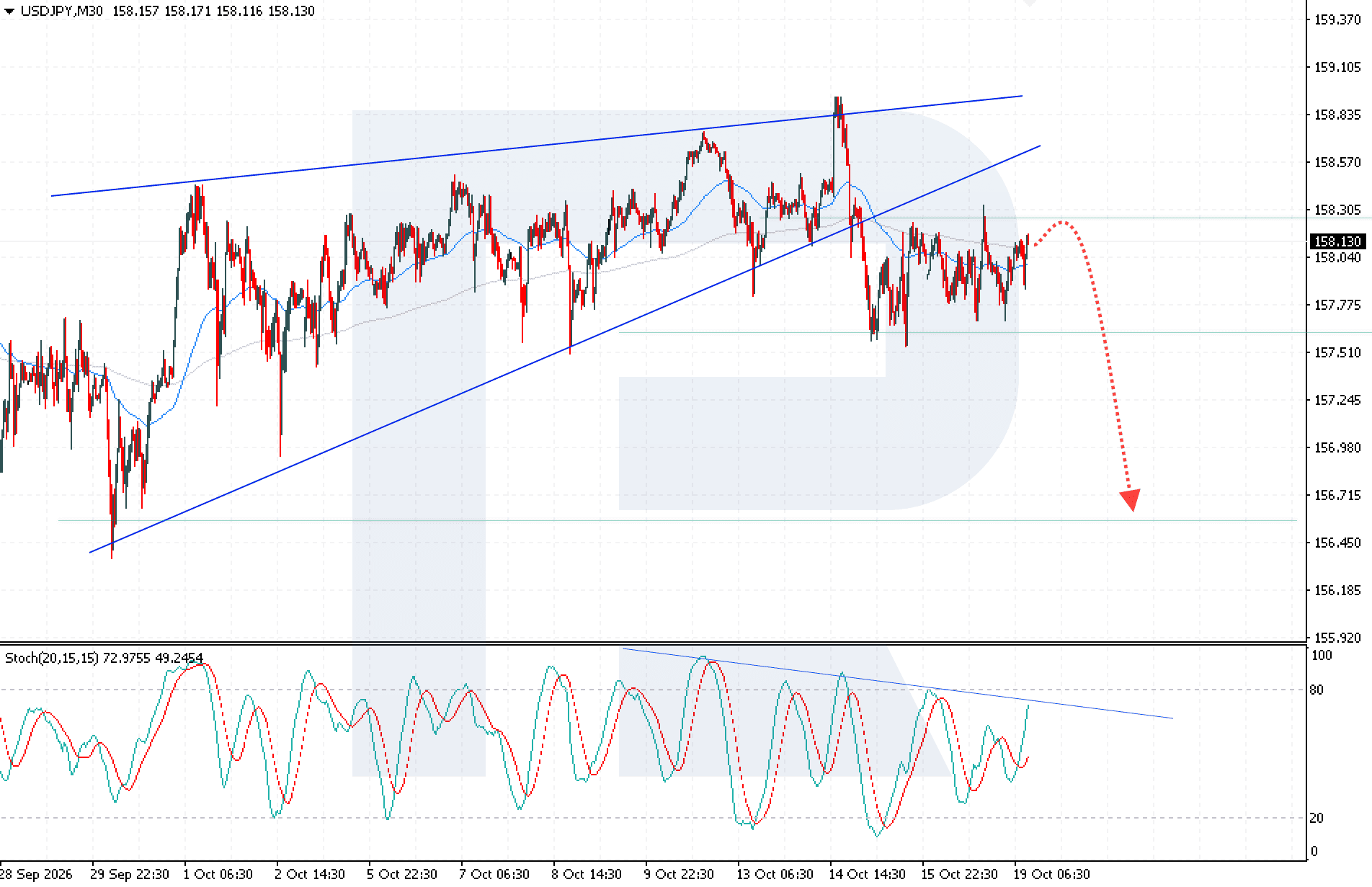
USDJPY trading scenario for today
Trading scenario (Sell Stop)
A breakout below a local support level and consolidation below 157.75 would signal increased selling pressure and create conditions for opening short positions.
- Current price: 158.13
- Entry level: 157.75
- Stop loss: 158.10
- Take profit: 156.65
- Risk-to-reward ratio: 1:3
The trade idea is valid until 8:00 AM on 20 October 2026 (server time, UTC+3).
Risk factors
A recovery in the US dollar amid changing expectations for Federal Reserve interest rates could bring buyers back into the market. Sustained trading above the 158.50 resistance level would invalidate the current bearish scenario and open the door for further gains.
Summary
USDJPY technical analysis indicates the potential for a decline towards 156.65 if the 157.75 support level is broken. Consolidation below this mark would confirm strengthening bearish momentum and increase the likelihood of further weakness in the currency pair.
Editors’ picks


EURUSD forecast 2026–2027: technical analysis, price levels & predictions
The EURUSD outlook for 2026 and 2027: key levels on the daily chart, three trading scenarios and the policy gap between the Fed and the ECB that drives the pair.

Gold (XAUUSD) forecast 2026: technical analysis, price levels & predictions
Where gold could trade in 2026: key levels, three trading scenarios with entry triggers and the forecasts from J.P. Morgan, Deutsche Bank and Goldman Sachs.
Forecasts presented in this section only reflect the author’s private opinion and should not be considered as guidance for trading. RoboForex bears no responsibility for trading results based on trading recommendations described in these analytical reviews.