
The dollar versus the Bank of Japan: who will prevail in November's battle for USDJPY?
The Japanese government has once again warned that it may intervene in the currency market. The USDJPY rate currently stands at 157.84. Discover more in our analysis for 2 November 2026.
USDJPY forecast: key takeaways
- The risk of a sudden strengthening of the yen remains if the authorities intervene
- The Bank of Japan leaves open the possibility of a rate hike this year
- Lower energy prices could ease inflationary pressure in Japan
- USDJPY forecast for 2 November 2026: 158.40
Fundamental analysis
Fundamental analysis for 2 November 2026 shows that the outlook for the USDJPY pair remains mixed. The dollar is supported by the resilience of the US economy, while expectations of further Bank of Japan rate hikes and the threat of currency intervention are limiting the pair's upside potential.
The yen remains vulnerable, but Japanese authorities are stepping up their warnings. On 2 November, Japan's Finance Minister Satsuki Katayama reiterated Tokyo's readiness to coordinate currency policy with the US and counter excessive speculative fluctuations. This maintains the risk of a sudden strengthening of the yen if the authorities intervene.
The Bank of Japan leaves the door open for a rate hike this year. At its meeting on 30 October, the central bank kept its interest rate at 1.25%, but investors continue to assess the probability of a rise to 1.50% in December at around 80.0%. More hawkish inflation forecasts and comments from Kazuo Ueda could provide additional support for the yen.
The market is factoring in political and geopolitical risks. Investors are monitoring the US midterm elections, developments surrounding Iran, and changes in the energy market. Lower energy prices could ease inflationary pressure in Japan, while greater global uncertainty could boost demand for the yen.
Today's USDJPY forecast takes into account that the fundamental backdrop remains moderately positive for the dollar, although reversal risks are increasing. The US interest rate advantage supports the pair, but the prospect of a BoJ rate hike and Japan's readiness to intervene in the currency market are limiting further dollar gains. The key market drivers will be new signals from the Bank of Japan and shifts in expectations regarding the Federal Reserve's interest rate.
Technical outlook
On the H4 chart, the USDJPY pair has formed a Hammer reversal pattern near the lower Bollinger Band and is trading around 157.84. As prices remain within an ascending channel, they could continue their upward wave as the pattern's signal plays out, with the first upside target at 158.80.
However, the USDJPY forecast also considers an alternative scenario in which the pair could form a corrective wave and move towards 157.40 before resuming its uptrend.
USDJPY overview
- Asset: USDJPY
- Timeframe: H4 (Intraday)
- Trend: bullish
- Key resistance levels: 158.00 and 158.80
- Key support levels: 157.40 and 156.70
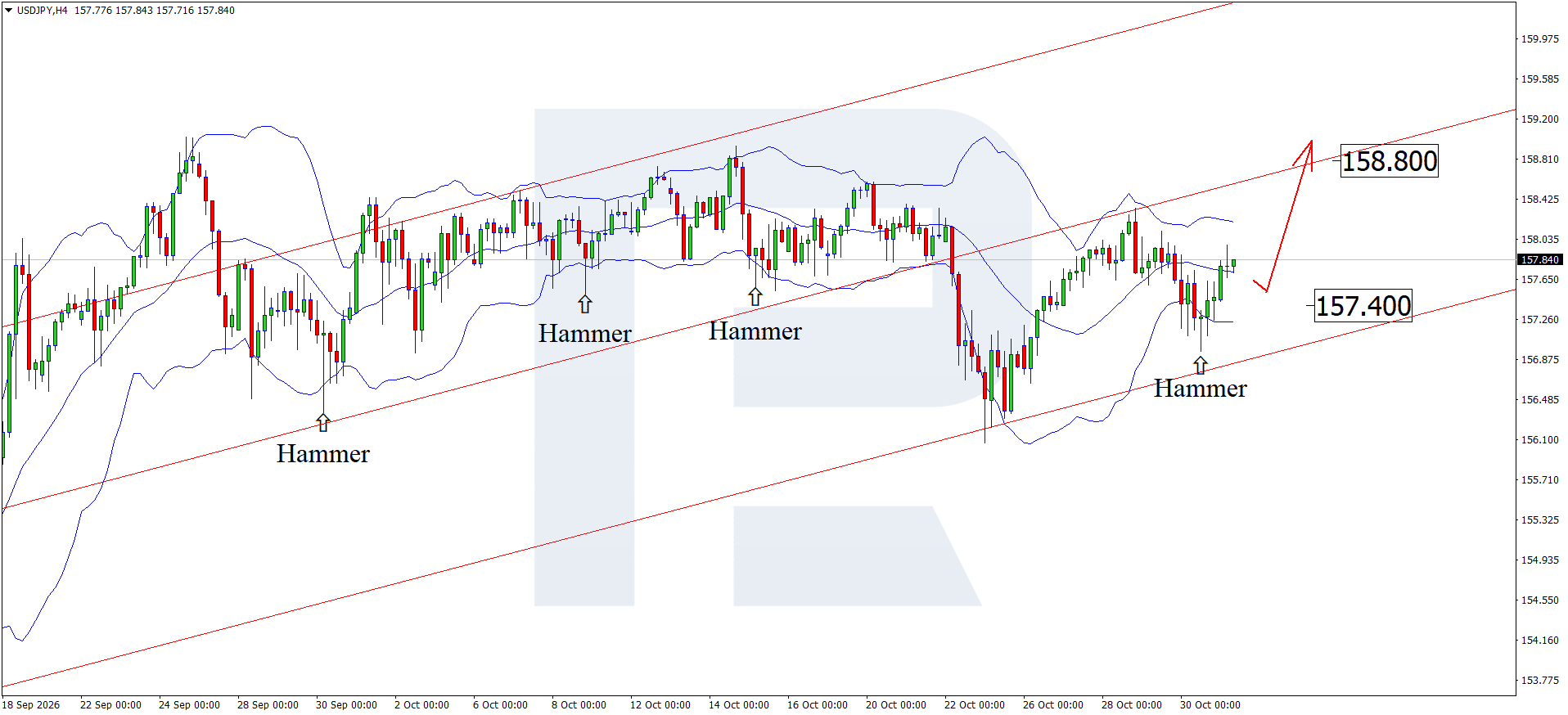
USDJPY trading scenario for today
A breakout above the resistance level, followed by consolidation above 158.00, would create conditions for opening long positions and confirm continued upward momentum.
Risk factors
The primary risk to USDJPY upside is more hawkish rhetoric from the Bank of Japan and growing expectations of a December rate hike, which could revive demand for the yen. Further risk comes from statements by the Japanese government about possible currency intervention.
Summary
The yen continues to face pressure from the US dollar, but the prospect of support from the BoJ and the Japanese government remains. USDJPY technical analysis suggests a rise towards 158.80 following a correction.
Editors’ picks


EURUSD forecast 2026–2027: technical analysis, price levels & predictions
The EURUSD outlook for 2026 and 2027: key levels on the daily chart, three trading scenarios and the policy gap between the Fed and the ECB that drives the pair.

Gold (XAUUSD) forecast 2026: technical analysis, price levels & predictions
Where gold could trade in 2026: key levels, three trading scenarios with entry triggers and the forecasts from J.P. Morgan, Deutsche Bank and Goldman Sachs.
Forecasts presented in this section only reflect the author’s private opinion and should not be considered as guidance for trading. RoboForex bears no responsibility for trading results based on trading recommendations described in these analytical reviews.