
Elections revive demand for the yen as USDJPY reverses sharply lower
The USDJPY pair has retreated sharply from local highs amid dollar weakness and renewed demand for the Japanese yen as a safe-haven asset. The rate currently stands at 157.62. Discover more in our analysis for 4 November 2026.
USDJPY forecast: key takeaways
- Political uncertainty in the US has boosted demand for the yen as a safe-haven asset and weighed on the dollar
- The Bank of Japan held its interest rate steady at 1.25%, but core inflation reaching the 2% target supports the possibility of another hike as early as December
- USDJPY forecast for 4 November 2026: 156.82
Fundamental analysis
The USDJPY rate approached 157.50 on Wednesday. Pressure on the pair intensified following a decline in the US dollar amid the first results of the US midterm elections and growing political uncertainty.
Demand for safe-haven assets is providing additional support for the yen. A sell-off in the technology sector and companies linked to artificial intelligence has heightened market caution, boosting demand for the Japanese currency and government bonds.
Investors’ attention is now gradually shifting towards Japan's domestic economic data. Wage figures are due later this week and could provide further indications of persistent inflation and the outlook for the Bank of Japan's monetary policy.
Last week, the BoJ kept its key interest rate at 1.25% but noted that underlying inflationary pressure had reached the 2% target. This leaves the door open for another rate hike as early as December and could limit a recovery in the USDJPY pair.
The USDJPY forecast for 4 November 2026 is bearish.
Technical outlook
The USDJPY rate reversed sharply downwards after failing to consolidate around 158.80. The price broke below the middle Bollinger Band and fell towards 157, indicating that the previous upward momentum has weakened. Today's USDJPY forecast suggests a further decline, with a potential target at 156.82.
MACD remains slightly above the zero line, but the indicator line has fallen below the signal line, generating an early bearish signal. The Stochastic Oscillator indicates stronger selling pressure, with the %K line falling to 30.92, well below the %D line at 57.80. A breakout below the 157 support level would further confirm the bearish scenario.
The primary scenario would be invalidated if the price recovers and consolidates above the 158.02 resistance level. Such a signal would ease selling pressure and set the stage for a recovery towards 158.42 and then 158.82.
USDJPY overview
- Asset: USDJPY
- Timeframe: H4 (Intraday)
- Trend: bearish
- Key resistance levels: 158.02 and 158.42
- Key support levels: 157.40 and 156.82
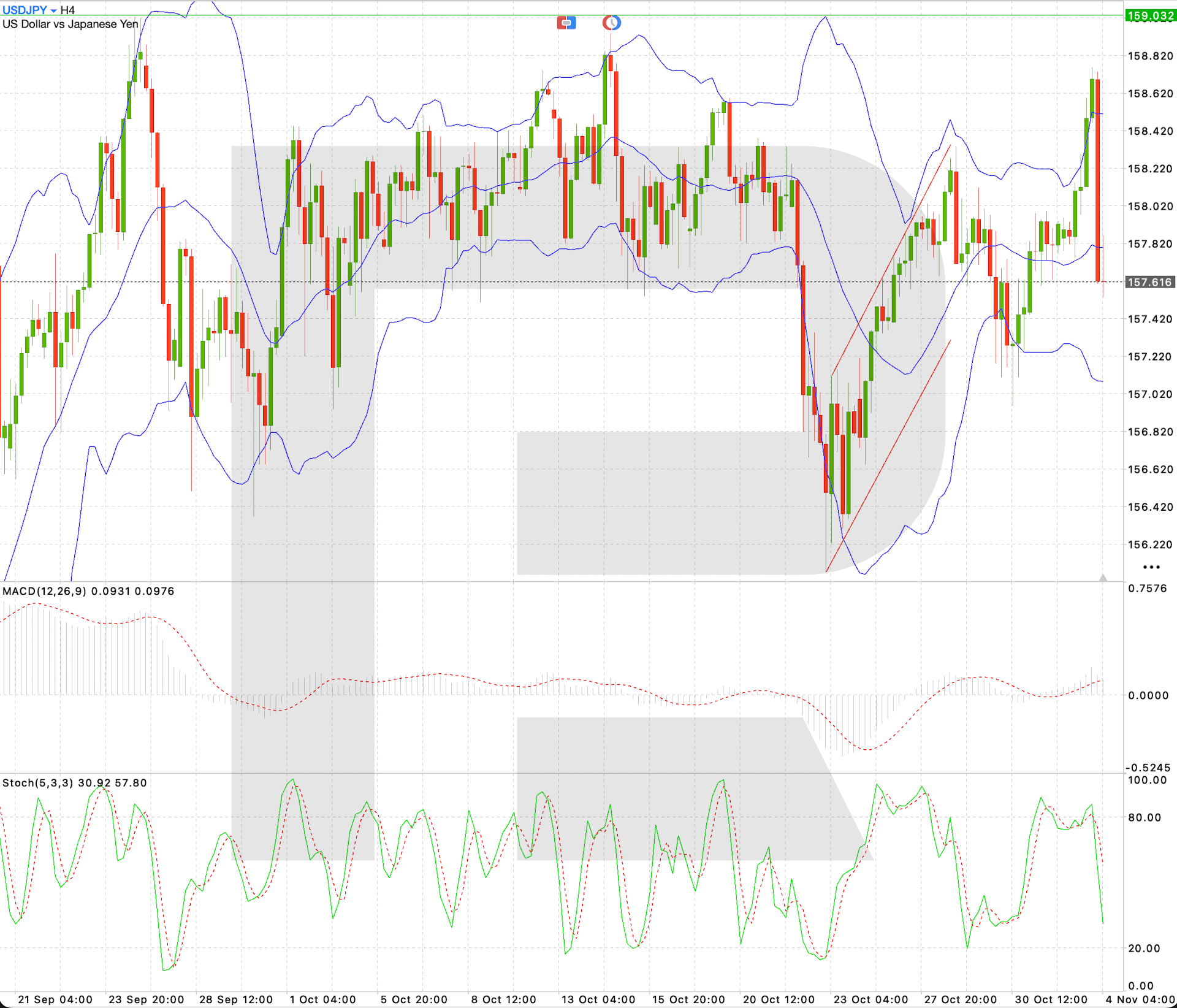
USDJPY trading scenario for today
A breakout below the local support level, with the price consolidating below 157.40, would create conditions for opening short positions and confirm a further strengthening of bearish momentum.
Risk factors
The main risk to the USDJPY bearish scenario is a recovery in the dollar and renewed interest in risk assets after the main phase of political uncertainty in the US has passed. Weak wage data from Japan could provide additional support for the pair by reducing expectations of a BoJ rate hike in December. Consolidation above 158.02 would weaken the bearish scenario and increase the likelihood of a recovery towards 158.42.
Summary
The USDJPY forecast for 4 November 2026 suggests continued bearish momentum, with a potential downside target at 156.82 and further confirmation should the price break below 157.40.
Editors’ picks


EURUSD forecast 2026–2027: technical analysis, price levels & predictions
The EURUSD outlook for 2026 and 2027: key levels on the daily chart, three trading scenarios and the policy gap between the Fed and the ECB that drives the pair.

Gold (XAUUSD) forecast 2026: technical analysis, price levels & predictions
Where gold could trade in 2026: key levels, three trading scenarios with entry triggers and the forecasts from J.P. Morgan, Deutsche Bank and Goldman Sachs.
Forecasts presented in this section only reflect the author’s private opinion and should not be considered as guidance for trading. RoboForex bears no responsibility for trading results based on trading recommendations described in these analytical reviews.