
Yen weakness persists: USDJPY tests resistance with a view to breaking above 160.00
The main catalyst for the move was the release of US inflation data, which fuelled expectations of further Federal Reserve monetary policy tightening. The USDJPY rate currently stands at 158.90. For more details, see our analysis for 11 November 2026.
USDJPY forecast: key takeaways
- The Consumer Price Index (CPI) rose by 0.4% month-on-month, above expectations of 0.3%, while core CPI increased by 0.3% against a forecast of 0.2%
- The likelihood of a Federal Reserve interest rate hike in December rose to around 90%
- USDJPY forecast for 11 November 2026: 160.25
Fundamental analysis
According to data released yesterday, the US CPI rose by 0.4% month-on-month in October, compared to a forecast of 0.3%. Core CPI increased by 0.3%, also exceeding analysts' expectations of 0.2%. Higher inflation indicates that price pressures in the US economy remain persistent and limits the Federal Reserve's scope to shift towards monetary policy easing. Following the release, the US Dollar Index (DXY) edged higher by approximately 0.6% to 102.26 points, while the yield on two-year US Treasury bonds rose to 4.73%.
Following the CPI release, market participants assessed the likelihood of a December interest rate hike at approximately 90%. Such expectations help maintain the positive yield differential between US and Japanese bonds, creating fundamental conditions for further gains in the USDJPY pair. The fundamental picture remains mixed for the Japanese yen. At its 29–30 October meeting, the Bank of Japan kept its key interest rate at 1.25% but signalled its readiness to tighten monetary policy further. The summary of opinions from the meeting, published on 10 November, showed that some policymakers favour accelerating rate hikes, as core inflation has reached the 2% target.
The USDJPY forecast for 11 November 2026 is bullish.
Technical outlook
On the D1 chart, the USDJPY pair is trading in an uptrend, with a resistance level at 159.00 and a support level at 156.95. On the H4 chart, local resistance has shifted to 158.75, while support lies at 156.95. The local trend remains sideways, but the price is testing the resistance level and appears poised for a breakout, with a target at 160.25.
However, today's USDJPY forecast also envisages an alternative scenario. The price could form a corrective wave and test the 156.95 support level before rising. A breakout below this mark would open the way for a decline towards 153.25.
USDJPY overview
- Asset: USDJPY
- Timeframe: D1 (Intraday)
- Trend: bullish
- Key resistance levels: 158.75 and 159.00
- Key support levels: 156.95 and 155.30
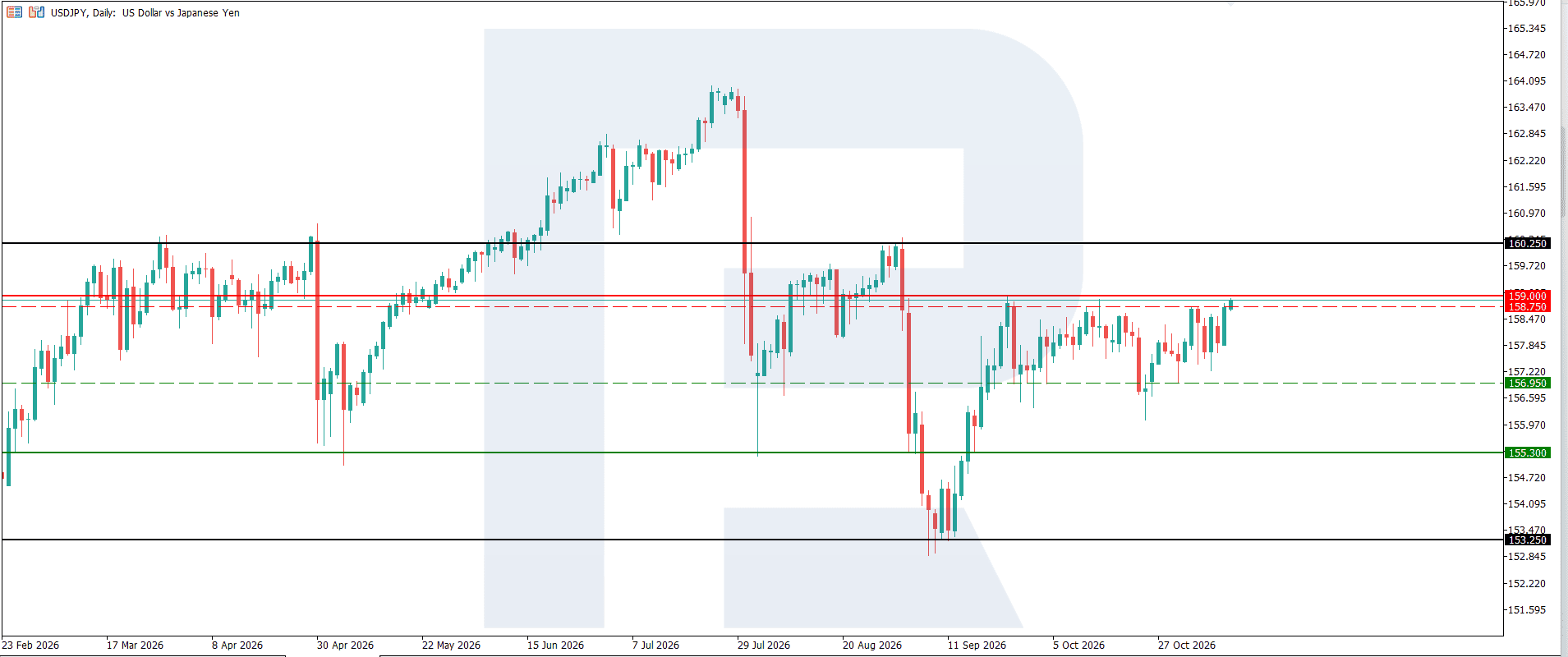
USDJPY trading scenario for today
A breakout above a local resistance level, with the price consolidating above 158.75, would favour opening long positions and confirm strengthening bullish momentum.
Risk factors
The main risk to further gains in USDJPY remains possible currency intervention by Japan's Ministry of Finance. Given the previous large-scale operations to support the yen, a further move towards 160.00 could prompt increased pressure from the Japanese authorities. Direct intervention in the foreign exchange market could cause the yen to appreciate sharply, pushing the USDJPY rate significantly lower over a short period.
Summary
In the short term, fundamental factors predominantly support further gains in the USDJPY pair. Higher-than-expected US inflation, resilient US labour market figures, and rising expectations of Federal Reserve interest rate hikes are supporting the dollar. Meanwhile, weak Japanese consumer demand limits the Bank of Japan's ability to accelerate monetary policy normalisation.
Editors’ picks


EURUSD forecast 2026–2027: technical analysis, price levels & predictions
The EURUSD outlook for 2026 and 2027: key levels on the daily chart, three trading scenarios and the policy gap between the Fed and the ECB that drives the pair.

Gold (XAUUSD) forecast 2026: technical analysis, price levels & predictions
Where gold could trade in 2026: key levels, three trading scenarios with entry triggers and the forecasts from J.P. Morgan, Deutsche Bank and Goldman Sachs.
Forecasts presented in this section only reflect the author’s private opinion and should not be considered as guidance for trading. RoboForex bears no responsibility for trading results based on trading recommendations described in these analytical reviews.