
USDJPY rises ahead of the Fed minutes as news flow intensifies
The USDJPY pair is edging higher amid hawkish expectations for Federal Reserve policy. However, the risk of currency intervention by Japanese authorities near 160.00 is limiting further gains in the pair. The rate currently stands at 159.46. Discover more in our analysis for 18 November 2026.
USDJPY forecast: key takeaways
- The likelihood of a 25-basis-point Federal Reserve rate hike in December is estimated at around 95.7%, continuing to support the dollar
- Expectations of a December rate hike by the Bank of Japan and the risk of currency intervention are limiting USDJPY gains near 160.00
- USDJPY forecast for 18 November 2026: 160.18
Fundamental analysis
The USDJPY rate is holding near 159.50 after recovering from local lows, with the dollar supported by hawkish rhetoric from Federal Reserve officials and the high probability of another interest rate hike in December.
St Louis Fed President Alberto Musalem stated that several additional rate hikes might be needed to bring inflation back under control. Against this backdrop, the market estimates the probability of a 25-basis-point increase in December at 95.7%, while the likelihood of a larger 50-basis-point hike stands at around 4.3%.
Tuesday’s data showed that US retail sales rose by 0.2% month-on-month in October, following a 0.8% increase a month earlier. The result matched market expectations and did not change the overall picture: a strong labour market and persistent inflationary pressures continue to underpin hawkish expectations for Federal Reserve policy.
Today, investors will focus on the minutes of the October FOMC meeting. Fresh signals pointing to the need for further monetary tightening could support the dollar and push the USDJPY pair back towards the 160.00 area.
However, developments in Japan are limiting the pair's upside. The market continues to view a Bank of Japan rate hike in December as highly likely despite weak GDP figures. The risk of currency intervention is another restraining factor, as Japanese authorities have again warned against excessive and one-sided exchange rate movements.
The USDJPY forecast for 18 November 2026 is moderately bullish.
Technical outlook
The USDJPY rate retains its bullish structure following a strong rally from the 158.00 area. After testing resistance at 160.18, the price entered a correction but held above 159.00 and is now recovering towards the middle Bollinger Band. Today's USDJPY forecast suggests further gains, with a potential target at 160.18.
MACD remains above the zero line, confirming that the overall bullish momentum is intact. However, the indicator line is below the signal line, indicating a slowdown in the previous upward wave. The Stochastic Oscillator is recovering in the upper part of its range, with the %K line at 73.78 and the %D line at 67.45. This supports the short-term scenario of further gains, although the approach towards overbought territory increases the likelihood of renewed consolidation.
Consolidation above local resistance at 159.64 would further confirm the bullish scenario, while a decline below the 159.08 support level would invalidate the main scenario. In the latter case, the correction could continue towards 158.80 and then 158.52.
USDJPY overview
- Asset: USDJPY
- Timeframe: H4 (Intraday)
- Trend: bullish
- Key resistance levels: 160.18 and 160.50
- Key support levels: 159.64 and 159.08
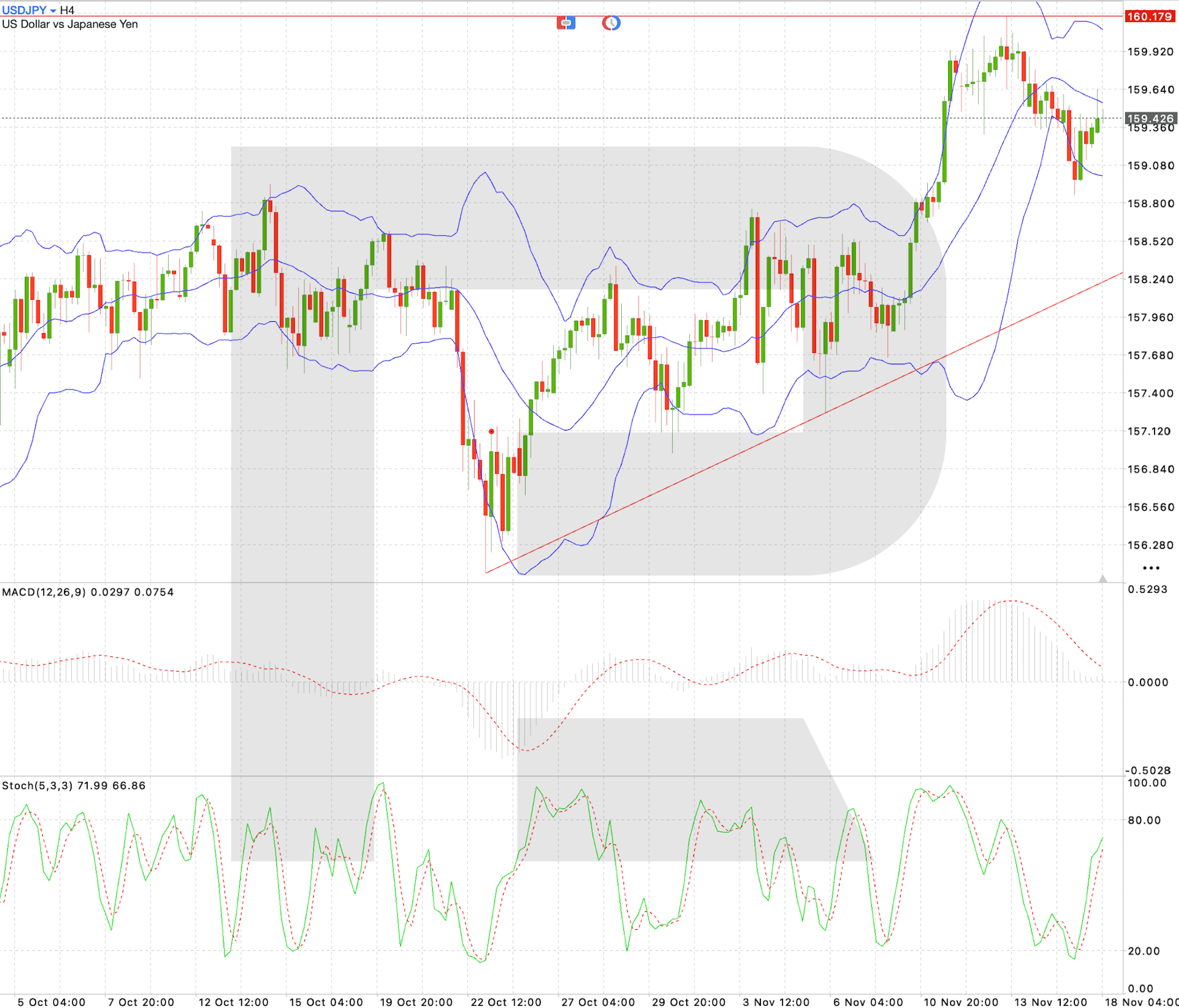
USDJPY trading scenario for today
Consolidation above the local resistance level at 159.64 would confirm renewed bullish momentum and provide an opportunity to open long positions.
Risk factors
The main risk to the bullish USDJPY scenario remains possible currency intervention by Japanese authorities as the pair approaches 160.00. A more dovish tone in the FOMC minutes or stronger expectations of a Bank of Japan rate hike in December could put additional pressure on prices. A decline below 159.08 would weaken the bullish scenario and increase the likelihood of a correction towards 158.80.
Summary
The USDJPY forecast for 18 November 2026 points to continued moderate bullish momentum, with a potential upside target at 160.18 and further confirmation if the price breaks above 159.64.
Editors’ picks


EURUSD forecast 2026–2027: technical analysis, price levels & predictions
The EURUSD outlook for 2026 and 2027: key levels on the daily chart, three trading scenarios and the policy gap between the Fed and the ECB that drives the pair.

Gold (XAUUSD) forecast 2026: technical analysis, price levels & predictions
Where gold could trade in 2026: key levels, three trading scenarios with entry triggers and the forecasts from J.P. Morgan, Deutsche Bank and Goldman Sachs.
Forecasts presented in this section only reflect the author’s private opinion and should not be considered as guidance for trading. RoboForex bears no responsibility for trading results based on trading recommendations described in these analytical reviews.