
USDJPY: the yen continues to weaken and tests the 160.00 level
The key factors driving the pair remain the prospects for monetary policy tightening by the Federal Reserve and the Bank of Japan, declining US Treasury yields, the risk of currency intervention, and deteriorating global risk appetite. The USDJPY rate currently stands at 159.12. For more details, see our analysis for 26 November 2026.
USDJPY forecast: key takeaways
- Japan's services Producer Price Index rose by 4.2% year-on-year in October
- The US core PCE price index rose by 3.3%
- USDJPY forecast for 26 November 2026: 160.85
Fundamental analysis
Accelerating inflation is providing support for the Japanese yen. Japan's services Producer Price Index rose by 4.2% year-on-year in October, up from 3.8% a month earlier and above a forecast of 3.6%. The growth rate reached its highest level since 1990. Rising inflationary pressure increases the likelihood that the Bank of Japan will raise its key interest rate from 1.25% to 1.50% in December. Further monetary tightening would help boost the appeal of the Japanese currency.
In the US, macroeconomic data indicates that persistent inflationary pressure remains. The PCE price index rose by 3.8% year-on-year in October, compared to 3.7% a month earlier, while the core PCE price index accelerated from 3.1% to 3.3%, above the forecast of 3.2%. Both indicators rose by 0.3% month-on-month.
The second estimate of US Q3 GDP growth was revised upwards from 3.4% to 4.3% on an annualised basis. Initial jobless claims fell from 202 thousand to 189 thousand, against a forecast of 200 thousand. Strong economic data, combined with accelerating inflation, creates conditions for further Federal Reserve interest rate hikes. According to the CME FedWatch Tool, the probability of a 25-basis-point rate hike in December is estimated at 97.5%.
The USDJPY forecast for 26 November 2026 is moderately bullish.
Technical outlook
On the D1 chart, the USDJPY pair is trading in an uptrend, with a resistance level at 160.05 and a support level at 157.65. On the H4 chart, local resistance has shifted to 159.55, while the support level lies at 158.80. The local trend remains sideways, but the price is testing resistance and is poised for a breakout, with the target for this move at 160.85.
However, today's USDJPY forecast also considers an alternative scenario. The price could form a corrective wave and test the 157.65 support level before rising. A breakout below that level would open the door for a decline towards 156.65.
USDJPY overview
- Asset: USDJPY
- Timeframe: D1 (Intraday)
- Trend: bullish
- Key resistance levels: 160.05
- Key support levels: 157.65
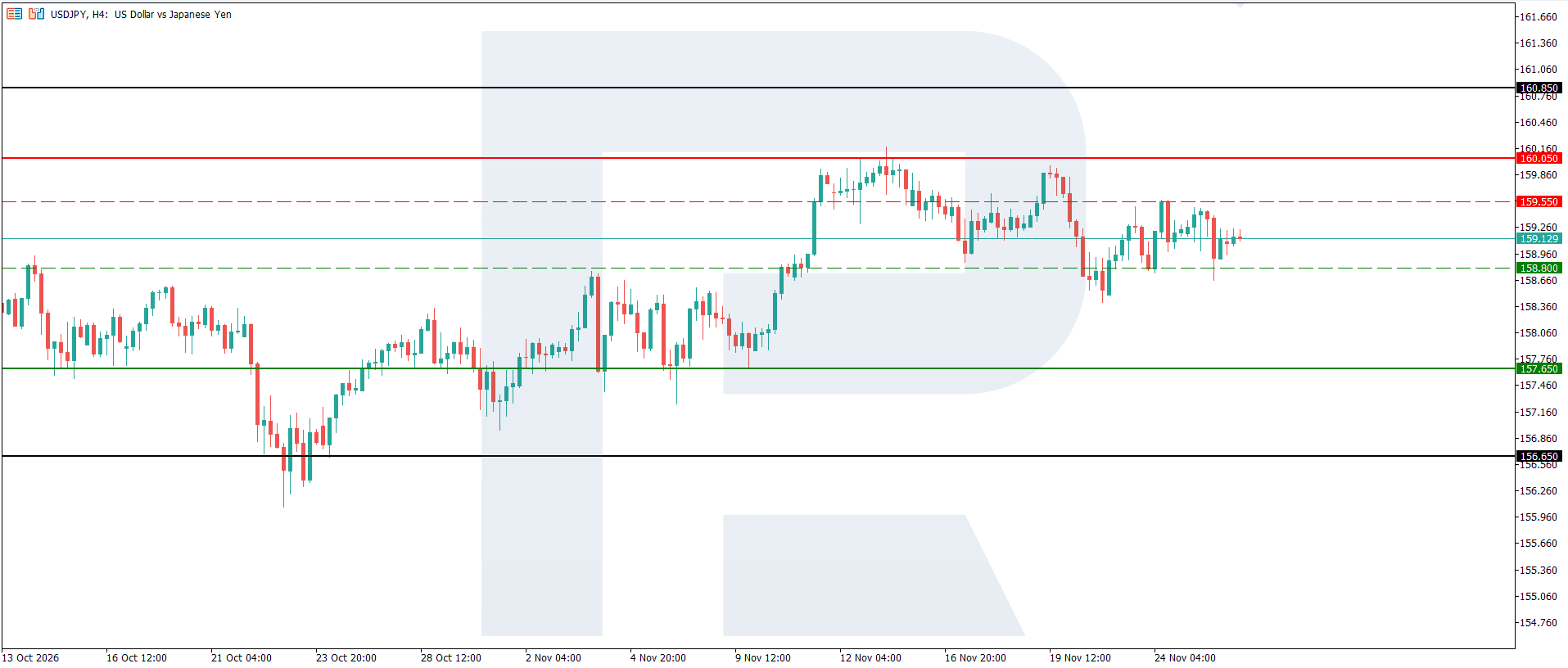
USDJPY trading scenario for today
Consolidation above a local resistance level at 159.55 would confirm renewed upward momentum and set the stage for opening long positions.
Risk factors
The main risk to the bearish USDJPY scenario is the Federal Reserve maintaining its hawkish monetary policy amid persistent inflation and strong US macroeconomic data. Higher-than-expected PCE and GDP figures could fuel expectations of an interest rate hike and trigger dollar appreciation. Another risk is the Bank of Japan’s continued cautious stance on further monetary tightening.
Summary
The USDJPY forecast for 26 November 2026 takes into account the mixed fundamental backdrop for the pair. Accelerating inflation and resilient US economic growth are supporting expectations of further Federal Reserve monetary tightening. However, the prospect of a Bank of Japan interest rate hike, the risk of currency intervention, declining US Treasury yields, and a reduction in carry trades are limiting the dollar's upside potential.
Editors’ picks


EURUSD forecast 2026–2027: technical analysis, price levels & predictions
The EURUSD outlook for 2026 and 2027: key levels on the daily chart, three trading scenarios and the policy gap between the Fed and the ECB that drives the pair.

Gold (XAUUSD) forecast 2026: technical analysis, price levels & predictions
Where gold could trade in 2026: key levels, three trading scenarios with entry triggers and the forecasts from J.P. Morgan, Deutsche Bank and Goldman Sachs.
Forecasts presented in this section only reflect the author’s private opinion and should not be considered as guidance for trading. RoboForex bears no responsibility for trading results based on trading recommendations described in these analytical reviews.