
Weekly technical analysis and forecast (29 June–03 July 2026)
In this weekly technical analysis, we examine the key chart patterns and price levels for EURUSD, USDJPY, GBPUSD, AUDUSD, USDCAD, Gold (XAUUSD), Brent crude oil, and Bitcoin (BTCUSD) to forecast market developments for the week ahead (29 June–03 July 2026).
Major technical levels to watch this week
- EURUSD: Support: 1.1310, 1.1260. Resistance: 1.1470, 1.1553
- USDJPY: Support: 160.98, 159.58. Resistance: 162.33, 164.14
- GBPUSD: Support: 1.3033, 1.2974. Resistance: 1.3196, 1.3275
- AUDUSD: Support: 0.6882, 0.6659. Resistance: 0.6934, 0.6986
- USDCAD: Support: 1.4114, 1.4044. Resistance: 1.4351, 1.4548
- Gold: Support: 3,918, 3,828. Resistance: 4,148, 4,327
- Brent: Support: 71.79, 69.74. Resistance: 76.70, 82.76
- BTCUSD: Support: 62,473, 57,680. Resistance: 64,332, 67,364
EURUSD forecast
The past week was marked by continued strength in the US dollar. The main market driver remains changing expectations regarding future Federal Reserve policy. Following the latest comments from Fed officials, market participants have once again increased expectations that restrictive monetary policy will remain in place for a longer period. Strong US macroeconomic data and persistent inflation risks continue to support the US currency.
The situation in Europe remains less favourable for the euro. At its June meeting, the European Central Bank (ECB) raised interest rates by 0.2500% while simultaneously reaffirming its data-dependent approach. ECB officials also noted that inflation remains elevated, although evidence of second-round inflationary effects is still limited, reducing the need for even more aggressive policy tightening.
Additional pressure on the single currency comes from weak eurozone business activity data. Preliminary PMI readings remain below the key 50.0000 level, signalling a continued contraction in economic activity, particularly in the services sector. The slowdown in the European economy is widening the gap between the outlooks for the US and the eurozone, encouraging further capital flows into US dollar-denominated assets.
During the coming week, investors will focus on the release of the US Core PCE Price Index, the Federal Reserve’s preferred inflation gauge. The market will also continue to assess comments from major central bank officials regarding the future path of interest rates.
EURUSD technical analysis
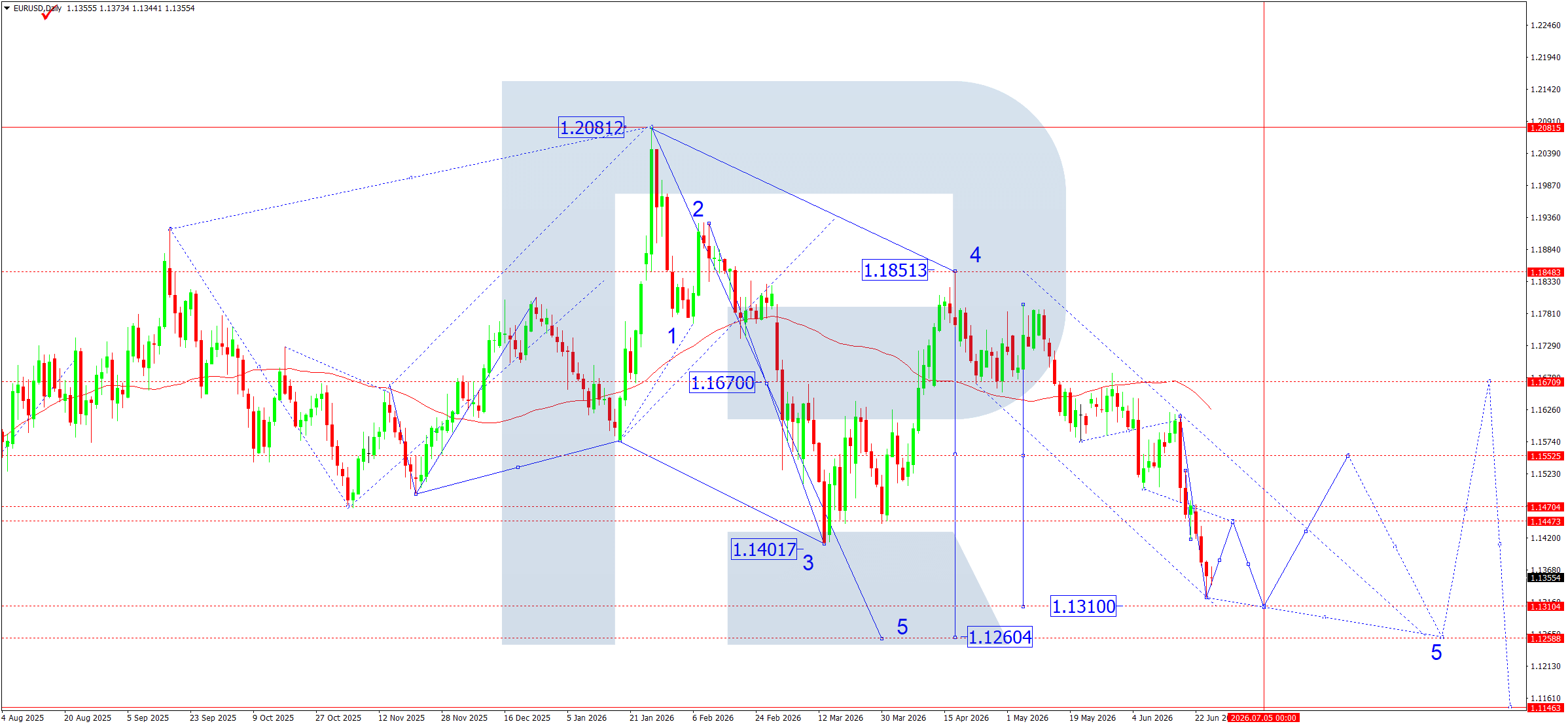
The daily chart shows that EURUSD remains in a well-established downward trend. After forming a peak around 1.1851, the market completed the corrective fourth wave and entered the next impulsive downward wave.
The price has firmly consolidated below the pivot level at 1.1670, which now acts as important medium-term resistance. Quotes also remain below the long-term moving average, confirming that sellers continue to control the market.
The price has now reached the first local downside target near 1.1310. This level marks the completion of an intermediate structure within the current downward wave. A short-term correction towards previously broken levels may develop from here.
However, the overall wave structure indicates that the fifth wave has not yet been completed. After the local recovery ends, there is still a high probability of a further decline towards the primary target at 1.1260. According to the current Elliott Wave count, this level represents the final objective of the ongoing downward impulse.
The nearest resistance remains at 1.1470. A recovery above this level would allow a deeper correction towards 1.1553, where the next supply zone and an important previous reversal area are located.
For now, the structure of the downward channel remains fully intact. Every attempt by buyers to regain control continues to attract selling pressure near the upper boundary of the channel, while the sequence of lower highs and lower lows continues to confirm seller dominance.
From a technical perspective, the priority therefore remains the completion of the fifth downward wave towards the 1.1260 area. Only a confident consolidation above 1.1470 would provide the first signal that a deeper corrective phase is beginning.
EURUSD forecast scenarios
Bearish scenario (base case): the market remains below 1.1470. Following a possible short-term correction, we expect the decline to continue towards 1.1310, followed by movement towards the primary target at 1.1260.
Bullish scenario (alternative): if buyers manage to secure a firm break above 1.1470 on increasing volume, a corrective move towards 1.1553 may develop.
USDJPY forecast
USDJPY ends the week near multi-year highs, maintaining a strong upward trend. The primary driver remains the widening divergence in monetary policy expectations between the US and Japan. Following the June central bank decisions, the market continues to reprice the probability of further policy tightening in the US, while the Japanese yen remains under pressure due to the persistent interest rate differential.
The US dollar continues to draw support from strong macroeconomic data and expectations that the Federal Reserve (Fed) will maintain its hawkish stance for considerably longer than previously anticipated. Investors remain focused on inflation data, labour market figures, and US Treasury yields. If incoming data continue to confirm the resilience of the US economy, demand for the dollar is likely to remain strong at the start of the new week.
The situation in Japan remains less straightforward. After raising interest rates to 1%, Bank of Japan (BoJ) officials continue discussing the possibility of further gradual rate increases. At the same time, domestic political pressure on the central bank is intensifying, as the government favours maintaining relatively accommodative financial conditions to support economic growth. This divergence in views continues to limit the yen’s upside potential despite rising inflation.
Another risk factor remains the possibility of verbal or direct currency intervention by the Japanese authorities. The higher USDJPY climbs towards new highs, the greater the likelihood of stronger comments from Japan’s Ministry of Finance. However, for now, underlying demand for the US dollar remains considerably stronger than these intervention risks.
USDJPY technical analysis
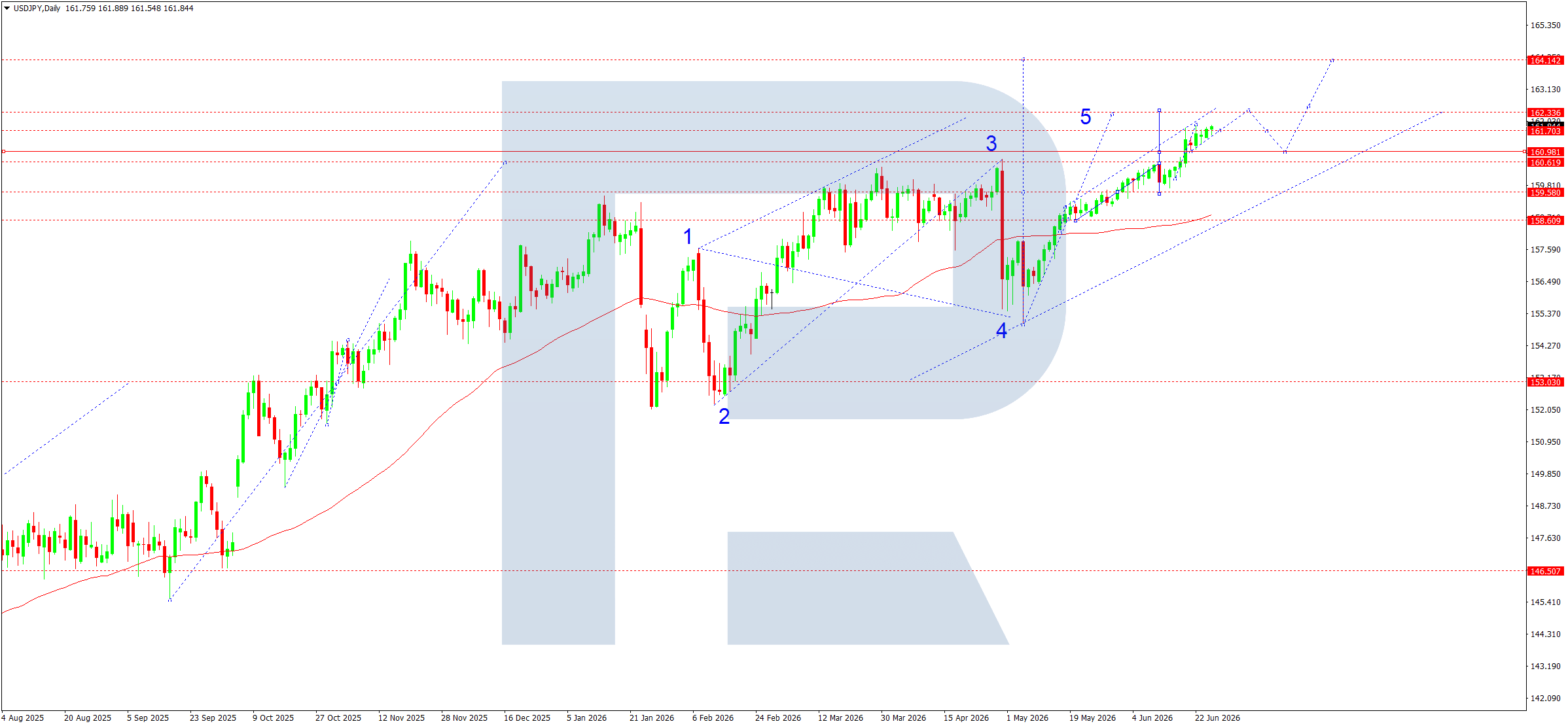
The daily chart shows that the upward trend remains fully intact. After completing corrective wave four, the market has confidently entered the fifth Elliott Wave impulse. The price has consolidated above the long-term moving average, which continues to trend upwards, confirming continued buyer dominance.
The price is currently trading above 160.98, which serves as the nearest support level while also confirming that the upward momentum remains intact. A local ascending channel is developing, with the price steadily posting new highs without showing signs of a meaningful reversal.
The first upside target for buyers remains resistance at 162.33. This area marks the upper boundary of the nearest projected range, where short-term profit-taking and a local correction may occur. However, the structure of the fifth wave does not yet appear complete.
If the market secures a confident break above 162.33, the next upside target becomes the strategic objective at 164.14. This level coincides with the upper boundary of the long-term ascending channel and represents the primary target of the current impulsive move.
The alternative scenario assumes that a correction develops once the current rally is complete. The first signal would be a break below 160.98. In this case, sellers could test the 160.62 area, which represents the nearest support zone. Only a sustained move below this level would open the way for a deeper correction towards 159.58–158.61. As long as the price remains within the ascending channel, this scenario is viewed solely as a corrective move.
The wave structure shown on the chart continues to indicate that the final stage of the fifth wave is still developing, meaning buyers retain the technical advantage.
USDJPY forecast scenarios
Bullish scenario (base case): the market remains above 160.98, preserving the potential for further growth towards 162.33, followed by the primary target at 164.14.
Bearish scenario (alternative): a break below 160.62 could accelerate the correction, leading to a decline towards 159.58 and then 158.61.
GBPUSD forecast
The past week ended with significant US dollar strength and fresh local lows in GBPUSD. The primary driver was the shift in expectations regarding future Federal Reserve (Fed) monetary policy. Following the Fed’s June meeting, market participants significantly increased the probability that restrictive policy would remain in place for a longer period, driving US Treasury yields higher and strengthening demand for the US dollar.
Additional pressure on the British pound came from weak UK macroeconomic data. Preliminary Purchasing Managers’ Index (PMI) readings once again pointed to contracting economic activity, particularly in the services sector, while easing inflationary pressures have led markets to almost completely abandon expectations of another near-term interest rate increase. Against this backdrop, investors continue to revise the UK monetary policy outlook towards a more accommodative scenario.
At its latest meeting, the Bank of England (BoE) left interest rates unchanged. Although several Monetary Policy Committee members continue to highlight persistent inflation risks, the majority preferred to adopt a wait-and-see approach. Meanwhile, lower oil prices following the easing of geopolitical tensions have reduced inflation risks for the UK economy, further limiting the pound’s recovery potential.
During the coming week, market participants will focus on US economic data, particularly labour market and business activity figures, which could influence expectations regarding the Fed’s next policy steps. For sterling, additional downside risks remain weak domestic economic data and ongoing political uncertainty.
GBPUSD technical analysis
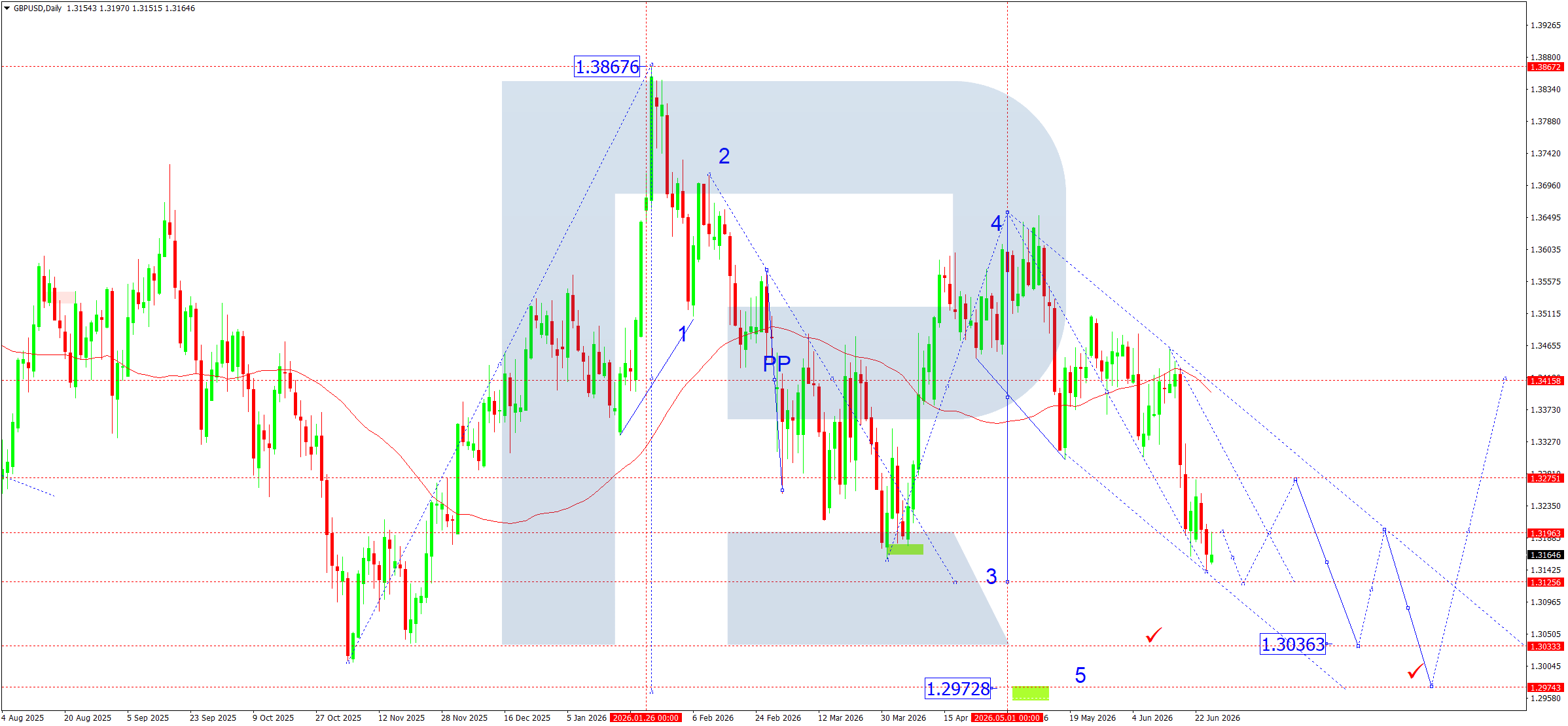
The daily chart shows that GBPUSD remains in a well-established downward trend. After completing the corrective wave near 1.3416, sellers regained full control, while the price has firmly consolidated below the moving average, which continues to turn downwards and acts as dynamic resistance.
According to the current wave structure, the final downward wave is developing towards the long-term target at 1.2974. An intermediate target lies at 1.3033, where a previous demand zone was formed. This area may temporarily slow the decline and trigger a local correction.
The descending channel remains intact, with the price continuing to move confidently along its lower boundary. Any recovery attempts are still viewed solely as corrective moves within the dominant bearish trend. The nearest significant resistance stands at 1.3196. Only a recovery above this level would allow buyers to begin forming a deeper correction.
If selling pressure persists, a break below 1.3033 will open the way towards the primary medium-term target at 1.2974. This area currently represents the key objective of the entire downward wave structure.
After reaching the 1.2974 area, the probability of a deeper correction increases, with the first recovery target at 1.3126 and, under more favourable conditions, a further advance towards 1.3275. Until clear reversal signals emerge, however, continuation of the downward trend remains the primary scenario.
GBPUSD forecast scenarios
Bearish scenario (base case): a continuation of the decline towards 1.3033 is expected. After a short-term consolidation, further movement towards the primary target at 1.2974 cannot be ruled out.
Bullish scenario (alternative): if buyers manage to regain control above 1.3196 and secure a firm break above this level, the probability of a corrective move towards 1.3275 will increase.
AUDUSD forecast
Several fundamental factors will shape AUDUSD price action during the coming week. Market participants will focus on the monetary policy outlook of both the Federal Reserve (Fed) and the Reserve Bank of Australia (RBA), as well as the state of the global economy and investors’ appetite for risk.
The US dollar ended the week on a strong footing following the release of resilient US macroeconomic data and the Fed’s continued cautious stance towards further interest rate cuts. US Treasury yields remain elevated, continuing to support demand for the dollar. Additional pressure on commodity-linked currencies came from weaker sentiment across global equity markets and increased demand for safe-haven assets.
The Australian dollar, by contrast, remained under pressure. Although the RBA left interest rates unchanged, policymakers signalled that they prefer to assess the impact of previous monetary policy tightening on the economy before making further decisions. At the same time, the Australian economy continues to show signs of slowing, while deteriorating external trade conditions, including China's introduction of additional restrictions on Australian beef imports, have increased concerns about the outlook for the country's export sector. As Australia's economy is closely linked to Chinese demand, any signs of weakness in China's economy traditionally weigh on the Australian dollar.
AUDUSD technical analysis
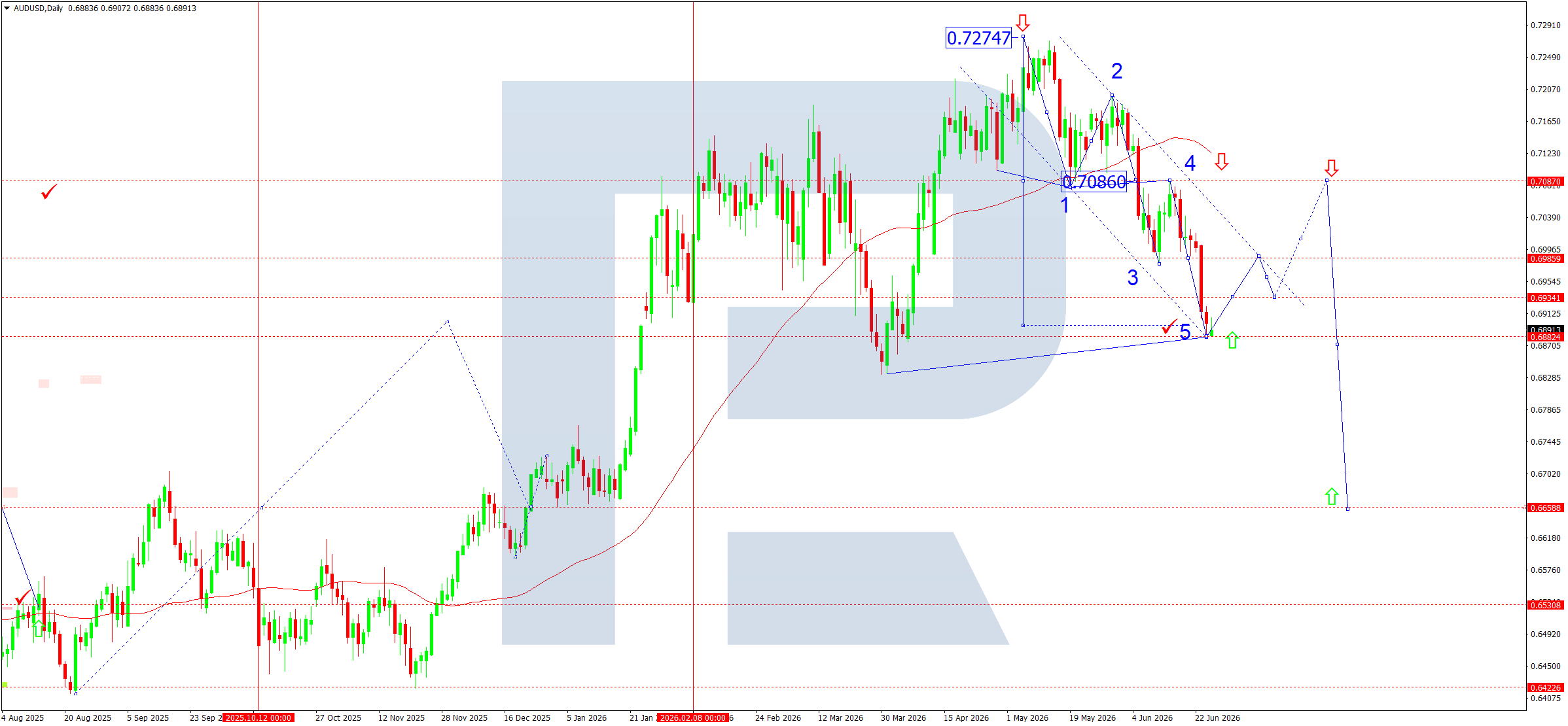
From a technical perspective, AUDUSD has completed a five-wave downward structure. The projected downside target near 0.6882 has been reached, where the market found support close to the long-term ascending trend line. This level now represents the key reference point for determining the next directional move.
As long as the price remains above 0.6882, there is a high probability that a corrective phase will develop. The first recovery target is located at 0.6934. A sustained move above this level would allow buyers to test resistance at 0.6986. If this barrier is successfully broken, the corrective recovery could extend towards 0.7080, where a strong resistance zone coincides with the previous breakout area and the 200-day moving average.
However, the overall chart structure remains bearish. The 0.7080 area continues to represent a significant level from which sellers may re-enter the market. If the correction ends below this level, pressure on the pair is likely to persist, allowing the primary downward trend to resume.
Additional confirmation of the bearish scenario would come from a break below 0.6882. In this case, the current consolidation phase would be completed, opening the way towards the next projected target near 0.6659. This level is identified on the chart as the next medium-term objective of the current downward impulse.
AUDUSD forecast scenarios
Bearish scenario (base case): after reaching the projected target at 0.6882, the market is expected to form a consolidation range, with attempts at a corrective recovery towards 0.6934 and then 0.6986. If buyers fail to secure a firm break above these levels, the downward trend is expected to resume, followed by a test of 0.6659.
Bullish scenario (alternative): if the market secures a firm break above 0.6986, the probability of a corrective recovery towards 0.7080–0.7100 will increase, followed by a test of the June highs.
USDCAD forecast
USDCAD ends the week near multi-month highs, maintaining strong upward momentum. The primary driver remains the divergence in monetary policy expectations between the US and Canada. Following its June meeting, the Federal Reserve (Fed) left interest rates unchanged but indicated that it remains prepared to maintain a restrictive stance if inflationary pressures persist. This rhetoric continues to support the US dollar.
At the same time, the Bank of Canada (BoC) also kept its key interest rate unchanged at 2.2500%, although the tone of its meeting minutes was considerably more cautious. Policymakers stressed the need to remain flexible amid slowing economic growth, uncertainty surrounding external trade, and volatile energy prices. Despite inflation accelerating to 3.2000% year-on-year, the BoC believes that the increase was primarily driven by temporary fuel price gains, while underlying inflation remains relatively stable.
Additional pressure on the Canadian dollar came from lower oil prices following the easing of geopolitical tensions in the Middle East. As oil remains Canada's principal export commodity, falling crude prices traditionally weaken the Canadian dollar. Investors also continue to factor in ongoing uncertainty surrounding US-Canada trade relations, which further limits demand for the Canadian currency.
During the coming week, market attention will focus primarily on US macroeconomic data, including labour market and business activity figures. Strong data could reinforce expectations that the Fed will maintain its hawkish stance, while weaker figures may trigger profit-taking in long US dollar positions.
USDCAD technical analysis
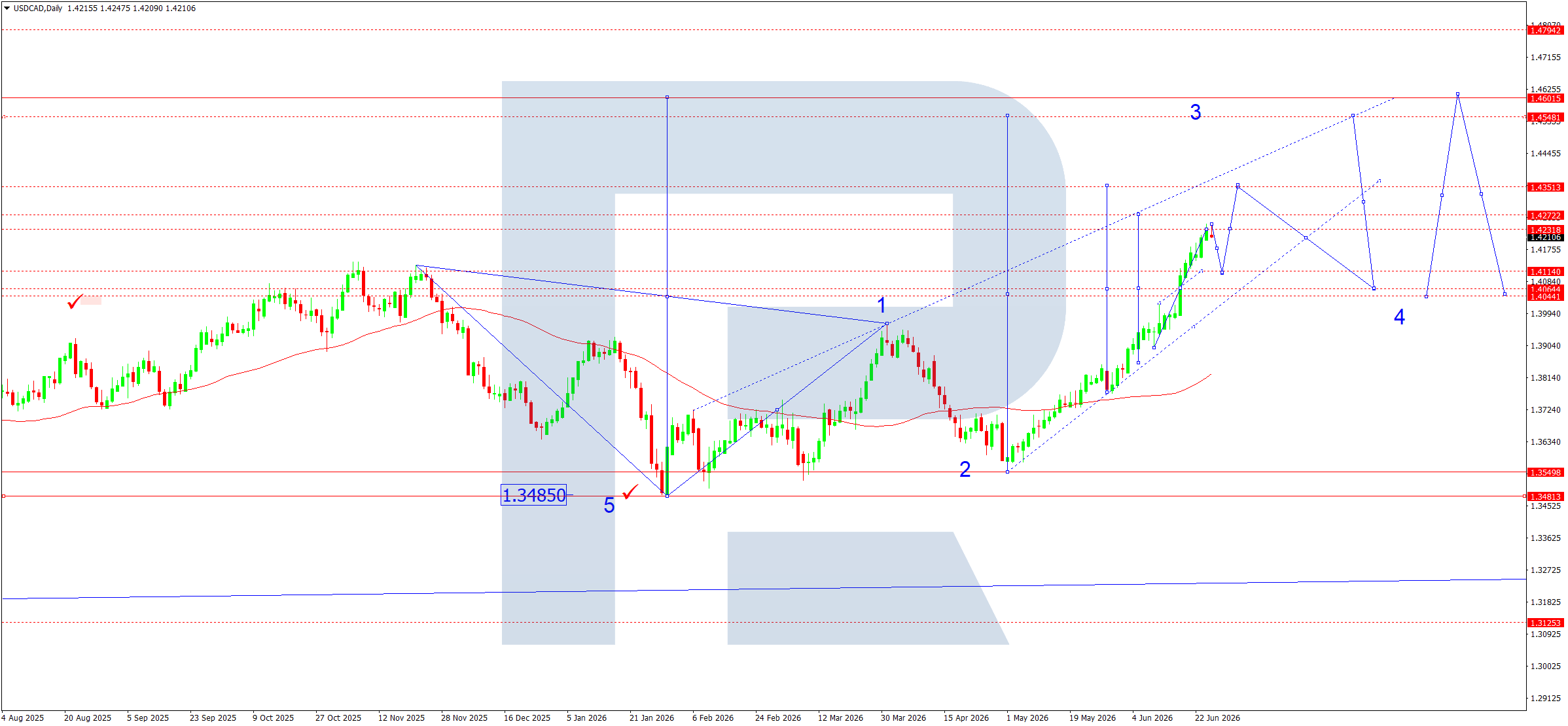
The daily chart continues to show a strong upward trend. After forming a reversal pattern near 1.3485, the market sequentially completed the first and second upward waves before entering the third Elliott Wave impulse, which currently remains the market's primary driving force.
The pair has reached the resistance area around 1.4232, where local profit-taking has emerged. According to the current wave count, completion of the first segment of the third wave may lead to a short-term correction towards 1.4114. This level coincides with the upper boundary of the previous consolidation zone and could serve as new support before the upward trend resumes.
Provided the price remains within the ascending channel, the primary upside target for buyers is located near 1.4548, followed by a potential test of 1.4601. This range corresponds to the upper boundary of the long-term wave structure and represents the main objective of the third Elliott Wave.
If buyers fail to defend 1.4114, the correction could deepen towards 1.4044. However, as long as the price remains above this level, the medium-term technical outlook continues to favour further upside.
The medium-term moving average continues to trend confidently upwards and remains well below current price levels, confirming continued buyer dominance. The sequence of higher highs and higher lows also confirms that the upward trend remains intact. Even if a correction develops at the beginning of the week, it is currently viewed solely as a technical pause within the ongoing impulse.
USDCAD forecast scenarios
Bullish scenario (base case): after a local correction towards 1.4114 is completed, we expect the upward trend to resume, followed by a test of 1.4351 and subsequent growth towards 1.4548.
Bearish scenario (alternative): if the market secures a firm break below 1.4044 on increasing volume, the probability of a deeper correction towards 1.3900 will increase.
XAUUSD forecast
After an exceptionally volatile second half of June, the gold market ends the week under continued pressure from a strong US dollar and the Federal Reserve’s (Fed) hawkish rhetoric. Although US inflation data broadly matched expectations, investors continue to price in the likelihood that interest rates will remain elevated for longer. Higher US Treasury yields continue to reduce the appeal of gold as a non-yielding asset. At the same time, easing geopolitical tensions in the Middle East have reduced demand for safe-haven assets, adding further pressure on the precious metal. However, continued gold purchases by central banks around the world remain one of the market's key long-term supportive factors, limiting the scope for further downside. During the coming week, market participants will focus on US labour market data, business activity indices, and fresh comments from Fed officials, all of which could significantly reshape expectations regarding the future path of monetary policy.
XAUUSD technical analysis
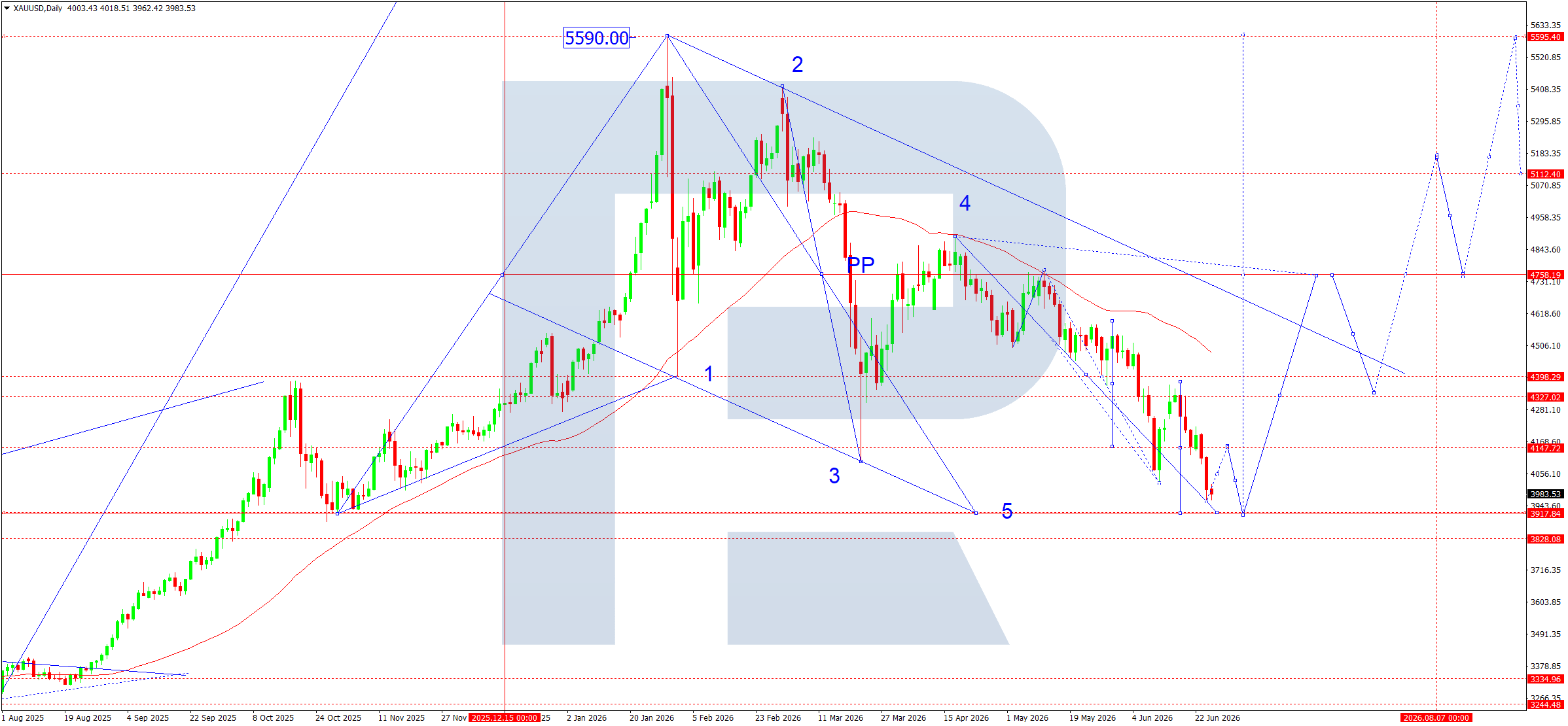
From a technical perspective, XAUUSD continues to develop a medium-term downward trend following the formation of its all-time high near 5,590. The daily chart shows the Elliott Wave bearish structure unfolding as expected. After completing the second wave, the market formed a strong downward impulse, followed by a corrective fourth wave, with the final fifth wave of the bearish cycle now in progress.
The price continues to trade within a descending channel, while all recovery attempts remain capped by the dynamic resistance of the long-term moving average. Recent trading sessions have been characterised by accelerating downward momentum, confirming that sellers remain firmly in control.
The key support area is located around 3,918, which coincides with the projected target of the current downward wave. This is where the fifth wave may complete and a higher-order reversal pattern could begin to form. If this support holds, the probability of the market establishing a base and entering a meaningful corrective recovery will increase.
According to the current wave count, once the ongoing decline is complete, the market may reverse upwards with an initial target near the Pivot Point at 4,758. This level will represent the first significant obstacle for buyers. A breakout above it would open the way for further recovery towards resistance at 5,112, followed by a potential retest of the all-time high at 5,590, which remains the long-term objective of the alternative scenario.
Until clear reversal signals emerge, sellers continue to hold the advantage. Any corrective rallies towards the 4,148–4,327 area should be viewed as technical rebounds within the broader downward trend. Only a sustained move above 4,758 would indicate the formation of a more durable upward trend.
XAUUSD forecast scenarios
Bearish scenario (base case): after a brief consolidation phase, the market is expected to maintain pressure on support at 3,918. A break below this level could extend the decline towards 3,828.
Bullish scenario (alternative): if buyers successfully defend the 3,918 area and secure a firm break above 4,148, the probability of a corrective recovery will increase, initially towards 4,327 and then to the Pivot Point at 4,758.
Brent forecast
Brent crude ends the week under heavy pressure following a sharp decline in the geopolitical risk premium. The main driver has been easing concerns over crude oil supplies from the Middle East. Following temporary agreements aimed at resolving tensions surrounding Iran and the gradual restoration of shipping through the Strait of Hormuz, investors actively took profits on long positions, pushing prices back towards levels seen before the military conflict. Additional pressure came from expectations of increased supply from OPEC+ producers and the recovery of exports from the Gulf region.
At the same time, the fundamental outlook remains mixed. Despite the decline in oil prices, inflationary risks within the global economy have not disappeared. Federal Reserve (Fed) officials continue to maintain a relatively hawkish stance, as lower energy prices alone do not guarantee slower inflation. During the coming week, investors will closely monitor US crude oil inventory data, manufacturing activity across the world's major economies, and further developments regarding the implementation of agreements in the Middle East. Any signs of renewed geopolitical tensions could quickly restore the risk premium to oil prices. For now, however, the market remains focused on improving supply conditions.
Brent technical analysis
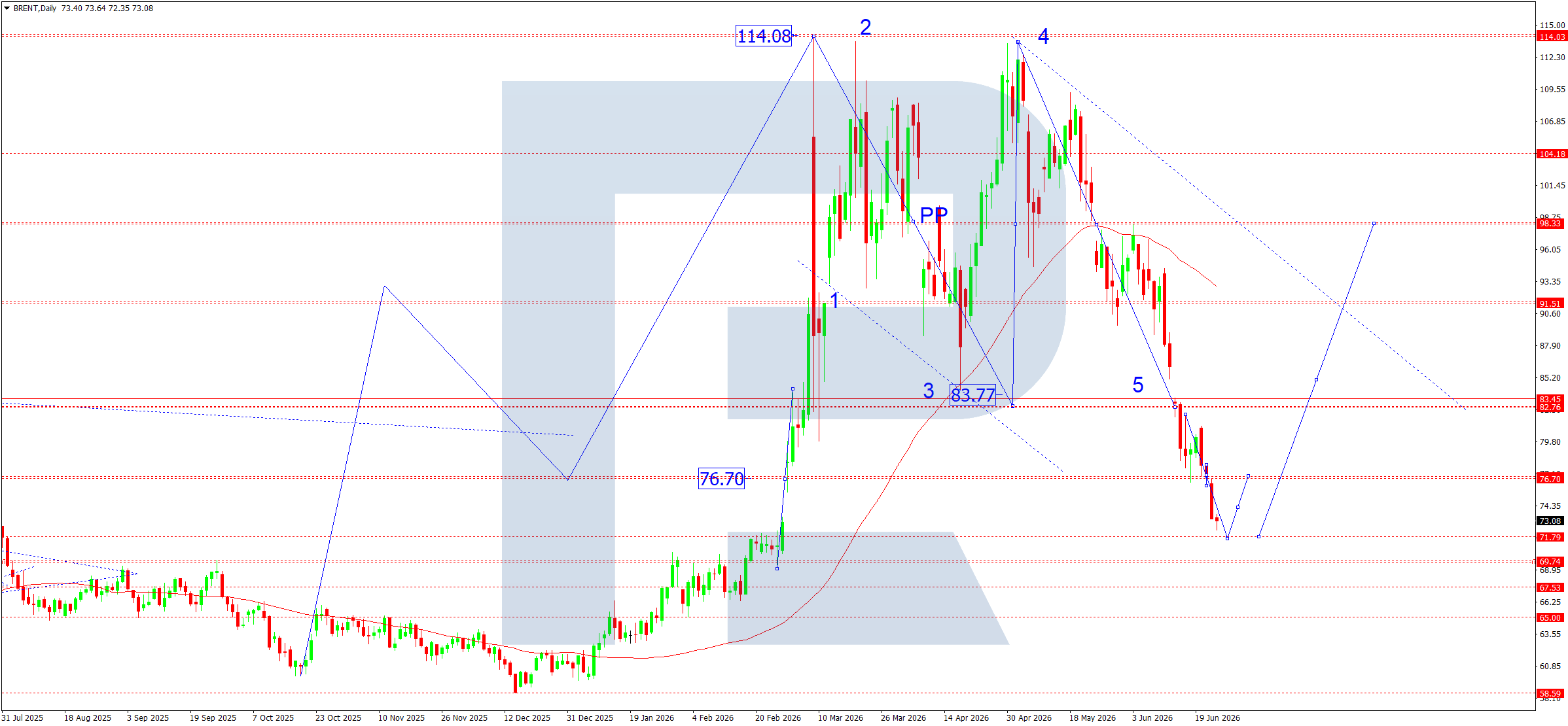
From a technical perspective, Brent has almost fully completed the bearish scenario outlined in previous weeks. After forming a peak near 114.08, the market completed a major corrective structure before developing a full five-wave Elliott Wave decline. The price has now reached the key support zone between 71.79 and 69.74, which corresponds to the projected completion area of the fifth wave. This range now represents the primary decision point for the coming days.
If support holds, the market may enter a recovery phase. The first upside target for buyers is a move back above 76.70, which previously acted as an important reversal zone. A sustained break above this resistance would allow the corrective recovery to extend towards 82.76, where the next major resistance area is located. If buying pressure strengthens further, a move towards the Pivot Point near 98.33 cannot be ruled out, although this scenario currently represents a medium-term outlook.
If selling pressure persists and support at 71.79 is decisively broken, the decline could accelerate further. Although the Elliott Wave structure suggests that the current downward impulse is approaching completion, the market may still produce one final false break below support before beginning a more sustainable corrective recovery. As long as the price remains below 76.70, sellers continue to hold the advantage.
Brent forecast scenarios
Bearish scenario (base case): a sustained move below 71.79 will open the way towards 69.74, where the fifth downward wave may complete before a new corrective recovery begins.
Bullish scenario (alternative): if support at 71.79 holds and the market returns above 76.70, the potential for recovery will increase, initially towards 82.76 and subsequently to the 98.33 area.
BTCUSD forecast
At the end of June, Bitcoin remains under pressure from several fundamental factors at once. The main market theme remains the hawkish rhetoric of the US Federal Reserve (Fed), which continues to support high interest rates. This reduces the appeal of risk assets, including cryptocurrencies. Additional pressure comes from the strengthening US dollar and rising US Treasury yields. At the same time, capital inflows into spot Bitcoin ETFs remain weak. Moreover, recent weeks have seen persistent ETF outflows, indicating reduced activity among large institutional investors. Some long-term market participants continue to accumulate positions, but this remains insufficient to form a sustainable upward impulse. Another factor is the reallocation of capital towards the technology sector and companies linked to artificial intelligence, which temporarily reduces investor interest in the cryptocurrency market. During the coming week, market participants will closely monitor new US macroeconomic data, which could shift expectations regarding further Fed policy and significantly affect Bitcoin price dynamics.
BTCUSD technical analysis
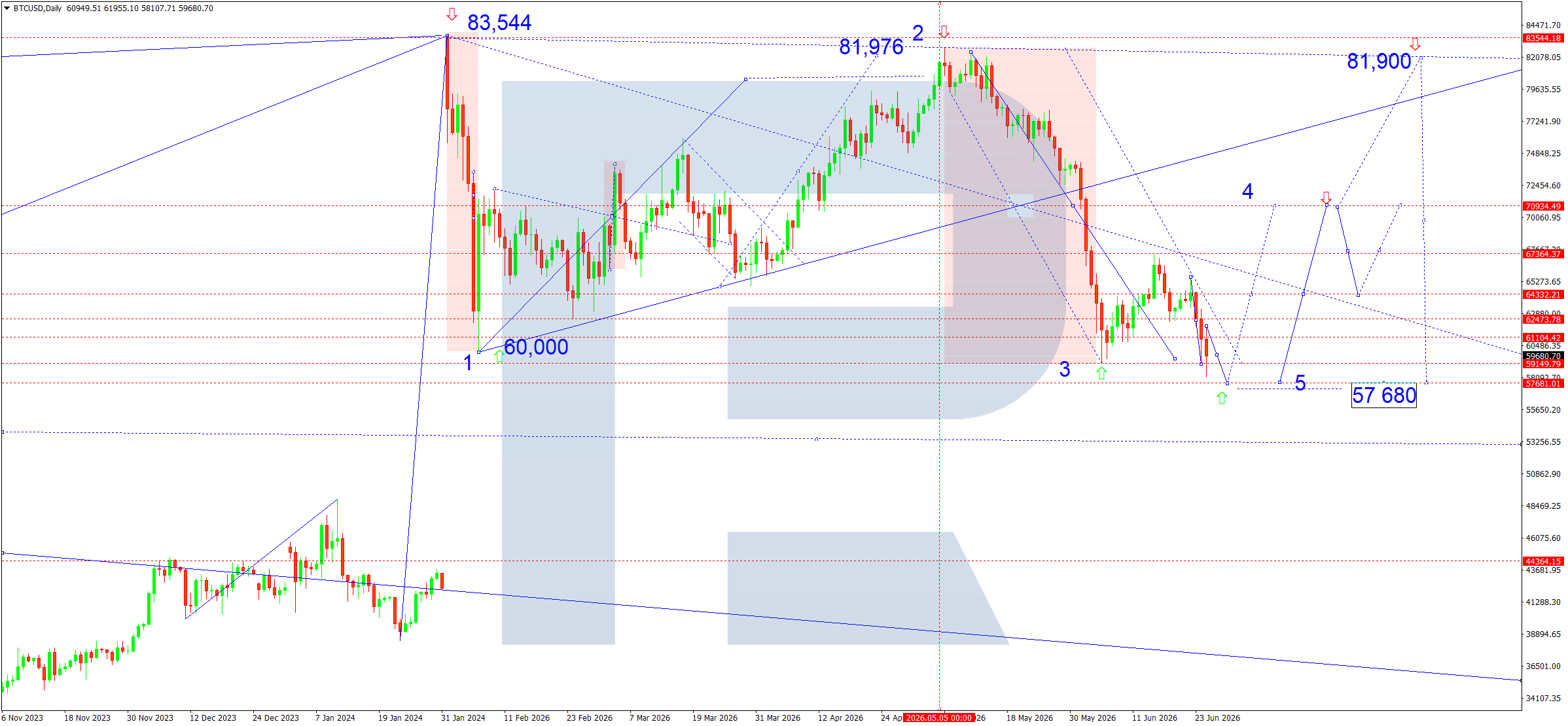
From a technical perspective, the daily chart continues to form a large corrective five-wave structure after reaching the all-time high at 83,544. The first downward wave ended near 60,000, after which the market formed corrective wave 2 with a high at 81,976. The development of a powerful third downward wave then began, reaching the 59,200 area and almost completing its primary objective.
At the moment, the market is in the final stage of forming a local correction. Buyers’ attempts to return the price above 62,500 remain limited, while the structure of the move indicates continued downward pressure. According to the chart structure, corrective wave 4 may complete within the 64,300–67,300 range, after which conditions may emerge for the development of the final fifth downward wave.
The key technical level remains 62,473. A break below this level would confirm the completion of the corrective recovery and open the way towards the primary target of the entire structure around 57,680. This level coincides with a long-term support area and the potential completion point of the entire corrective model. After reaching this zone, the market may begin forming a more sustained upward phase. Until then, any recovery should be viewed solely as a corrective move within the dominant downward trend.
BTCUSD forecast scenarios
Bearish scenario (base case): the market continues to form a five-wave correction from 83,544. After wave 4 is completed, a break below 62,473 will confirm the development of wave 5, with the primary target at 57,680.
Bullish scenario (alternative): if buyers manage to consolidate above 62,500 and develop momentum on rising volumes, the next recovery targets may be 67,364 and 70,930.
Editors’ picks
 EURUSD forecast 2026–2027: technical analysis, price levels & predictions
The ECB holds rates at 2.15% while the Fed stays at 3.75% — and that divergence is the central driver of EURUSD in 2026. The pair is range-bound between 1.1400 and 1.1915, with Deutsche Bank targeting 1.2500 and Morgan Stanley calling for 1.3000 by year-end. We analyse the technicals, break down the macro factors, and outline three trading scenarios with specific entry levels.
 Gold (XAUUSD) forecast 2026: predictions based on fundamental and technical analysis
Where is gold headed after pulling back from the all-time high of 5,597 USD? XAUUSD is consolidating near 4,518 USD between key levels 4,220 USD and 4,855 USD, with major banks targeting 5,243–6,200 USD by year-end. Read our comprehensive gold forecast: technical analysis across three timeframes, trading scenarios with specific entry levels, Fed policy and central bank demand outlook, and institutional predictions for 2026 and beyond.
Forecasts presented in this section only reflect the author’s private opinion and should not be considered as guidance for trading. RoboForex bears no responsibility for trading results based on trading recommendations described in these analytical reviews.