
DE 40 forecast: the index may enter a sideways range
The downtrend in the DE 40 stock index still dominates, but a sideways range is likely to form in the short term. The DE 40 forecast for today is negative.
DE 40 forecast: key takeaways
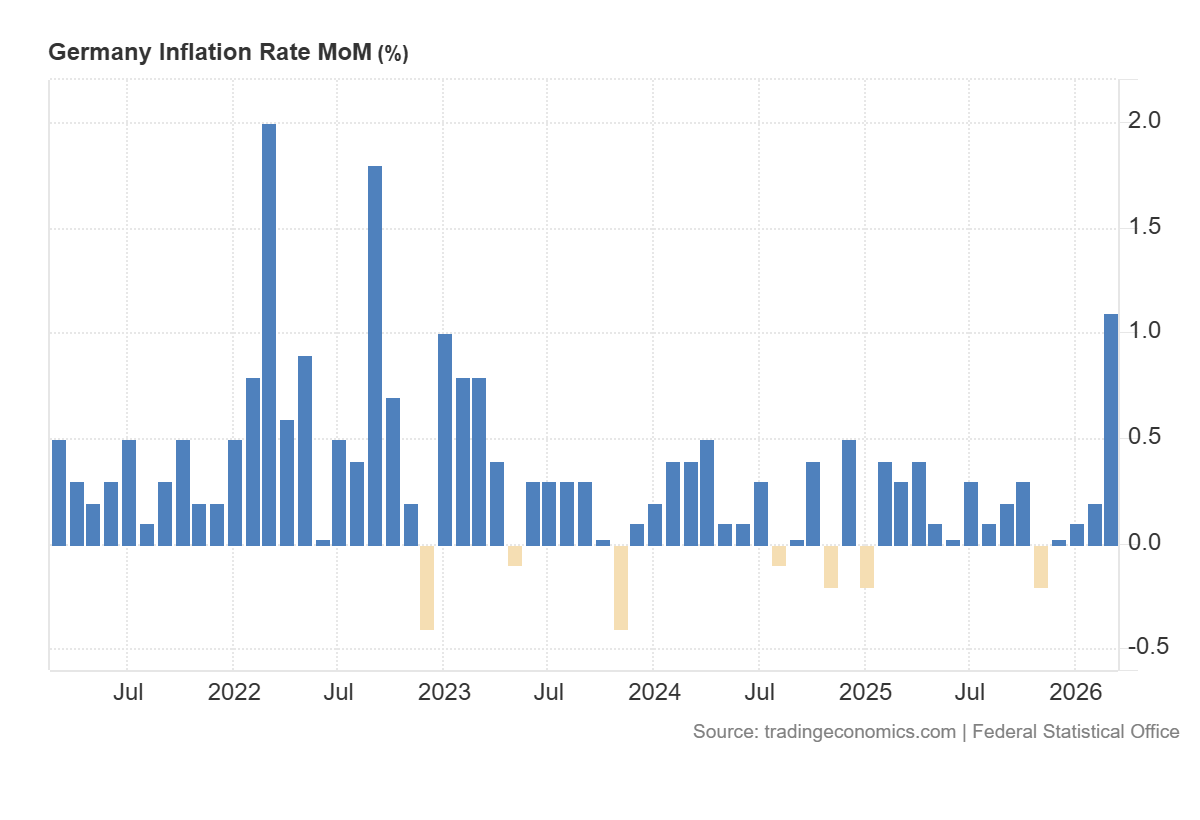
- Recent data: Germany’s CPI rose by 1.1% in March
- Market impact: the data creates a positive backdrop for German equities
DE 40 fundamental analysis
The release of Germany’s March CPI, which increased by 1.1% month-on-month after 0.2% previously, appears rather cautiously negative for the DE 40, although the impact should not be uniform across all stocks. Importantly, the figure matched the forecast, so this is not an unexpected shock to the market, but rather a confirmation that inflationary pressure has strengthened. Annual inflation accelerated to 2.7%, and core inflation came in at 2.5%, suggesting not only the impact of volatile components but also persistent price pressure in the economy.
For the DE 40 index, this means the room for a more accommodative ECB policy is narrowing. When inflation accelerates, the market tends to become more cautious about the prospects of rate cuts or even starts to price in the possibility of a more hawkish stance. Higher prices in Germany and the eurozone have reinforced expectations of further ECB tightening steps in 2026. This is negatively impacting stock market valuations.
DE 40 technical analysis
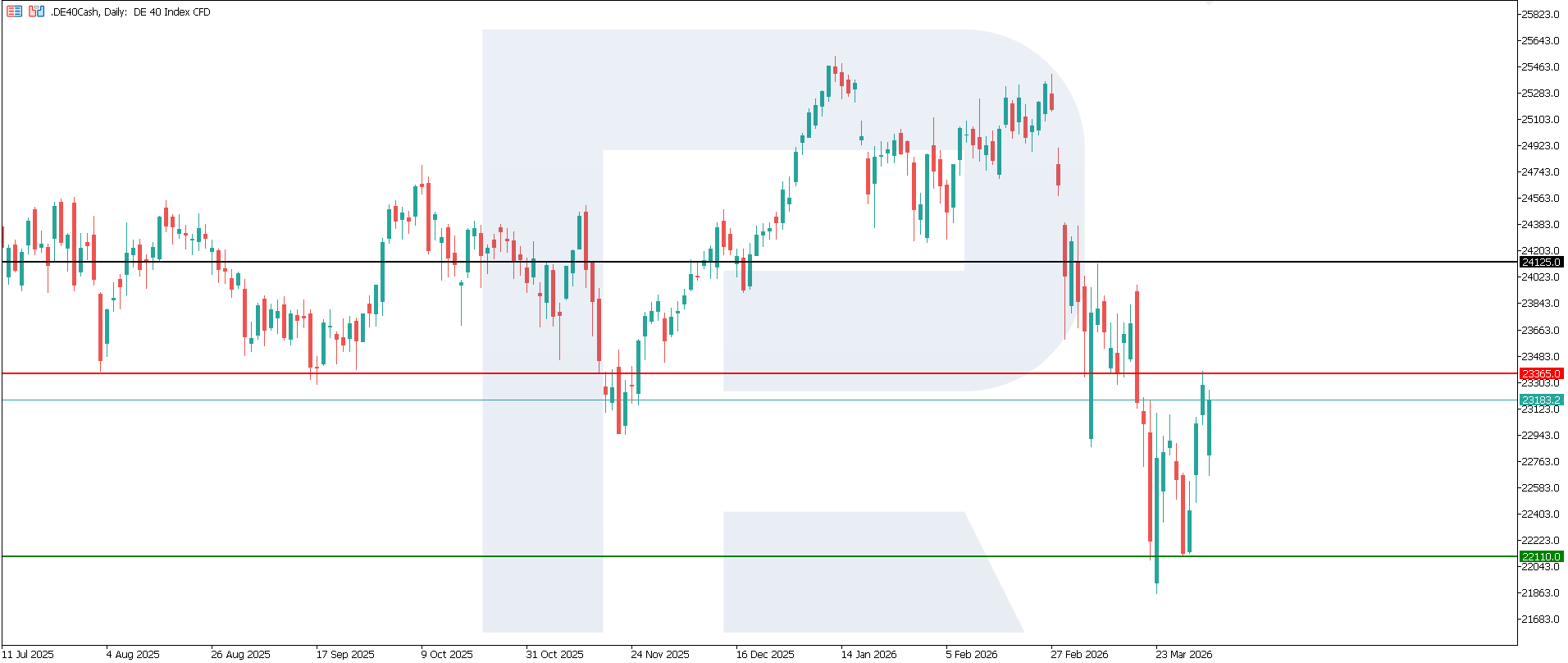
The DE 40 index formed a resistance level around 23,365.0 and a support level at 22,110.0. The price has already broken above resistance, but momentum was so weak that it was premature to talk about a trend reversal to the upside. If the decline continues, the target could be 21,145.0.
The DE 40 price forecast considers the following scenarios:
- Pessimistic DE 40 scenario: a breakout below the 22,110.0 support level could send the index to 21,145.0
- Optimistic DE 40 scenario: a breakout above the 23,365.0 resistance level could drive the index to 24,125.0
Summary
Overall, the data is rather moderately negative for the DE 40, not because the figure was in line with the forecast, but because it confirms renewed inflationary pressure in the eurozone’s largest economy. The weakest reaction is most likely in industrials, autos, chemicals, and other energy-intensive segments. Banks, certain defensive securities, and companies that can pass higher costs on to end consumers may look more resilient. The next downside target remains 21,145.0.
Editors’ picks
 EURUSD 2026-2027 forecast: key market trends and future predictions
This article provides the EURUSD forecast for 2026 and 2027 and highlights the main factors determining the direction of the pair’s movements. We will apply technical analysis, take into account the opinions of leading experts, large banks, and financial institutions, and study AI-based forecasts. This comprehensive insight into EURUSD predictions should help investors and traders make informed decisions.
 Gold (XAUUSD) forecast 2026 and beyond: expert insights, price predictions, and analysis
Dive deep into the Gold (XAUUSD) price outlook for 2026 and beyond, combining technical analysis, expert forecasts, and key macroeconomic factors. It explains the drivers behind gold’s recent surge, explores potential scenarios including a move toward 4,500 to 5,000 USD per ounce, and highlights why the metal remains a strong hedge during global uncertainty.
Forecasts presented in this section only reflect the author’s private opinion and should not be considered as guidance for trading. RoboForex bears no responsibility for trading results based on trading recommendations described in these analytical reviews.