
Stock market outlook for the week of 16–20 November 2026: key levels for world indices
Global stock indices are under pressure following a controversy involving NVIDIA’s CEO. NVIDIA had discussed providing guarantees worth billions of dollars to companies unable to afford its chips in exchange for a share of their revenue. The largest project was to involve supporting an OpenAI campus in Ohio, with plans to use chips worth approximately 300 billion USD.
Key levels for the week
| Instrument | Week | Support | Resistance | Scenario |
|---|---|---|---|---|
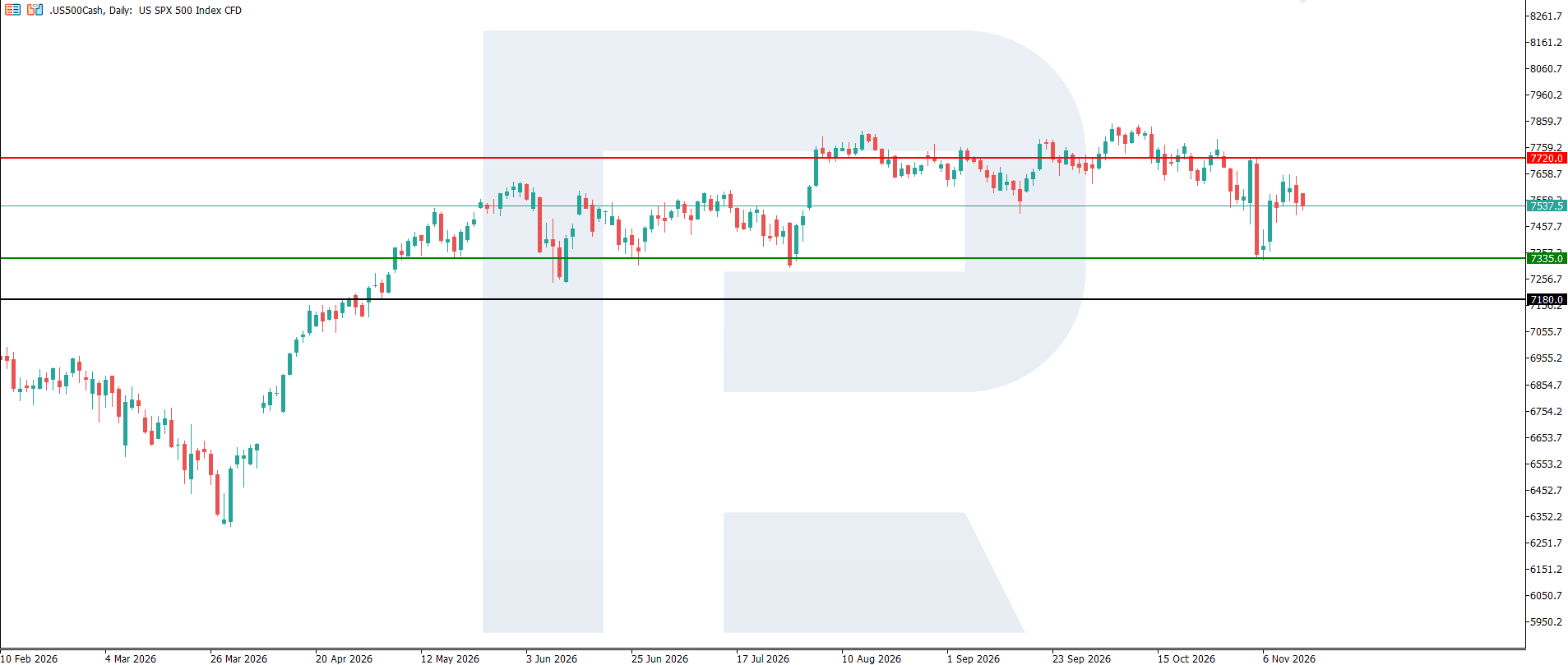
| US 500 | −2.1% | 7,335.0 | 7,720.0 | Sell below 7,330.0 |
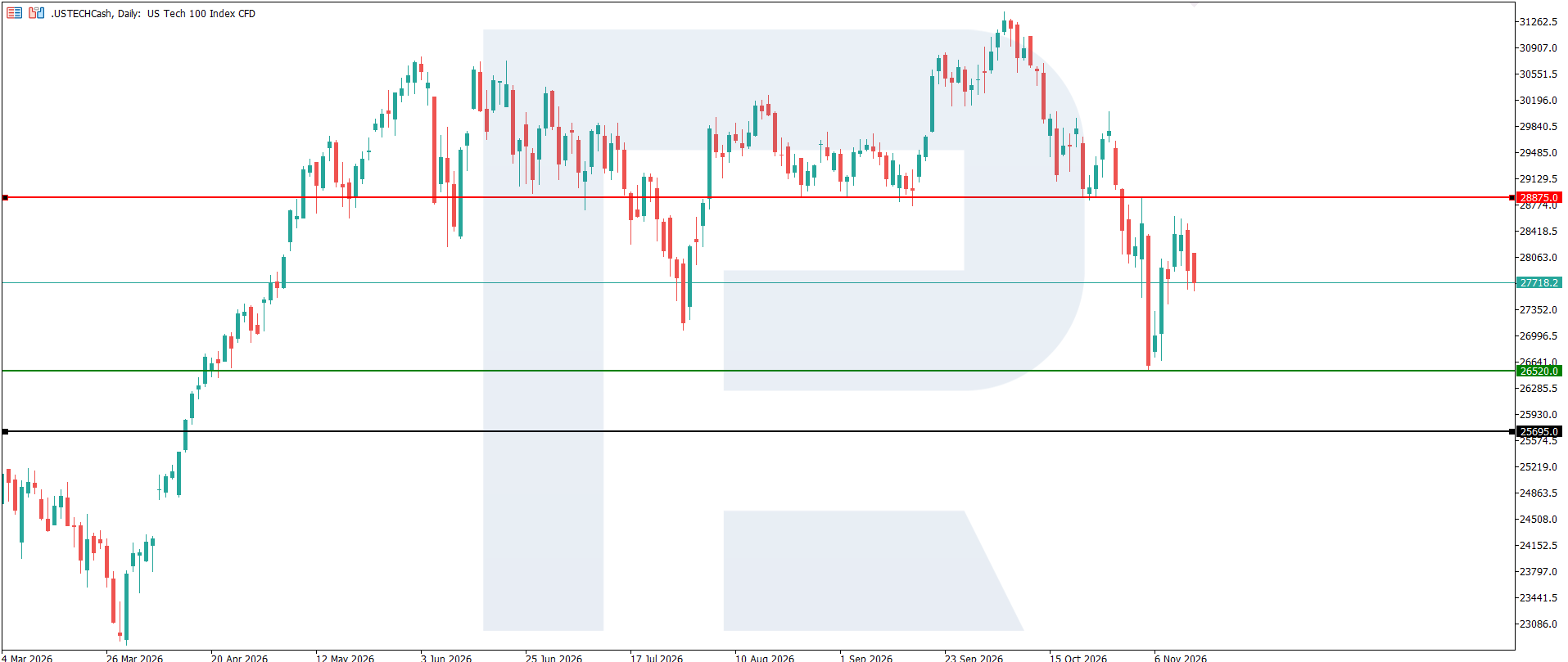
| US Tech | −3.1% | 26,520.0 | 28,875.0 | Sell below 26,515.0 |
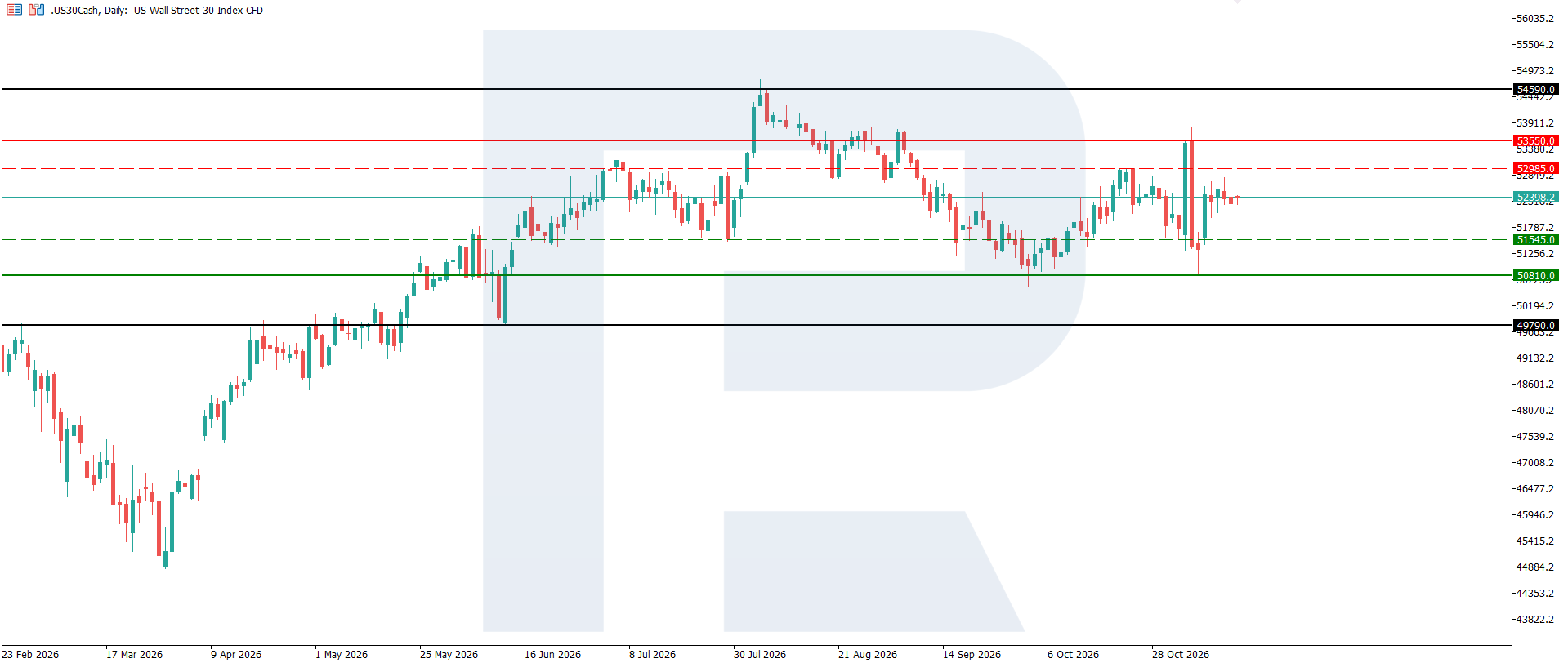
| US 30 | −2.0% | 50,810.0 | 53,550.0 | Sell below 50,805.0 |
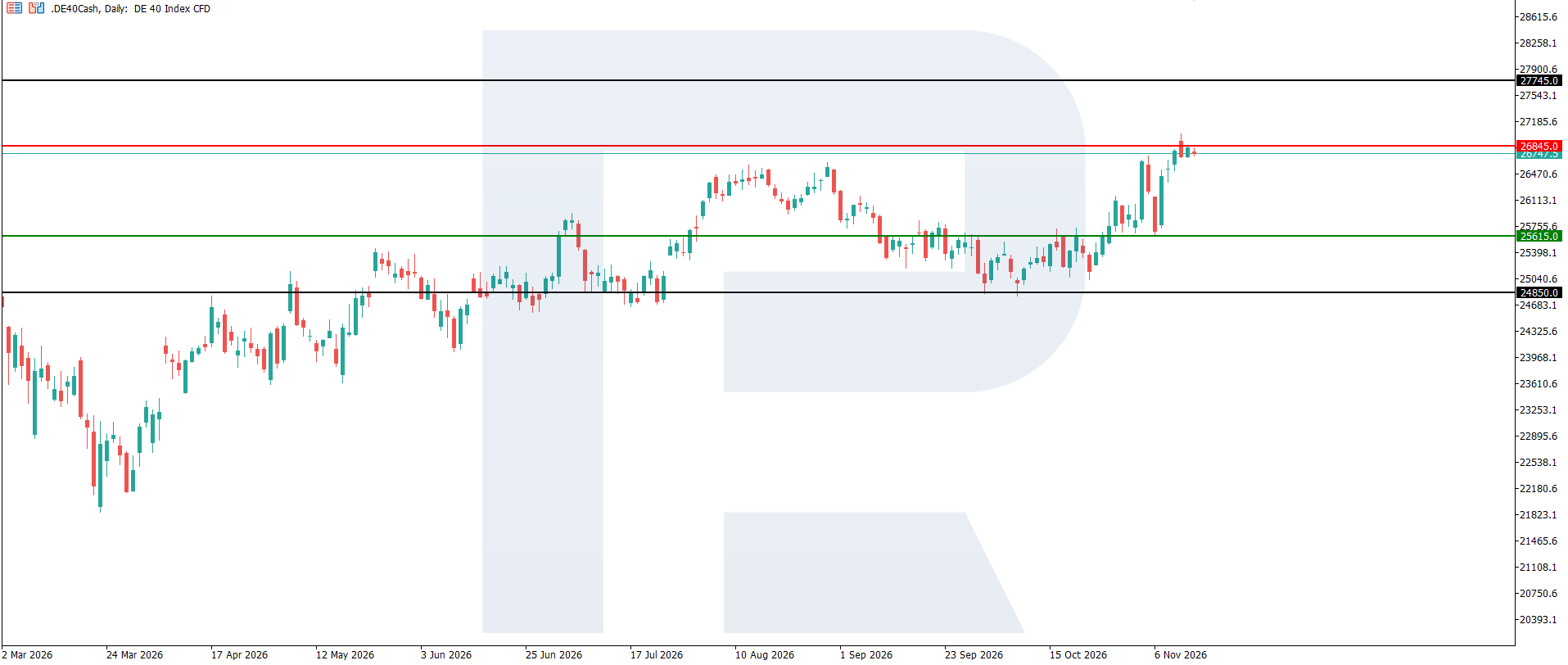
| DE 40 | +3.3% | 25,615.0 | 26,845.0 | Buy above 26,850.0 |
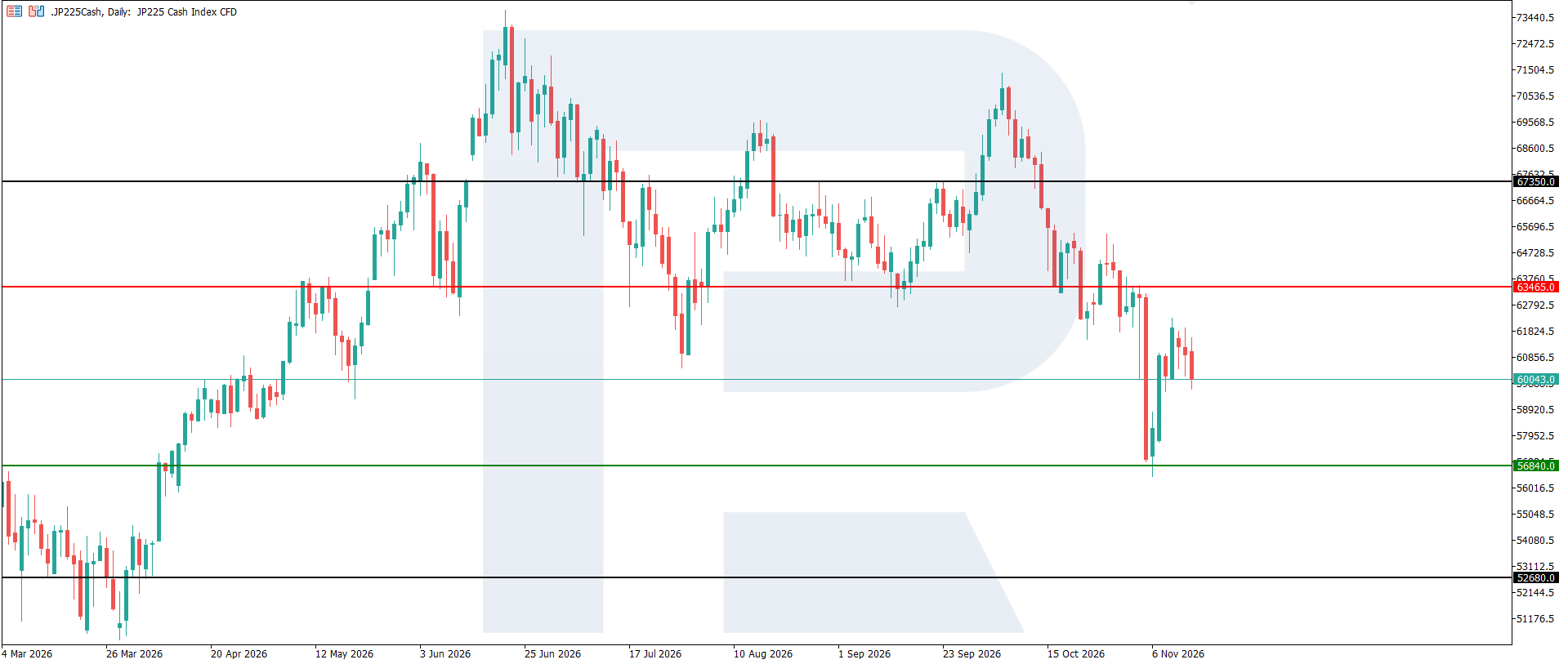
| JP 225 | −7.3% | 56,840.0 | 63,465.0 | Sell below 56,840.0 |
Events that can move indices this week
| Date | Event | Instruments affected |
|---|---|---|
| Monday, 16 November 2026 | Japan's Q3 GDP | JP 225 |
| Tuesday, 17 November 2026 | US retail sales for October | US 500, US 30, US Tech |
| Tuesday, 17 November 2026 | NVIDIA quarterly earnings | US Tech, US 500, US 30 |
| Wednesday, 18 November 2026 | Federal Reserve meeting minutes (FOMC minutes) | US 500, US 30, US Tech |
| Wednesday, 18 November 2026 | Eurozone Consumer Price Index (CPI) for October | DE 40 |
US indices forecast: US 30, US 500, and US Tech
Fundamental analysis
The US 30 index is showing relative resilience amid heightened stock market volatility. Support comes from a rotation of capital out of technology stocks and into industrial, financial, and consumer companies. However, accelerating inflation and the risk of Federal Reserve interest rate hikes are limiting the potential for gains. Key factors remain the resilience of consumer demand, industrial production trends, and corporate profits. High borrowing costs could constrain business investment. At the same time, slowing inflation and sustained economic growth could support the index. Risks of a correction remain in the short term.
The US 500 is under pressure from inflation risks, rising government bond yields, and a reassessment of expectations for Federal Reserve policy. Investor concerns about the returns on technology companies' large-scale investments in artificial intelligence are creating additional uncertainty. High market valuations make the index more sensitive to deteriorating economic forecasts. Nevertheless, resilient corporate profits and capital rotation between sectors could limit the decline in prices. Slowing inflation and improved corporate financial results could revive buying interest, although the prospect of further monetary tightening continues to pose correction risks.
The US Tech index is under pressure amid a reassessment of the outlook for artificial intelligence and rising US government bond yields. Investors are concerned about increasing capital expenditure by major corporations on data centre construction and AI infrastructure, which could adversely affect free cash flow. Inflation is another risk factor, increasing the likelihood that the Fed will maintain a restrictive policy stance. Despite sustained demand for cloud technologies and digital services, high market valuations limit the potential for gains. Improved corporate earnings and easing inflationary pressure could support a recovery in the index, but the risks of a further correction remain high.
US 500 technical analysis
The US 500 ended the week lower. The broader trend remains bearish. On the D1 chart, a resistance level has formed at 7,725, while support lies at 7,335. Despite a recovery of more than 4% from the lows, sellers remain in a strong position. The next downside target is 7,180.
US 500 trading scenario
US Tech technical analysis
The US Tech has corrected by almost 8% following the decline. On the D1 timeframe, the price has established a support level at 26,520 and a resistance level at 28,875. The broader trend remains bearish as long as the current resistance is not broken. The next downside target is 25,695.
US Tech trading scenario
US 30 technical analysis
Following the decline, the US 30 index corrected by almost 4% but failed to reverse the trend to the upside. At this stage, resistance is located at 53,550, while support has formed at 50,810. The next support level at 49,790 would be the downside target.
US 30 trading scenario
European index forecast: DE 40
Fundamental analysis
The German DE 40 stock index remains resilient near all-time highs, supported by positive corporate earnings and a rotation of capital into European equities. The gradual recovery of Germany's industrial sector is providing support, although weak consumer demand and high energy prices are limiting economic growth prospects. Uncertainty surrounding US trade policy, the slowdown in China's economy, and inflationary pressure in the eurozone remain additional risk factors. The index's future performance will depend on ECB decisions, the financial results of Germany's largest corporations, and the state of global trade. Improving economic indicators could support the uptrend, while rising energy costs and deteriorating external demand could trigger a correction.
DE 40 technical analysis
The DE 40 index reached a new all-time high last week. The broader trend remains bearish, although a short-term correction cannot be ruled out. A resistance level is located at 26,845, with support at 25,615. A breakout above resistance would open the way for a rise towards 27,745.
DE 40 trading scenario
Asian index forecast: JP 225
Fundamental analysis
The Japanese JP 225 stock index is experiencing heightened volatility amid a weakening yen, rising government bond yields, and uncertainty over the Bank of Japan's future policy. Depreciation of the national currency supports shares of export-oriented companies, but at the same time raises the cost of imported energy and raw materials, adding to inflationary pressure. A potential Bank of Japan interest rate hike remains another risk factor, as it could constrain investment activity. Investors are also awaiting Japan's GDP figures, with growth forecast at 0.1% quarter-on-quarter. Demand for technology and semiconductor products is supporting the index. Improved corporate earnings and a stabilisation of the currency market could underpin price gains, but tighter monetary policy and an economic slowdown continue to pose correction risks.
JP 225 technical analysis
The JP 225 index has entered a downtrend. The price has established resistance at 63,465 and support at 56,840. If the decline continues, the downside target will be 52,680.
JP 225 trading scenario
Summary and what to watch this week
The fundamental backdrop for global stock indices remains predominantly negative. The US 30 and US 500 are under pressure from inflation risks, high bond yields, and uncertainty over the future course of Federal Reserve policy. The US Tech index remains the most vulnerable, as investors reassess the potential returns on large-scale investment in artificial intelligence. Europe's DE 40 has a neutral outlook amid weakness in German industry, although corporate profits and ECB policy could provide support. Japan's JP 225 is influenced by yen weakness and expectations of Bank of Japan interest rate hikes. Overall, stock market correction risks persist, and the future direction will depend on macroeconomic data, central bank decisions, and corporate earnings.
Editors’ picks


EURUSD forecast 2026–2027: technical analysis, price levels & predictions
The EURUSD outlook for 2026 and 2027: key levels on the daily chart, three trading scenarios and the policy gap between the Fed and the ECB that drives the pair.

Gold (XAUUSD) forecast 2026: technical analysis, price levels & predictions
Where gold could trade in 2026: key levels, three trading scenarios with entry triggers and the forecasts from J.P. Morgan, Deutsche Bank and Goldman Sachs.
Forecasts presented in this section only reflect the author’s private opinion and should not be considered as guidance for trading. RoboForex bears no responsibility for trading results based on trading recommendations described in these analytical reviews.