
US Tech forecast: index poised to reach a new all-time high
The US Tech index has broken above the resistance level and could set a new all-time high. The US Tech forecast for next week is positive.
US Tech forecast: key takeaways
- Recent data: US CPI rose by 3.4% year-on-year in July
- Market impact: the current data is positive for the technology sector
US Tech fundamental analysis
The US inflation data is, overall, a moderately positive signal for the US Tech index and the US stock market. Annual consumer price inflation slowed from 3.5% to 3.4% in July. At the same time, monthly price growth was only 0.1%, while core inflation, excluding food and energy, rose by 0.2% month-on-month and slowed to 2.5% year-on-year from 2.6% previously. Therefore, the most important factor is not so much the 3.4% level itself, which investors had already expected, but confirmation that inflationary pressure is gradually easing.
The impact on the US Tech index is broadly positive, as the technology sector is particularly sensitive to interest rate expectations. The Federal Reserve maintains the federal funds rate range at 3.50-3.75%, while its long-term inflation target is 2% based on the Personal Consumption Expenditures price index. Lower consumer inflation increases the likelihood that the regulator will not need to tighten monetary policy further.
US Tech technical analysis
For the US stock market as a whole, the data can also be considered favourable. A combination of gradually easing inflation and no signs of a sharp economic slowdown is a preferred scenario for the stock market. If inflationary pressures continue to ease without a significant deterioration in business activity and the labour market, the Federal Reserve will have more scope to ease monetary policy without having to respond to an economic downturn.
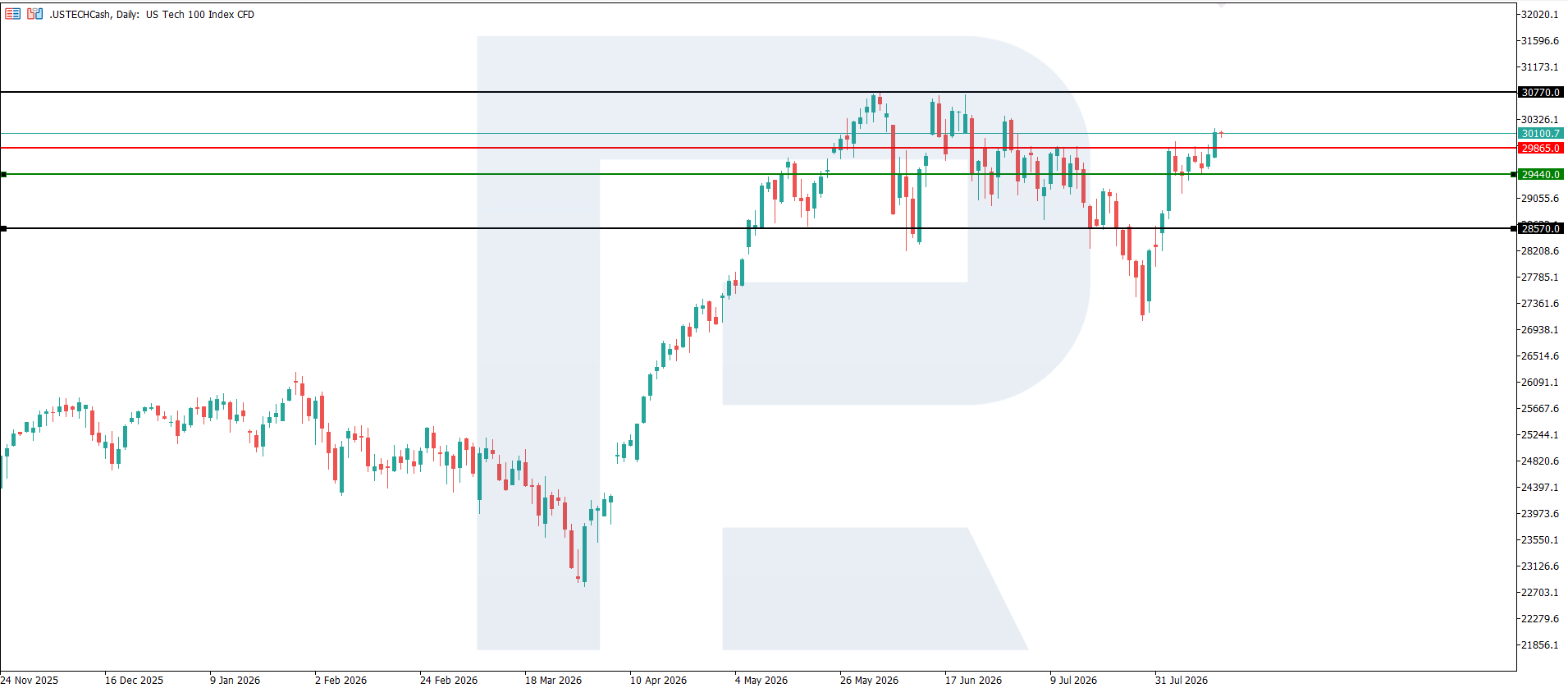
The US Tech index continues to rise and has broken above the 29,865.0 resistance level, while the main support is located at 29,440.0. The price is highly likely to hit a new all-time high. If growth continues, the nearest target could be 30,770.0.
The US Tech price forecast outlines the following scenarios:
- Pessimistic US Tech scenario: a breakout below the 29,440.0 support level could send the index down to 28,570.0
- Optimistic US Tech scenario: if the price consolidates above the broken 29,865.0 resistance level, the index could climb to 30,770.0
Summary
For the US Tech, the current release is moderately positive and creates conditions for further index growth. The slowdown in headline inflation to 3.4% and core inflation to 2.5% reduces the risk of further Federal Reserve tightening and supports expectations for lower interest rates in the future. Technology companies, software, the internet sector, semiconductors, consumer companies, and real estate could benefit the most. The nearest upside target could be 30,770.0.
Editors’ picks
 EURUSD forecast 2026–2027: technical analysis, price levels & predictions
EURUSD has pulled back from the 2026 high of 1.1915 and is now trading near 1.1450 — below both EMA65 and EMA200 — with the active scenario shifting from bullish to bearish. The ECB raised rates to 2.40%, but the Fed holds at 3.75%, and US inflation (3.5%) continues to outpace the eurozone (2.8%). A confirmed break below 1.1280 opens the next downward wave toward 1.1080. We break down the key levels, three trading scenarios with entry triggers, and what Deutsche Bank, Morgan Stanley and UBS are forecasting for EURUSD in 2026.
 Gold (XAUUSD) forecast 2026: predictions based on fundamental and technical analysis
Gold has corrected over 25% from its all-time high of 5,597 USD and is now trading near 4,100 USD — testing a critical support zone. Is this the bottom, or will the downtrend continue? We break down the key levels (support 3,920 USD, breakout trigger 4,500 USD), three trading scenarios with entry levels, and what J.P. Morgan, Goldman Sachs and Deutsche Bank are forecasting for gold in 2026.
Forecasts presented in this section only reflect the author’s private opinion and should not be considered as guidance for trading. RoboForex bears no responsibility for trading results based on trading recommendations described in these analytical reviews.