
Adobe – strong quarter as shares approach support and may begin to recover
Despite investor concerns over AI, Adobe delivered a strong quarterly performance. The technical picture points to a potential rebound from the key support level.
Following Q1 of the 2026 financial year, Adobe Inc. (NASDAQ: ADBE) delivered strong results and exceeded analyst expectations. Revenue rose to 6.40 billion USD (+12% year-on-year), compared with consensus estimates of around 6.28 billion USD. Non-GAAP EPS came in at 6.06 USD (+19% year-on-year), while the market had expected approximately 5.87 USD. Non-GAAP operating income reached 3.04 billion USD, and operating cash flow totalled a record 2.96 billion USD for the first quarter.
The subscription model remains the primary driver of growth. Total subscription revenue increased to 6.17 billion USD (+13% year-on-year). Of this, the Business Professionals & Consumers segment contributed 1.78 billion USD (+16% year-on-year), while Creative & Marketing Professionals accounted for 4.39 billion USD (+12% year-on-year).
The company is already actively monetising AI. AI-first ARR more than tripled year-on-year, and total ARR at the end of the quarter reached 26.06 billion USD. Growth was driven not only by pricing adjustments but also by the expansion of the user base. Combined monthly active users across Acrobat, Creative Cloud, Express, and Firefly exceeded 850 million, up 17% compared with a year earlier.
For Q2 2026, Adobe expects revenue in the range of 6.43–6.48 billion USD and non-GAAP EPS of 5.80–5.85 USD. The full-year outlook has been reaffirmed. Overall, the report appears strong; however, investors continue to seek evidence that newer AI-driven initiatives can fully offset slower growth in mature products and sustain the company’s longer-term expansion.
This article reviews Adobe Inc., outlining its revenue structure, summarising quarterly performance, and presenting expectations for the 2026 financial year. It also includes a technical analysis of ADBE shares, which forms the basis for the Adobe stock forecast for the 2026 calendar year.
About Adobe Inc.
Adobe was founded in December 1982 by John Warnock and Charles Geschke. The company specialises in software for businesses and individual users through the Adobe Acrobat, Illustrator, Photoshop, and Premiere Pro applications. It also provides digital marketing and document management solutions through the Creative Cloud and Experience Cloud platforms. The company went public on 20 August 1986, listing its shares on the NASDAQ under the ticker symbol ABDE.

Adobe Inc.’s main revenue streams
Adobe’s revenue comes from the following sources:
- Digital Media: products and solutions that help create, edit, and distribute digital content. This segment enables users to work with graphics, video, animation, web design, and other digital media. It forms the core of Adobe’s business.
- Digital Experience: business solutions that improve client interaction through digital channels. This includes Adobe Experience Cloud, which offers analytics, marketing campaign management, content personalisation, and client experience optimisation tools. It helps businesses analyse data, automate marketing processes, and create a seamless user experience across websites, apps, and other platforms.
Since Q1 of fiscal year 2025, Adobe has begun providing information on subscription revenue by creating two groups:
- Business Professionals and Consumers Group: this group includes revenues from Acrobat, Adobe Express, and Document Cloud subscriptions.
- Creative and Marketing Professionals Group: includes revenues from Digital Experience subscriptions and all other Creative Cloud subscriptions.
Adobe Inc. Q1 2025 financial results
On 12 March, Adobe Inc. released its Q1 2025 financial results for the quarter ended 28 February 2025. Below are its highlights:
- Revenue: 5.71 billion USD (+10%)
- Net income: 2.22 billion USD (+8%)
- Earnings per share: 5.08 USD (+13%)
- Operating income: 2.71 billion USD (+10%)
Revenue by segment:
- Digital Media: 4.23 billion USD (+11%)
- Digital Experience: 1.41 billion USD (+10%)
- Business Professionals and Consumers Group: 1.53 billion USD (+15%)
- Creative and Marketing Professionals Group: 3.92 billion USD (+10%)
Commenting on its record Q1 FY 2025 revenue, Adobe’s management emphasised the significant role of AI-based innovation. CEO Shantanu Narayen stated that Adobe’s AI achievements drive creative economic growth. In particular, he noted that AI-focused products (Acrobat AI Assistant, Firefly App, and GenStudio) generated over 125.00 million USD in revenue, which is expected to double by the end of fiscal year 2025.
As part of its Q2 2025 financial guidance, Adobe expects total revenue to be between 5.77 and 5.82 billion USD and EPS between 4.95 and 5.00 USD. The company also anticipates an operating margin of approximately 45%. In the Digital Media segment, Adobe expects revenue of 4.27-4.30 billion USD. Overall, these projections are broadly in line with analysts’ expectations. However, following their release, the company’s stock fell by over 14% as investors voiced concerns about the pace of monetising Adobe’s AI initiatives.
Adobe Inc. Q2 2025 financial results
On 12 June, Adobe Inc. released its Q2 2025 financial results for the quarter ended 30 May. Below are its key highlights:
- Revenue: 5.87 billion USD (+10%)
- Net income: 2.17 billion USD (+8%)
- Earnings per share (EPS): 5.06 USD (+13%)
- Operating profit: 2.67 billion USD (+10%)
Revenue by segment:
- Digital Media: 4.35 billion USD (+11%)
- Digital Experience: 1.46 billion USD (+10%)
- Business Professionals and Consumers Group: 1.60 billion USD (+15%)
- Creative and Marketing Professionals Group: 4.02 billion USD (+10%)
Adobe reported a strong performance in Q2 fiscal 2025, with revenue reaching 5.87 billion USD, up 11% year-on-year. Growth was underpinned by sustained demand for Creative Cloud products and robust performance in the Digital Experience segment.
Artificial intelligence remains a key driver of growth, with Firefly (image and video generation), Acrobat AI Assistant, Adobe Express and GenStudio contributing to increased user engagement. Adobe stated that it expects to exceed 250 million USD in annual revenue from AI products by year-end.
Management raised its full-year 2025 guidance. Revenue was expected in the range of 23.50-23.60 billion USD and EPS at 20.50-20.70 USD, both above previous estimates. For Q3 FY2025, Adobe projected non-GAAP EPS of 5.15-5.20 USD and revenue of 5.87-5.92 billion USD, also above analysts’ consensus forecasts. The operating margin was expected to be around 45.5%.
The company’s cash flows remained strong, with an operating cash flow of 2.19 billion USD and 3.5 billion USD spent on share buybacks. A further 10.9 billion USD remained in repurchase reserves, supporting shareholder value.
Nevertheless, the shares came under pressure as investors grew concerned about intensifying competition in AI-based solutions from players such as Canva, OpenAI, and Alphabet Inc. The market was also waiting for firm evidence that AI integration would deliver sustained margin expansion rather than remain just a buzzword.
Adobe Inc. Q3 2025 financial results
On 11 September, Adobe Inc. published its Q3 2025 financial results for the quarter ended 29 August. The key figures are as follows:
- Revenue: 5.99 billion USD (+11% year-on-year)
- Net profit: 2.25 billion USD (+8% year-on-year)
- Earnings per share (EPS): 5.31 USD (+14% year-on-year)
- Operating profit: 2.77 billion USD (+10% year-on-year)
Revenue by segment:
- Digital Media: 4.46 billion USD (+12% year-on-year)
- Digital Experience: 1.48 billion USD (+9% year-on-year)
- Business Professionals and Consumers Group: 1.65 billion USD (+15% year-on-year)
- Creative and Marketing Professionals Group: 4.12 billion USD (+11% year-on-year)
Adobe outperformed expectations in Q3 FY2025. Revenue was 5.99 billion USD (+11% year-on-year), while non-GAAP EPS reached 5.31 USD – both ahead of analyst estimates of 5.92 billion USD in revenue and 5.18 USD in EPS. Growth was driven primarily by subscription products, with Digital Media revenue rising to 4.46 billion USD (+12% year-on-year) and annual recurring revenue (ARR) in this segment reaching 18.59 billion USD (+11.7% year-on-year). Digital Experience contributed 1.48 billion USD (+9% year-on-year), while remaining performance obligations (RPO) rose to 20.44 billion USD, of which 67% are short-term. Operating cash flow totalled 2.20 billion USD, and the company repurchased around 8 million shares.
A positive development was management’s upward revision of the company’s full-year guidance: Adobe now anticipates revenue of 23.65–23.70 billion USD and non-GAAP EPS of 20.80–20.85 USD. Progress in AI monetisation was also highlighted: ARR linked to AI features surpassed 5 billion USD. At the same time, revenue from new AI products had already exceeded the full-year target of 250 million USD in the latest quarter.
However, the report also included factors that concerned investors. Growth in Digital Media ARR slowed compared with previous periods, and the outlook for monetising generative AI remained uncertain against a backdrop of intensifying competition. These issues tempered market optimism despite the strong results.
For Q4 FY2025, Adobe expected revenue of 6.075–6.125 billion USD, GAAP EPS of 4.27–4.32 USD and non-GAAP EPS of 5.35–5.40 USD. Expected segment revenue included 4.53–4.56 billion USD from Digital Media and 1.495–1.515 billion USD from Digital Experience.
Adobe Inc. Q4 2025 financial results
On 10 December, Adobe Inc. released its Q4 2025 financial results for the quarter ended 28 November. The key figures are as follows:
- Revenue: 6.19 billion USD (+10%)
- Net income (non-GAAP): 2.29 billion USD (+7%)
- Earnings per share (EPS): 5.50 USD (+14%)
- Operating income: 2.82 billion USD (+8%)
Revenue by segment:
- Digital Media: 4.62 billion USD (+11%)
- Digital Experience: 1.52 billion USD (+9%)
- Business Professionals and Consumers Group: 1.72 billion USD (+15%)
- Creative and Marketing Professionals Group: 4.25 billion USD (+11%)
Adobe delivered record results in Q4 of the 2025 financial year and exceeded market expectations on both revenue and earnings. Revenue amounted to 6.19 billion USD (+10% y/y), compared with a consensus estimate of around 6.11 billion USD, while non-GAAP earnings per share reached 5.50 USD (+14% y/y), above expectations of approximately 5.40 USD. Non-GAAP operating income totalled 2.82 billion USD, and non-GAAP net income came in at 2.29 billion USD. The Digital Media segment generated 4.62 billion USD (+11% y/y), while Digital Experience contributed 1.52 billion USD (+9% y/y), indicating solid growth across the company’s core segments. Annual recurring revenue (ARR) increased to 25.2 billion USD (+11.5% y/y), with more than one-third of this base already attributable to products incorporating AI capabilities. This suggests that AI adoption is genuinely supporting subscription growth, rather than serving solely as a marketing tool. Operating cash flow for the quarter totalled 3.16 billion USD, and the company continued its active share repurchase program, buying back 7.2 million shares in Q4 and 30.8 million shares over the full year. This demonstrates management’s confidence in the sustainability of cash flows and the company’s business valuation.
For Q1 2026, Adobe had projected revenue of 6.25–6.30 billion USD and non-GAAP EPS of 5.85–5.90 USD. For the full 2026 financial year, revenue was expected to reach 25.9–26.1 billion USD, with adjusted earnings per share of 23.3–23.5 USD, reflecting expectations for continued double-digit growth in both ARR and profits. Management placed particular emphasis on AI initiatives: AI capabilities are being expanded across Creative Cloud, Document Cloud, and Experience Cloud; the 1.9 billion USD acquisition of Semrush was announced; and Adobe applications are being integrated with ChatGPT.
Overall, the report shows that Adobe is confidently leveraging AI as a growth driver while maintaining strong non-GAAP performance and a measured yet positive outlook for 2026.
Adobe Inc. Q1 2026 financial results
On 12 March, Adobe Inc. (NASDAQ: ADBE) released its Q1 2026 financial results for the quarter ended 27 February 2026. Key figures are as follows:
- Revenue: 6.40 billion USD (+12%)
- Net income (non-GAAP): 2.49 billion USD (+12%)
- Earnings per share (non-GAAP)*: 6.06 USD (+19%)
- Operating income*: 3.04 billion USD (+12%)
Revenue by segment:
- Total Customer Group subscription revenue: 6.17 billion USD (+13%)
- Business Professionals & Consumers subscription: 1.78 billion USD (+16%)
- Creative & Marketing Professionals subscription: 4.39 billion USD (+12%)
Adobe delivered a strong Q1 2026 performance, with results exceeding market expectations. Revenue rose to 6.40 billion USD (+12% y/y), versus the consensus of around 6.28 billion USD. Non-GAAP EPS came in at 6.06 USD (+19% y/y), versus expectations of roughly 5.87 USD, while total ARR at the end of the quarter increased to 26.06 billion USD (+10.9% y/y). These results demonstrate that Adobe continues to achieve double-digit growth while maintaining exceptionally high profitability, with a non-GAAP operating margin of 47.4%.
Management again highlighted AI as a key driver of growth. ARR from AI-first applications more than tripled year-on-year. Firefly continues to gain traction rapidly, while Acrobat AI Assistant and Express are showing strong growth in both user base and monetisation. Adobe is also integrating its products into new AI platforms: in Q1, Acrobat and Express were launched for ChatGPT, while Photoshop received a conversational editing feature within ChatGPT. However, the transition to the new AI-driven model is not entirely smooth. Management noted that revenue from Adobe Stock – the service for selling photos, videos, and other content – declined more sharply than expected.
For Q2 2026, Adobe expects revenue in the range of 6.43–6.48 billion USD and non-GAAP EPS of 5.80–5.85 USD, above market expectations.
The full-year guidance remains unchanged: revenue of 25.90–26.10 billion USD, non-GAAP EPS of 23.30–23.50 USD and ending ARR growth of 10.2% for the year. These targets currently exclude the anticipated contribution from the expected Semrush acquisition, which Adobe still aims to complete in Q2 pending regulatory approval.
Overall, the report can be considered strong. The core business continues to grow, cash flow remains robust, and AI is already delivering measurable results. However, the market will likely continue to seek clearer evidence that the new AI products can fully offset weakness in the traditional Stock segment and accelerate overall revenue growth.
Analysis of key valuation multiples for Adobe Inc.
Below are the key valuation multiples for Adobe Inc. based on Q1 2026, calculated at a share price of 350 USD.
| Multiple | What it indicates | Value | Comment |
|---|---|---|---|
| P/E (TTM) | Price paid for 1 USD of earnings over the past 12 months | 14.3 | ⬤ For a large-cap software company, the valuation appears moderate. |
| P/S (TTM) | Price paid for 1 USD of annual revenue | 4.2 | ⬤ Price-to-revenue is elevated, but Adobe’s strong margins and subscription model justify this multiple. |
| EV/Sales (TTM) | Enterprise value to sales, accounting for debt | 4.2 | ⬤ The stock is somewhat expensive, but not extreme for a market leader with a strong brand and ecosystem. |
| P/FCF (TTM) | Price paid for 1 USD of free cash flow | 10.2 | ⬤ Free cash flow valuation looks attractive. |
| FCF Yield (TTM) | Free cash flow yield to shareholders | 9.8% | ⬤ Cash yield is strong. |
| EV/EBITDA (TTM) | Enterprise value to operating profit before depreciation and amortisation | 10.6 | ⬤ Mid-range: investors are paying a premium for a high-quality asset, but not an excessive one. |
| EV/EBIT (TTM) | Enterprise value to operating profit | 11.5 | ⬤ Operating profit-based valuation appears solid. |
| P/B | Price to book value | 9.0 | ⬤ Premium to book value is notable but normal for a software company. |
| Forward P/E | Forward price-to-earnings (P/E) ratio | 14.0 | ⬤ The market expects profit growth, yet even with this, the stock does not appear expensive. |
| Net Debt/EBITDA | Debt burden relative to EBITDA | -0.07 | ⬤ The company holds modest net cash, with virtually no debt. |
| Interest Coverage (TTM) | Ability to cover interest expenses with operating profit | 34 | ⬤ Interest expenses are low relative to operating profit. |
Based on current multiples, Adobe appears to be a high-quality software business with a moderate valuation, rather than an overheated AI story. The P/E ratio is around 14, EV/EBITDA 10.6, and EV/EBIT 11.5 – levels typical for a company with strong margins and a stable subscription model.
The main strength of the business is its robust cash flow. With a P/FCF of around 10 and an FCF yield close to 10%, the market does not require aggressive growth to justify the current price. Even if double-digit growth persists, the valuation appears sustainable.
The balance sheet also remains strong. The company has virtually no net debt, high interest coverage, and sufficient flexibility to support investments, buybacks, and acquisitions.
Overall, Adobe appears either undervalued or fairly valued. The key question, as with other AI-related companies, is whether it can sustain growth and demonstrate that its AI products are supporting both revenue and profitability.
Expert forecasts for Adobe Inc.’s stock
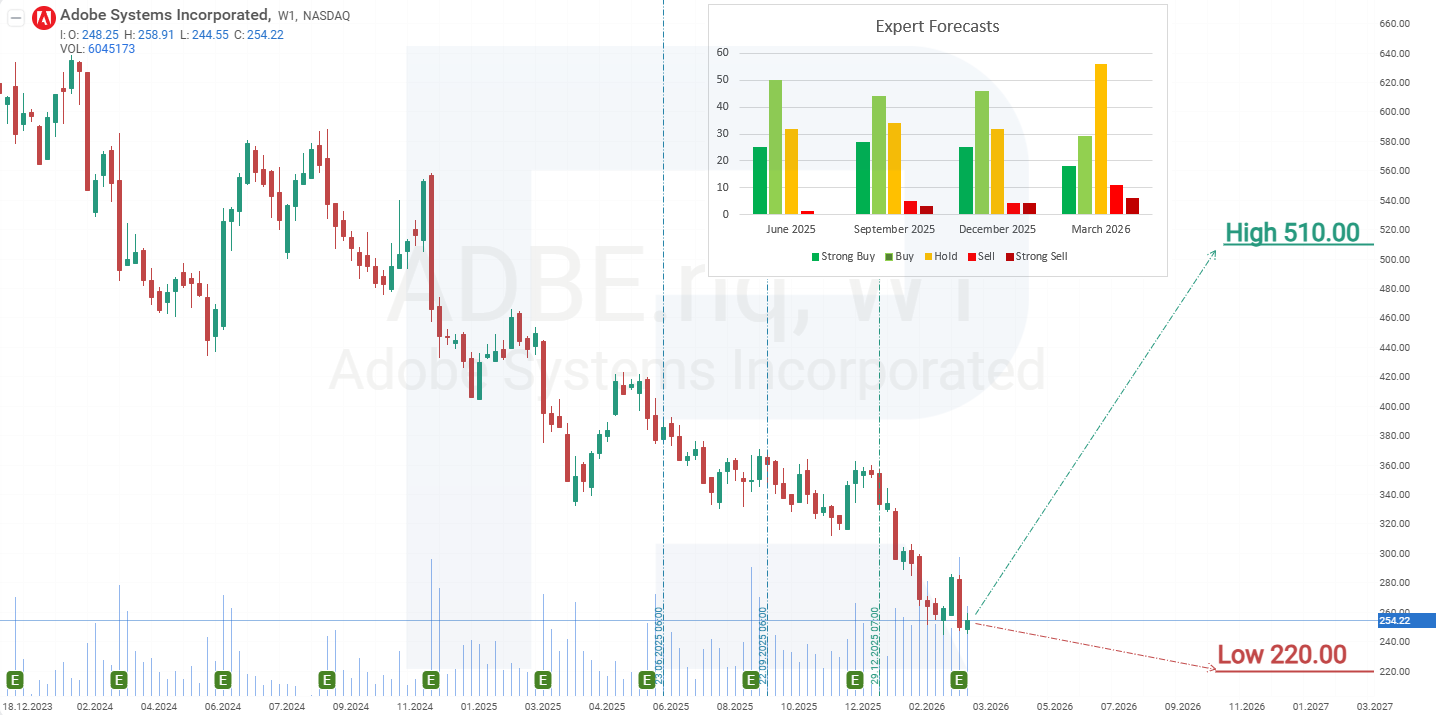
- Barchart: 15 out of 37 analysts rated Adobe shares as Strong Buy, 2 as Moderate Buy, 16 as Hold, and 4 as Strong Sell. The upper price target is 510 USD, and the lower bound is 220 USD.
- MarketBeat: 11 out of 29 analysts assigned a Buy rating, 13 recommended Hold, and 5 recommended Sell. The upper price target is 475 USD, and the lower bound is 220 USD.
- TipRanks: 9 out of 25 analysts rated the shares as Buy, 13 as Hold, and 3 as Sell. The upper price target is 460 USD, and the lower bound is 220 USD.
- Stock Analysis: 3 out of 27 experts rated Adobe shares as Strong Buy, 7 as Buy, 14 as Hold, 1 as Sell, and 2 as Strong Sell. The upper price target is 500 USD, and the lower bound is 220 USD.
Adobe Inc. stock price forecast for 2026
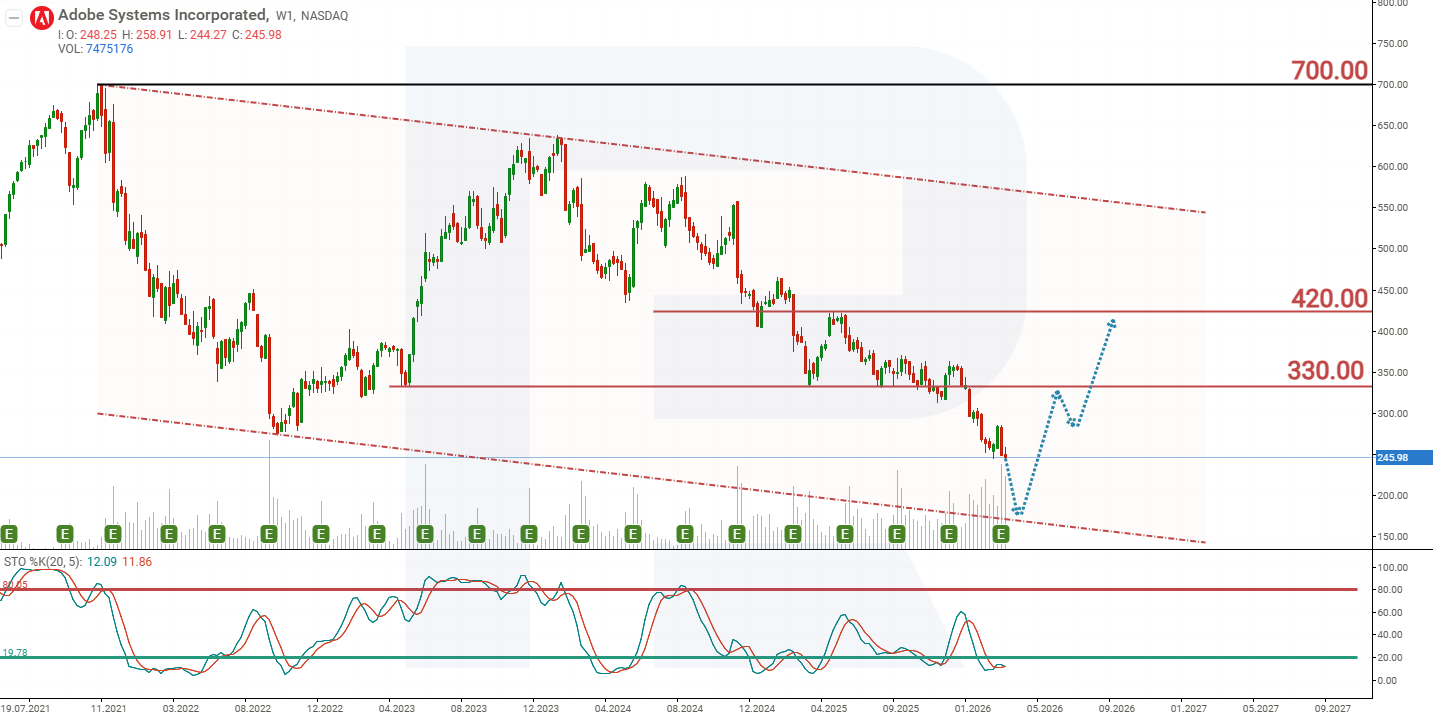
On the weekly timeframe, Adobe shares continue to trade within a descending channel. Despite a strong Q1 2026 report and a moderate valuation, investors remain concerned that developments in AI could erode Adobe’s market share, potentially weighing on future revenue and profits.
Against this backdrop, market participants are reducing positions in the stock; however, a Short Float of 3.50% indicates relatively few investors are betting on a further decline. This suggests that most investors are taking a wait-and-see approach. The market needs reassurance that AI developments do not pose a threat to the company’s business.
Chart-wise, ADBE is approaching the lower boundary of the channel around 150 USD, which serves as support. Additionally, the Stochastic indicator is in oversold territory, suggesting that the downtrend may be nearing completion and a potential price rebound could be imminent. Based on the current dynamics of Adobe shares, the potential price scenarios for 2026 are as follows:
The primary forecast for Adobe stock anticipates a test of support at 170 USD, followed by a rebound towards resistance at 330 USD. A break above this level could act as a catalyst for further upside, potentially driving ADBE shares to 420 USD.
Risks of investing in Adobe Inc. stock
Investing in Adobe stock involves several risks that may negatively impact the company’s profitability, revenue, and investor returns:
- Macroeconomic factors: Adobe’s performance is influenced by the broader global economy. Economic downturns and geopolitical events may adversely affect the company’s financial position.
- Competitive environment: the emergence of new competitors, including affordable AI models from startups such as DeepSeek, threatens Adobe’s market share. Intensified competition may exert pricing pressure and reduce profitability.
- Market volatility: Adobe’s financial performance is subject to market fluctuations and other macroeconomic factors. Investors should consider diversifying their portfolio to mitigate the risks associated with investing in the company’s shares.
Forecasts presented in this section only reflect the author’s private opinion and should not be considered as guidance for trading. RoboForex bears no responsibility for trading results based on trading recommendations described in these analytical reviews.