Meta Goes on Trial in California. How to Trade META Shares Toward 440 USD

Meta is under pressure from a major court case in California. If the outcome touches the algorithms and the advertising model behind Facebook and Instagram, META shares have room to slide toward 440 USD. Below is the trade setup, the levels that confirm it, and the metrics that will show whether the pressure is reaching the business.
In Brief
- Meta faces a large-scale legal risk over claims about the effect of Facebook and Instagram on children.
- Restrictions on algorithms and teen features would cut engagement, and engagement is what generates ad impressions.
- Financial results are still strong, so the first warning will come from advertising metrics rather than from headlines.
- The Bayer case shows that mass litigation can weigh on a valuation for years while the core business keeps working.
- Analysts hold a Strong Buy consensus, which leaves target prices exposed to downward revision if the case goes badly.
- A break of support at 520 USD opens the path toward 485 USD and then 440 USD.
- A settlement that leaves the algorithms and the ad model intact is the scenario that invalidates the short idea.
Trade Idea Parameters
Below are the specific parameters for the Meta Platforms Inc trade idea. The ticker for trading via RoboForex MobileTrader and MT5 on RoboForex is META.
| Parameter | Value |
|---|---|
| Instrument | Meta Platforms Inc (NASDAQ: META) |
| Ticker in MobileTrader / MT5 | META |
| Idea Date | August 18, 2026 |
| Time Horizon | 1–3 months |
| Direction | ↓ Sell (Short) |
| Entry Level (trigger) | 560 USD |
| Take Profit | 440 USD |
| Stop Loss | 602 USD |
| Risk per Trade | No more than 3% of account · Medium risk |
Instant Access to Global Markets with RoboForex MobileTrader
The Lawsuit Against Meta Puts the Advertising Model in Play
Meta is facing one of the most serious legal risks of recent years. A trial is opening in California in which the company stands accused of deliberately designing Facebook and Instagram to keep children and teenagers on the platforms for as long as possible, using techniques capable of forming dependency, and of collecting data from minors without proper parental consent.
If the court finds those claims justified, the engagement methods that the advertising business is built on come under direct threat. Feature restrictions, new protection requirements for minors, fines, and rising legal costs would all raise expenses and slow down the monetisation of the audience, which eventually shows up in the financial results.
What the States Are Actually Demanding from Meta
This case is far larger than an ordinary private lawsuit. It grew out of a 2023 filing by a coalition of attorneys general from 29 US states. In the current proceedings in Oakland, the court is examining safety claims brought by California, Colorado, Kentucky, and New Jersey against Facebook and Instagram, together with charges common to all 29 states over the unlawful collection and use of children's data. The remaining states are due to present their claims later.
The central allegation is that Meta knowingly designed Facebook and Instagram so that children and teenagers would spend as much time in the apps as possible. The plaintiffs point to the infinite feed, notifications, algorithmic recommendations, and other mechanisms that encourage users to keep coming back. Meta rejects the accusations.
A separate part of the case concerns children under 13. The attorneys general argue that Meta regularly collected and used their personal data without the required parental consent, in violation of federal child privacy law. This block unites the claims of all 29 states and materially raises the potential scale of the company's liability.
The states want the operating principle of Facebook and Instagram changed. The demands include stricter age limits, removal of the infinite feed and part of the notification system for minors, caps on time spent in the apps, and a redesign of the algorithms so that they prioritise user wellbeing over maximum engagement. The plaintiffs also want the algorithms and AI models built using children's data to be deleted.
The financial scale remains undefined. The attorneys general have not publicly named a final figure, although Meta itself has warned that potential losses in the worst case could reach 1.4 trillion USD. That is the company's own estimate rather than a penalty already presented to the court. The trial is scheduled to run for seven weeks, with Mark Zuckerberg and Instagram head Adam Mosseri among the expected witnesses.
Global Rules for Social Media Keep Tightening
Meta's problem stretches well beyond a single US court case. Governments around the world are limiting access for children and teenagers to social media and shifting responsibility for the consequences onto the platforms themselves.
Australia offers the toughest example, with restrictions in force for users under 16. Meta now has to identify underage users, remove those accounts, strengthen age verification, and prove to the regulator that it genuinely complies with the law.
The United Kingdom has chosen a different model. Social networks are required to limit children's access to harmful content, introduce age verification, and change how their services work when existing algorithms create elevated risks for minors.
In France, an attempt to ban social media for children under 15 ran into legal obstacles over freedom of expression and privacy. Even that case points in the same direction. The debate has moved on from whether social media should be regulated to how strict the limits should be.
For Meta this is an uncomfortable shift. Facebook and Instagram earn more when a user stays inside the app longer, interacts with content more often, and sees more advertising. Limits on the infinite feed, recommendations, notifications, personalisation, and access for minors strike at the base of that model. If similar requirements spread to the largest markets, Meta will have to choose between complying with new rules and preserving current engagement levels. Either path carries a cost through higher expenses, less time spent in the apps, and pressure on advertising revenue.
Which Metrics Will Show Pressure on Meta’s Business First
So far, legal and regulatory risks barely register in Meta's financial results. Once restrictions for children and teenagers start to change user behaviour, the effect should appear in several key metrics.
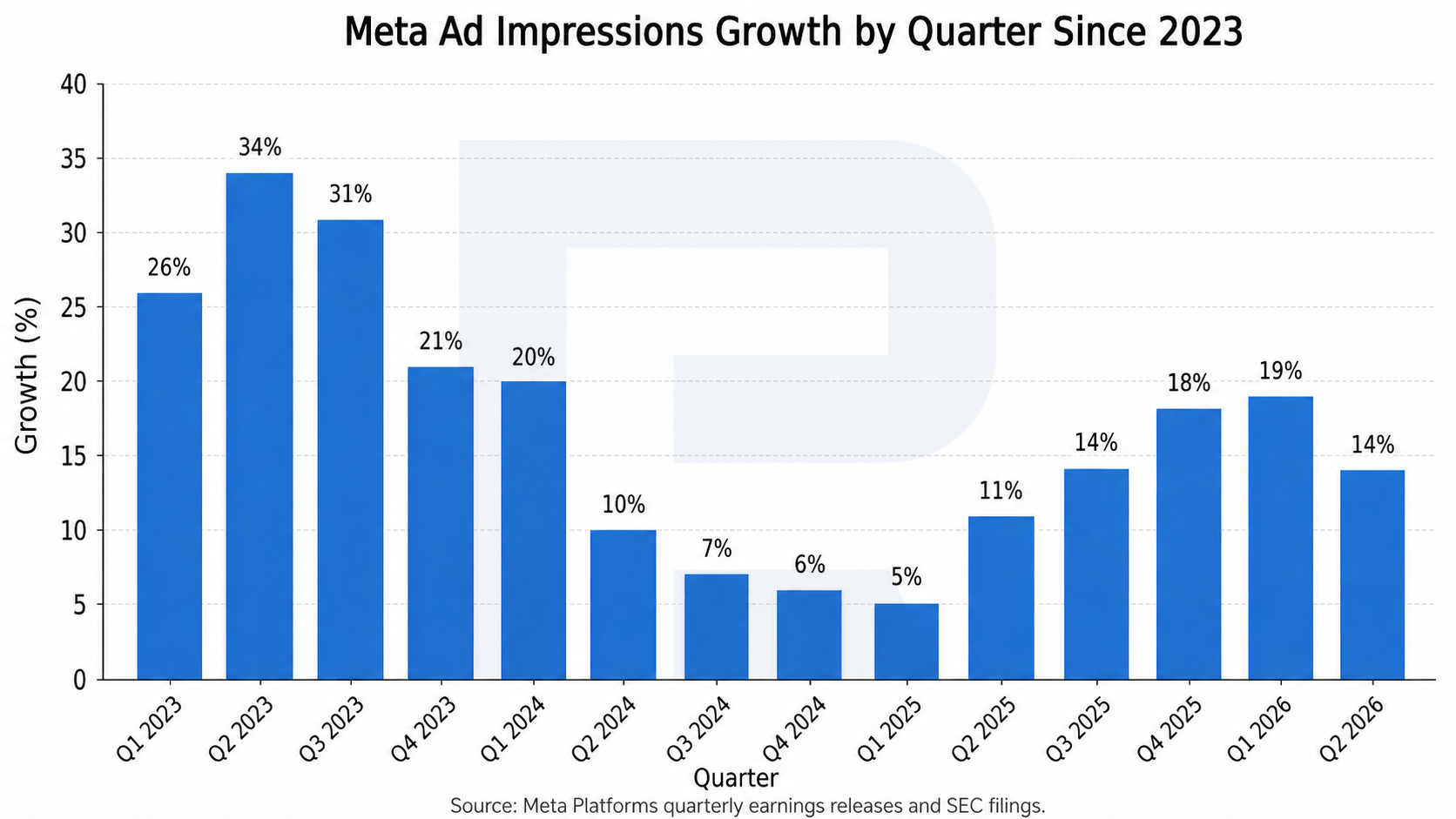
Growth in ad impressions. In Q2 2026 this metric rose by 14% year on year. It is one of the most important indicators for Meta, because the number of impressions depends on audience engagement and time spent in the apps. A sharp slowdown here would be the first sign that restrictions are starting to weigh on how Facebook and Instagram are used.
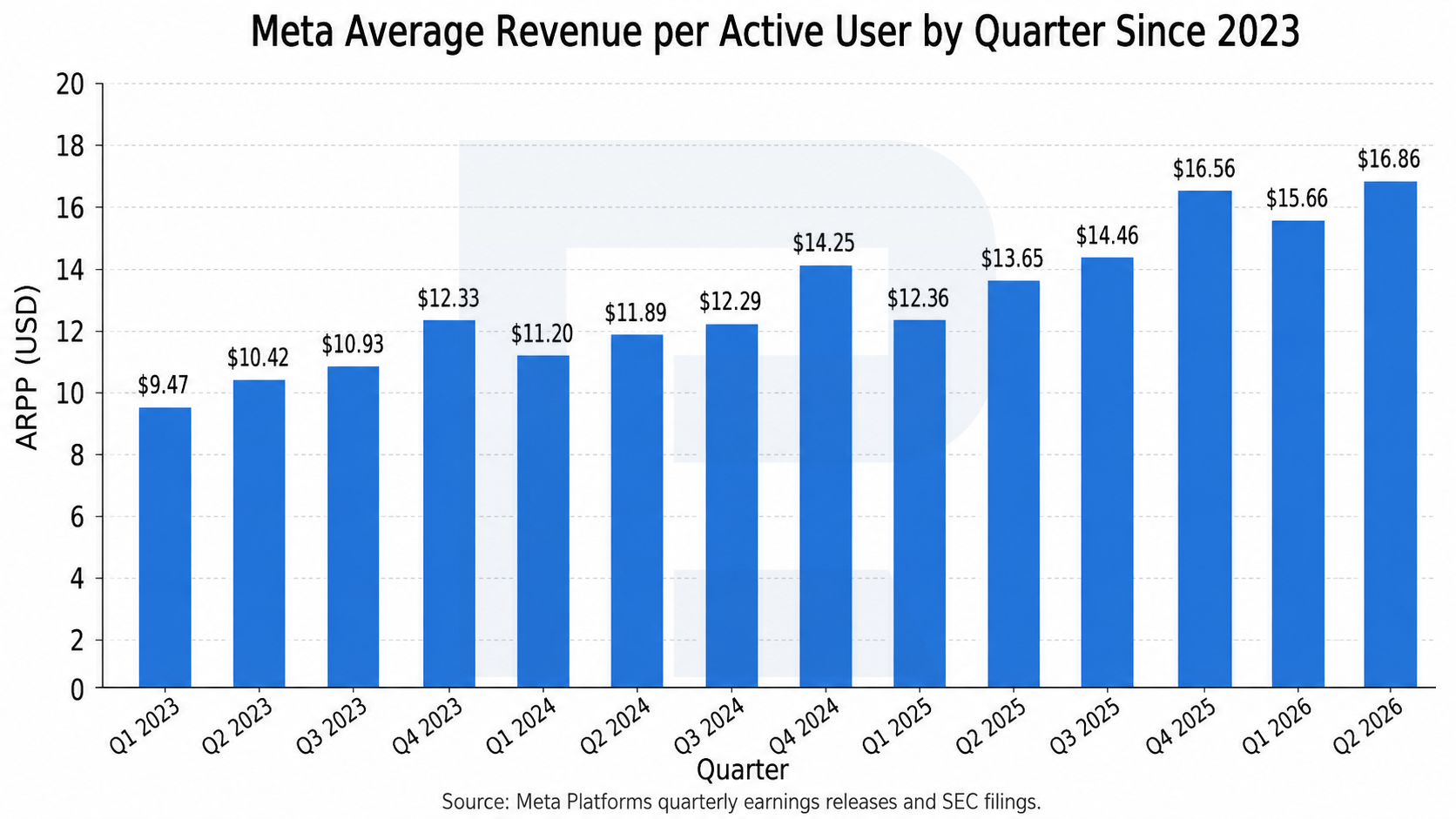
ARPP, the average revenue per person. In Q2 2026 it rose by 24% to 16.86 USD. If Meta is forced to reduce the ad load, limit personalisation, or change how the algorithms work for minors, ARPP growth is likely to slow.
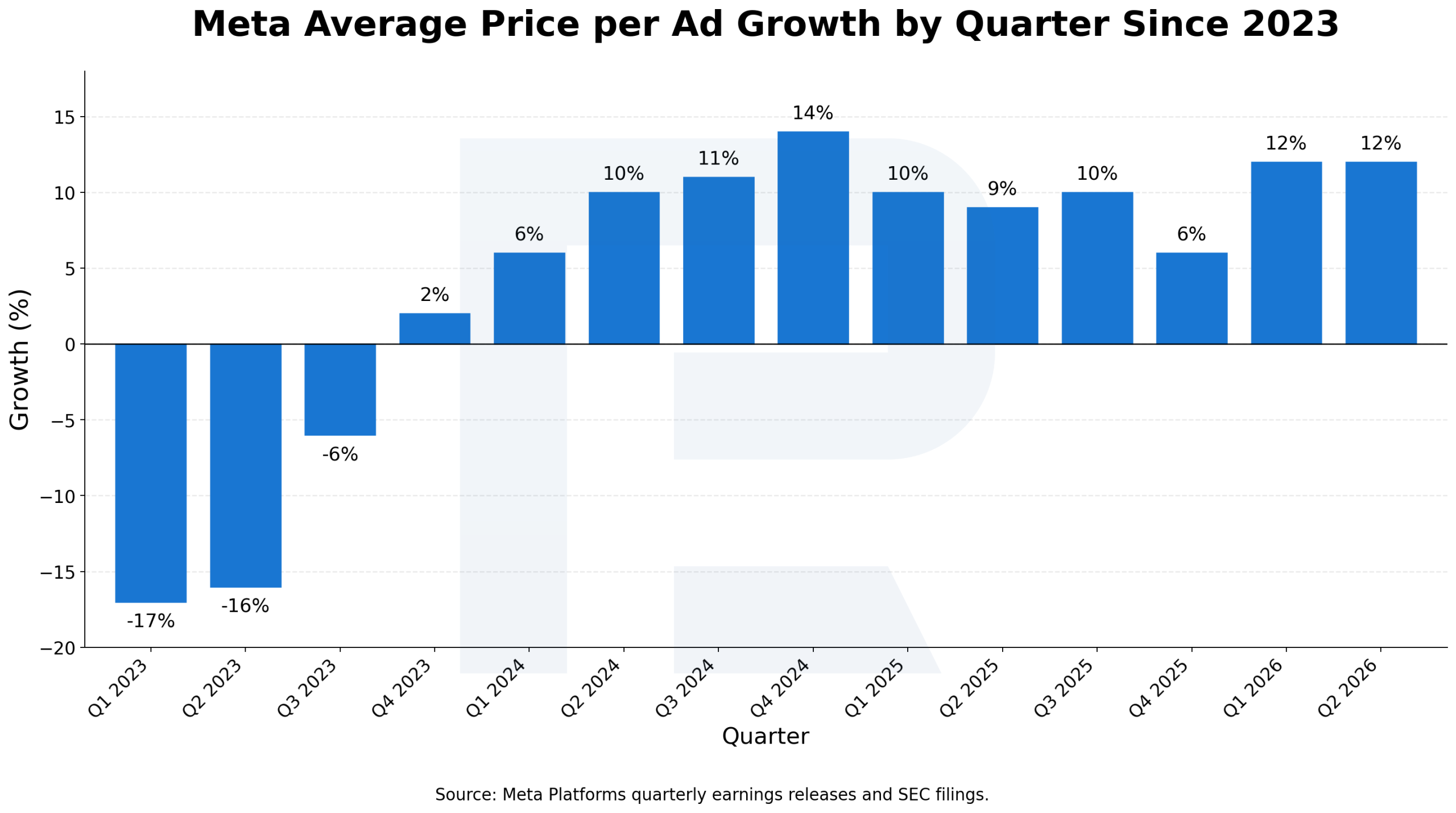
Average price per ad. In Q2 2026 it grew by 12% year on year. Rising ad prices can offset a decline in impressions and keep revenue supported. The dangerous situation is one where impressions and ad prices start slowing at the same time.
The main warning signal would be a consistent deterioration across several metrics at once: slower growth in ad impressions, followed by ARPP and the average price per ad. That combination would mean regulatory pressure has moved past the legal stage and started hitting the advertising model directly.
The Bayer Case Shows How Litigation Erodes a Valuation
Bayer Ag went through a similar scenario after buying Monsanto. In August 2018, a court ordered Monsanto to pay 289 million USD in the first major case linking the Roundup herbicide to cancer. For Bayer, the amount itself was manageable. The problem lay elsewhere: investors immediately understood that thousands of similar claims could follow that single ruling.
The market reacted instantly. Bayer shares dropped 14% in one session, and the company's market value shrank by more than 14 billion USD. Investors wrote off many times more in price than the fine itself, pricing in future payouts, legal costs, provisions, and the risk that Roundup would turn from an isolated case into a systemic crisis.
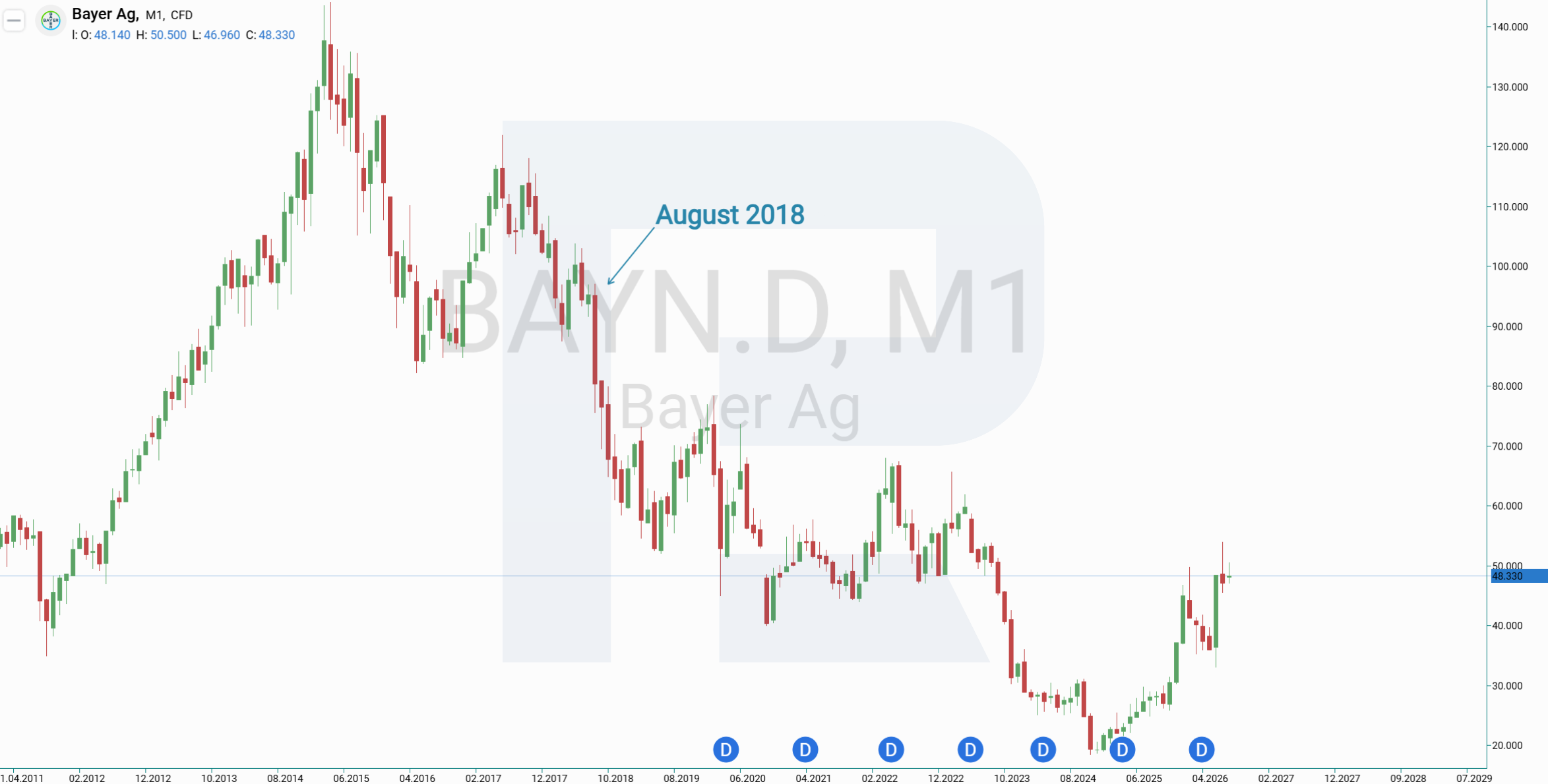
That is exactly what followed. Bayer faced new multi-billion verdicts, tens of thousands of claims, and years of pressure on its shares. From the moment of the Monsanto purchase, the stock lost around 70% at one point. The core business kept operating while legal uncertainty destroyed part of the market value year after year.
The risk logic for Meta looks very similar. If US courts begin treating harm from social media to children as a systemic problem, the market will not wait for a final verdict in every case. Investors can start lowering their valuation of META in advance, pricing in new claims, fines, restrictions on Instagram and Facebook, higher safety spending, and tougher requirements for handling data on minors.
Open a Trading Account at RoboForex
Swap-free accounts, spreads from 0, and execution in 0.01 seconds.
Analyst Ratings for META Stock
As of August 2026, Barchart analyst ratings for Meta Platforms Inc show a consensus in favour of active buying: 47 out of 55 tracked analysts rate META as a Buy and 8 as a Hold. Not a single analyst currently recommends selling the stock.
Buy — 47
Hold — 8
Sell — 0
47 out of 55
recommend Buy (85%)
Hold
8 (15%)
Sell
0 (0%)
Average Target Price
750.37 USD
Maximum Target
1,000.00 USD
The average target price stands at 750.37 USD, the maximum reaches 1,000 USD, and the minimum sits at 580 USD. With the stock trading around 569 USD, the average target implies upside of roughly 32%. Those forecasts still give little weight to the court case over the effect of Facebook and Instagram on children. If the case produces restrictions on algorithms, engagement, and ad monetisation on top of fines, analysts will have to revise their numbers downward. The strong Buy consensus looks convincing today, and that is precisely what makes a repricing of META shares more likely once the legal risk is factored in.
META Stock: Technical Picture
META shares fell 3.5% after the news broke. That is a modest move compared with what happened to Bayer, and the decline is continuing. On the daily timeframe the price trades below the 200-period Moving Average, which points to a prevailing downtrend. The 20- and 50-period Moving Averages have crossed downward, reinforcing the probability of further weakness. The Stochastic indicator sits in neutral territory and gives no oversold reading, so there is still room for the decline to extend.
Based on the current technical picture, the trade idea on META shares involves selling at the market price around 560 USD. The first target is support at 485 USD. A Stop Loss can be placed above the 50-period Moving Average at 602 USD.
The weekly timeframe looks more concerning. META has broken the ascending trendline, then retested it from the underside and turned lower. That behaviour points to the end of the uptrend and raises the probability of a downtrend forming. A break of support at 520 USD would be additional confirmation of this scenario. In that case the first downside target remains 485 USD, followed by the lower boundary of the channel around 440 USD.
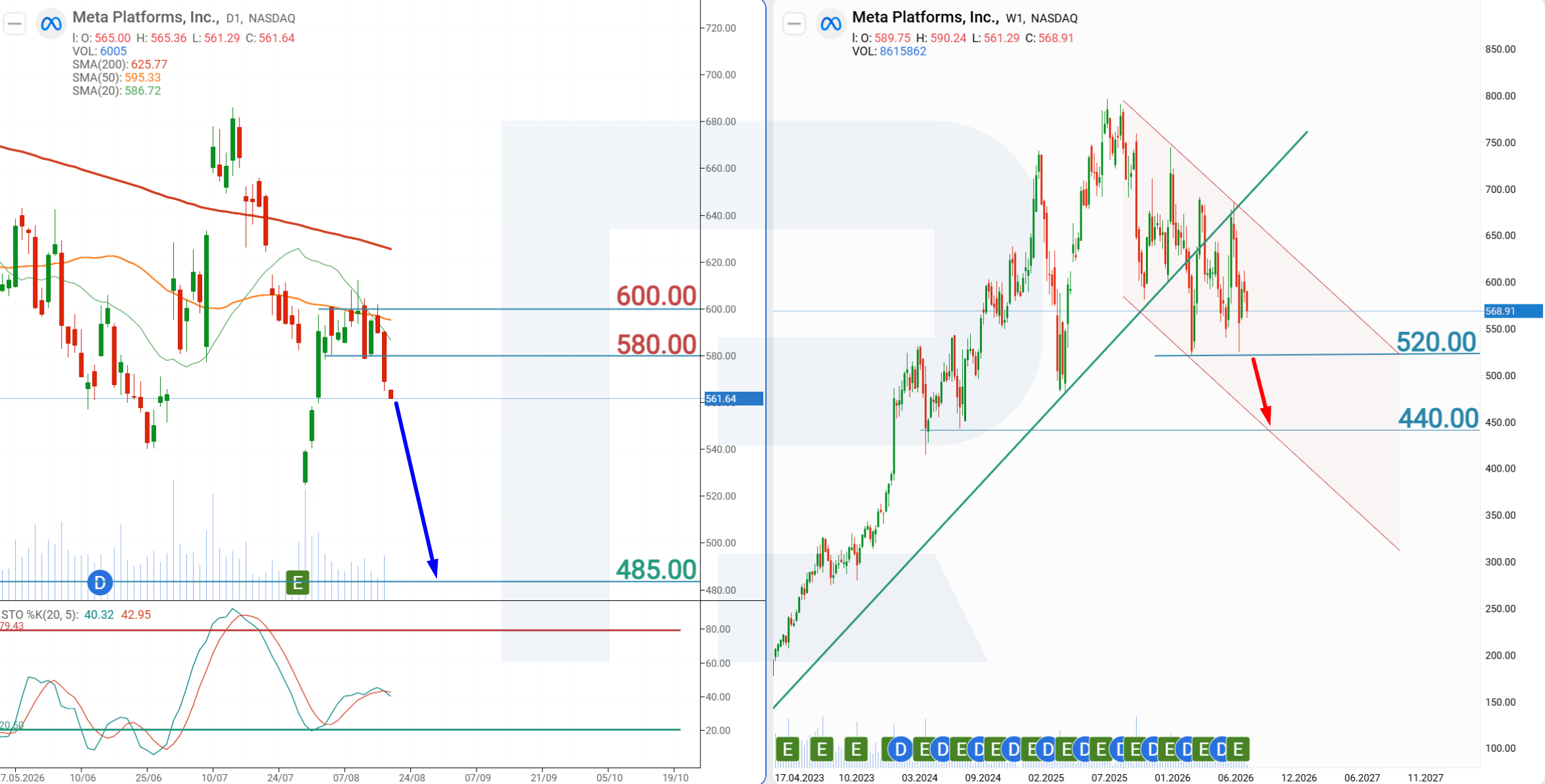
- The 200-day Moving Average (MA200) sits above the price, which points to a prevailing downtrend.
- The ascending trendline has been broken, signalling scope for further declines.
- A break of support at 520 USD will strengthen bearish sentiment in META shares.
- The trade idea is to sell the stock at the market price around 560 USD.
- Downside targets sit at 485 USD and 440 USD.
Position management rule. Once the price has travelled 8% in the direction of the forecast, the Stop Loss is moved to the entry level. The protective order is then trailed behind the price at a distance of 8%.
Sample Trading Strategy for META Shares
Below is a sample trading strategy for META shares. This example is for educational purposes only and does not constitute investment advice. Investors should assess their own risk tolerance independently.
| Parameter | Value |
|---|---|
| Entry Point | Sell at market around 560 USD |
| Take Profit | Lower channel boundary at 440 USD |
| Stop Loss | 602 USD, above the 50-period Moving Average |
| Risk / Reward Ratio | 1 : 2.9, potential profit is roughly 2.9× the risk |
| Position Size | No more than 3% of account |
Sample Calculation for 10 META Shares
| Scenario | Calculation | Result |
|---|---|---|
| Sell 10 shares at 560 USD | 10 × 560 USD | 5,600 USD |
| If target reached (440 USD) | (560 − 440) × 10 | +1,200 USD (+21.4%) |
| If stop triggered (602 USD) | (602 − 560) × 10 | −420 USD (−7.5%) |
| Risk / Reward | 420 / 1,200 | 1 : 2.9 |
A risk/reward ratio of 1:2.9 sits comfortably in the acceptable range for position trading. Keep in mind that markets are volatile: META shares can move both for and against an open position.
Trade with RoboForex MobileTrader
Live charts, deposits and withdrawals, analytics and copy trading, all in one app.
What a Favourable Scenario for Meta Looks Like
There is a softer path for events to take. Meta could negotiate a large yet manageable settlement. The company would pay a fine, agree to additional safety measures, strengthen parental controls, and introduce new limits for minors, while avoiding radical intervention in the algorithms and the advertising model.
Facebook went through a similar sequence in 2019 after the Cambridge Analytica scandal. The company agreed to pay a 5 billion USD fine to the US Federal Trade Commission. The sum was a record at the time, and Facebook shares still rose on news of the deal, because the market treated the settlement as the removal of part of the uncertainty.
For Meta today, the favourable scenario would look roughly like this:
- The fine turns out to be large without being destructive.
- The court stops short of demanding a full redesign of the algorithms.
- The company keeps the ability to monetise Instagram and Facebook.
- New rules for children prove painful yet manageable.
The key condition is that Meta avoids a situation where the court or regulators start changing the structure of the product itself. If the restrictions cover only child safety and reporting, the company can absorb them. If they reach the algorithms, engagement, and data, the risk to the valuation becomes far higher. That is the scenario in which this short idea stops working, and a recovery above 602 USD is the signal to step aside.
Is It Worth Selling META Shares on This News
The trial against Meta carries a considerably larger risk for the company than a routine multi-billion fine. Recommendation algorithms, ad personalisation, and user engagement mechanisms could all come under scrutiny, and those elements form the base of the advertising model behind Facebook and Instagram.
Meta's financial results remain strong for now, although the market is capable of pricing in future restrictions long before they surface in the reporting. The clearest warning would be a simultaneous slowdown in ad impressions growth, ARPP, and the average price per ad.
A break of support at 520 USD would strengthen the bearish technical picture and raise the probability of a move first toward 485 USD and then toward 440 USD. Traders who want to act on this setup can open a short position in META at market around 560 USD with a Stop Loss at 602 USD, risking no more than 3% of the account.
* The information in this article reflects the personal opinions of the authors. It should not be construed as trading advice or a call to action. The authors and RoboForex bear no responsibility for trading results based on the recommendations and reviews contained in this material. Past performance is not a guarantee of future results. Trading stocks and CFDs involves a high risk of capital loss.