What Is a Cent Account in Forex and Who Needs It?

A cent account shows your balance in cents: a 10 USD deposit appears as 1,000 US cents, so every profit and loss is 100 times smaller than on a standard account. Beginners use it to move from a demo account to real money at minimal risk, and experienced traders use it to test strategies and Expert Advisors live. At RoboForex, this is the ProCent account, opened from 10 USD or 10 EUR.
TL;DR
- Open a ProCent account from 10 USD or 10 EUR.
- Trade the same strategy you used on demo, or test an Expert Advisor with real execution.
- Move to a standard account after a stable result over a quarter or longer.
This article explains how a cent account works, what it is needed for and when to move to a standard account.
Trade on the Go With RoboForex MobileTrader
What Is a Cent Account?
A cent account in Forex is a trading account provided by the broker; the balance is measured in the base currency (US Cent, EU Cent, etc.) denominated 100 times. Trading conditions on cent accounts are almost the same as on real ones. You only need to deposit it for 10 USD to get a 1,000 US Cent deposit.
The Cent account type is widely used for market beginners and those traders who practice or want to test a certain strategy in real market conditions with smallest expenses.
A cent account is always a transition point between a demo account and a classic one, the first step to real trading with a decreased risk. If, for example, a trader wants to work with a capital of 10,000 USD, they only need 100 USD to open a 10,000 US Cent account.
What Are Cent Accounts Used For?
Whether one needs a cent account or not, this is always for each trader to decide. One trader needs it to practise with real money at minimal risk, another to test a new strategy or robot. Let us focus on the main reasons for using cent accounts.
A cent account, also called a micro account, solves one problem: it lets you trade with real money and real order execution while the amounts stay small. The quotes, spreads and trading rules are the same as on a standard account. Only the unit changes: the balance is counted in cents, so every profit and loss is 100 times smaller in dollar terms. That makes a cent account the natural step between a demo account, where nothing is at stake, and a standard account, where every mistake costs full price. Traders use it in three situations, described below: to move from demo to live trading, to test a strategy or an Expert Advisor with real execution, and to keep experimental trades away from the main account.
Test Trading
This must be the most widespread reason for using cent accounts. Beginners practice their skills on demo accounts, but as long as money is virtual there, they leave out one of the main aspects of trading, the psychological one. Hence, for further development, they need to switch to a real account, and a cent one is a great choice. It allows getting real trading experience and check the working ability of their trading system with minimal expenses.
They can just keep in mind the capital that they plan to use in the market. For example, to check the abilities of a capital of 5,000 USD, they can open a cent account and deposit it for 50 USD to get a 5,000 US Cent capital. As a result, the trader can fully test their strategy on this deposit, risking 50 USD at worst. However, their profit will also be in cents, not in dollars.
In such cases, the trader’s task is not to make a large profit but to train their skills and develop psychological stability. After the trader makes sure their trading is stable (they get a positive result over a reporting period: quarter, semester, year), they may switch to a real trading account.
Psychological Vent
Another reason for using cent accounts is making emotional trades that go counter your trading rules. For example, you see on the chart that after some important fundamental news there is a strong active movement. You are sure that a mighty impulse will follow but your trading system does not give any signals in this direction. You want to open a position but this is against your rules, right?
You can use a cent account as a vent for your emotions. Put your hands off your main account, there you need to stick to your rules while opening all emotional positions on your cent one. This will satisfy your craving and keep your money safe.
If your “emotional” trading ideas are correct, you will make a small profit; if not (which is more probable), you will lose just a bit. As they say, all the wolves are fed and the sheep are safe.
Open a ProCent Account From 10 USD
Trade real money at cent size on MetaTrader 4 and MetaTrader 5.
Testing and Using Advisors
Among traders, special trading algorithms called expert advisors are rather popular. They allow making your work automatic and decreasing your time at the terminal. But before entrusting your trade to an expert advisor, you need to test it in real conditions with minimal risks. For this, you can use a cent account and make sure the robot brings you a profit and has no bugs.
Another option is trading directly on cent accounts with expert advisors that open a lot of orders simultaneously and allowing for deep drawdowns. These can be Martingale, Averaging, other "order grid" variants. These are risky trading systems that need sustainability, provided by the size of your capital.
Instead of a standard account with 5,000 USD or 10,000 USD on it, risk your cent account, so that you potentially lose 100 times less.
Cent Account vs Standard Account
The table compares the RoboForex ProCent account with the Pro account, its standard counterpart, on the points that matter for a first live trade.
| Parameter | Cent account, ProCent | Standard account, Pro |
|---|---|---|
| Balance shown in | US or euro cents: 10 USD appears as 1,000 US cents | US dollars or euros |
| A 1-pip move on 1 lot of EUR/USD | 10 US cents, or 0.10 USD | 10 USD |
| Result of a 100-pip loss on 0.1 lot | 1 USD | 100 USD |
| Minimum order | 0.1 lot on MT4, 0.01 lot on MT5 | 0.01 lot |
| Leverage | Up to 1:2000 | Up to 1:2000 |
| Instruments | 28 currency pairs, metals, cryptocurrencies | Adds stock indices, oil and stocks |
| Who it suits | First live trades, testing strategies and Expert Advisors | Trading at full size once the strategy has proved itself |
Cent Account Specifications at RoboForex
At RoboForex the cent account is called ProCent. The cent account minimum deposit is 10 USD or 10 EUR, which gives you 1,000 cents to trade with. The main conditions are below.
| Parameter | ProCent |
|---|---|
| Minimum deposit | 10 USD or 10 EUR |
| Account currencies | USD, EUR, GOLD |
| Platforms | MetaTrader 4, MetaTrader 5 |
| Instruments | 28 currency pairs, metals, cryptocurrencies |
| Spread | Floating, from 1.3 pips |
| Execution | Market execution, no commission |
| Leverage | Up to 1:2000 |
| Order size | From 0.1 lot on MT4 and 0.01 lot on MT5, up to 1,000 lots, step 0.01 |
| Open positions | Up to 200 on MT4, up to 1,000 on MT5 |
| Stop out | 30% |
The low cent account minimum deposit is what makes it useful for a first live test: 10 USD is enough to trade the minimum size on every currency pair. Stop out at 30% means the platform starts closing positions when your equity falls to 30% of the margin they use, so keep the leverage and the number of open trades modest. Conditions change, so check the current figures on the ProCent account page before you open the account.
Where to Open a Cent Account and How to Trade?
Many brokers, including RoboForex, offer cent accounts to their clients. They can be called differently, yet they are United by the same idea: they use cents as a base currency unit.
You open it the same way as any other account: choose the currency, leverage and the trading platform.
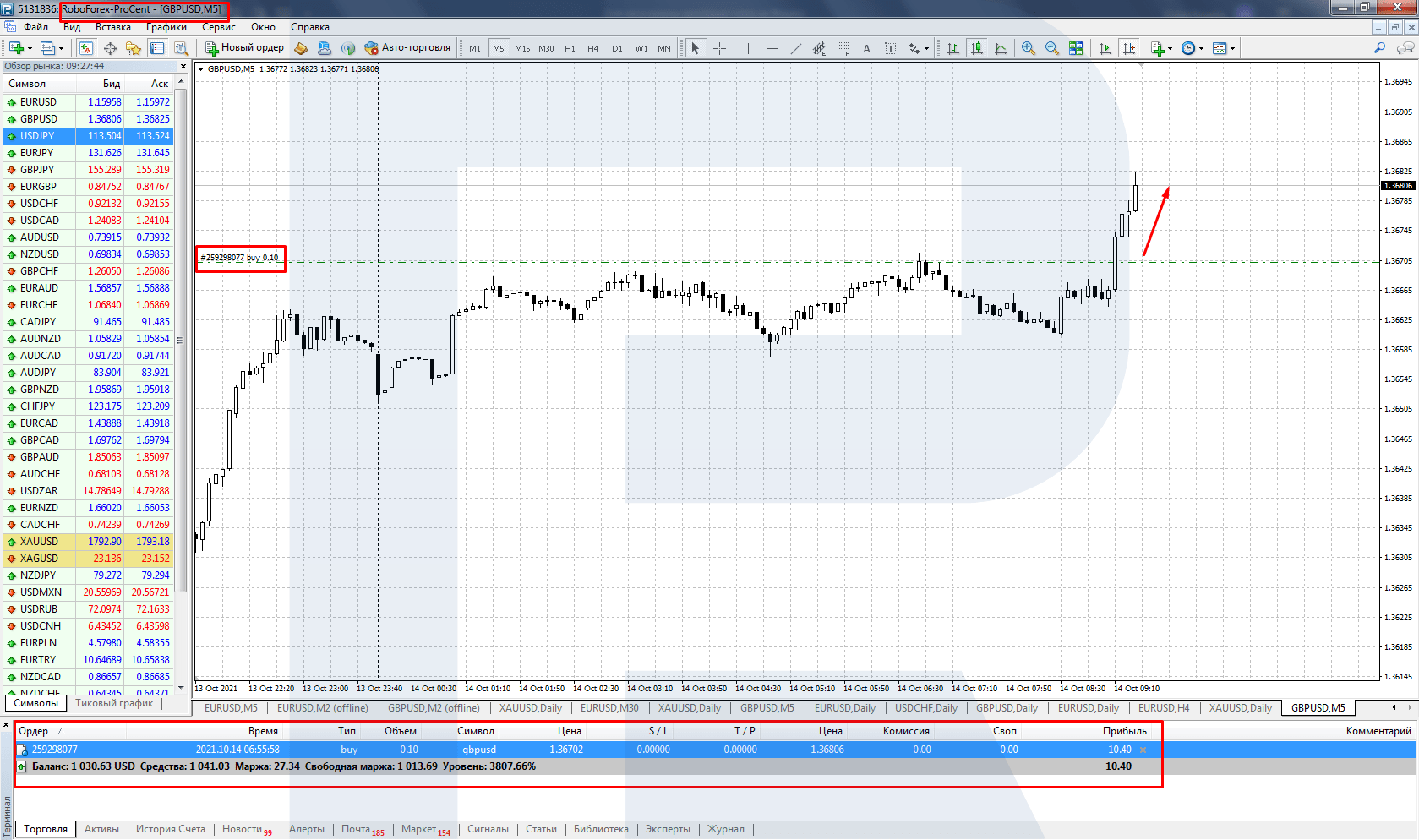
Trading on such an account is quite similar to other types of trading, only remember that 1 point, as well as your profits and losses, is 100 times smaller than on a real one. Have a look at an example:
- Open a cent account and deposit it for 10 USD, getting a 1,000 US Cent deposit;
- Open a position for 0.1 lots in GBP/USD. The price goes up for 10 points and brings you a profit of 10 US Cent.
- To see your profit in dollars, just divide the sum by 100: 10 / 100 = 0.1 USD.
- If you had opened a position for 1 lot, you would have gained 100 US Cent, which is 1 USD.
Closing Thoughts
Cent accounts are rather popular in Forex, and they deserve it. They give beginners an opportunity to check their skills in real conditions with minimal investments. They can also be used by more experienced traders to get rid of emotional strain (by making random unsystematic trades), as well as to test or use various trading advisors.
Find more about the conditions of trading on cent accounts at RoboForex on the website of the company in Cent Accounts.
FAQ
What is a cent account in forex?
A cent account is a live trading account whose balance is counted in cents instead of dollars or euros. A 10 USD deposit appears as 1,000 US cents, and every profit and loss is 100 times smaller in dollar terms than the same trade on a standard account.
What is the minimum deposit for a cent account?
At RoboForex the ProCent account opens from 10 USD or 10 EUR, which gives you 1,000 cents to trade with.
Is a cent account the same as a micro account?
The two names are often used for the same thing: an account where positions and results are 100 times smaller than on a standard account. RoboForex calls its version ProCent and describes it as a micro account.
Can I move from a cent account to a standard account?
Yes. Open a standard account alongside it, such as Pro, and start with the same strategy at a small lot size. Keep the cent account for testing new ideas and Expert Advisors before they reach the main account.
Any information provided in articles on this website is based solely on the personal opinions of the authors. These articles should not be construed as trading recommendations or a call to action. The authors and RoboForex accept no responsibility for the results of any trades made on the basis of these recommendations and reviews. Past performance is not indicative of future results. Trading stocks and CFDs involves a high risk of capital loss.