Anthropic IPO Lockup: When Insiders and Retail Buyers Can Sell, and What It Means for Day-One Buyers
The Anthropic IPO lockup decides how many shares can reach the market in the first days and weeks of trading, and that matters for anyone planning to buy ANT at the open. According to the S-1/A of 2 November, some directors, officers, employees and consultants may sell part of their shares from the first trading day, and Bloomberg reports that retail investors may receive 15 to 20% of the offering.
TL;DR
- Non-founder directors and officers, and some current and former employees and consultants, may sell up to 10% of their locked-up shares from the first day of trading.
- Retail investors may get 15 to 20% of the IPO shares, according to Bloomberg, and some of them may resell on day one.
- Other shareholder groups unlock part of their shares 27, 48, 62 and 76 days after the prospectus date.
- The price you pay matters as much as the IPO terms: buying at the open can mean paying the premium that early holders are happy to sell into.
Last updated: 10 November 2026
This post covers who can sell on the first day, how retail allocations can add supply, how a day-one premium turns into a loss for late buyers and how the staged lockup works after that. For the full picture of the IPO, see our Anthropic IPO guide.
Follow Stock Markets in RoboForex MobileTrader
Quotes, charts and orders in one app, on your phone or in Telegram.
Insiders Can Sell From the First Trading Day
The S-1/A sets a lockup for existing holders, and it opens early for one group. Non-founder directors and officers, and certain current and former employees and consultants, may sell up to 10% of their locked-up securities from the first day of trading. The figure is a share of their own holdings, and it does not cover all the company's shares. The filing adds a second step for the same group: up to a further 35% after the full-year 2026 results are published.
For new investors this means that a shortage of shares cannot be taken for granted. A sharp rise in the price can attract buyers, and it can also give current holders a convenient moment to sell.
The right to sell does not mean that employees will sell. A buyer at the open still accepts the risk that their demand lands on someone else's profit-taking.
Retail Allocation Can Add Supply on Day One
On 28 October Bloomberg reported that Anthropic weighed giving retail investors about 15 to 20% of the shares in the IPO, with JPMorgan leading the US retail sales. This is the share of the offering and not of the whole company, and the report says details could still change.
A bigger retail part widens the circle of buyers. It also creates possible supply once trading starts, because some retail participants treat an IPO as a chance to earn on the first jump and sell.
Receiving shares in an IPO does not always bar a sale on day one. Brokers set their own rules: some let clients sell at once, others may limit access to future offerings for quick resales or require a holding period. Check your broker's terms before you apply.
Some recent IPOs also gave individual investors a large share of the offering. How their shares traded after the listing is shown in the Anthropic IPO guide.
How a Day-One Premium Turns Into a Loss
The IPO price and the first price on the exchange can differ a lot. If the stock opens far above the IPO price, a buyer at the open already pays a premium for the hype.
A simple example shows how one holder's profit becomes another's loss. An investor who received shares at 100 USD and a buyer who bought at the open at 130 USD both see the stock close the day at 120 USD.
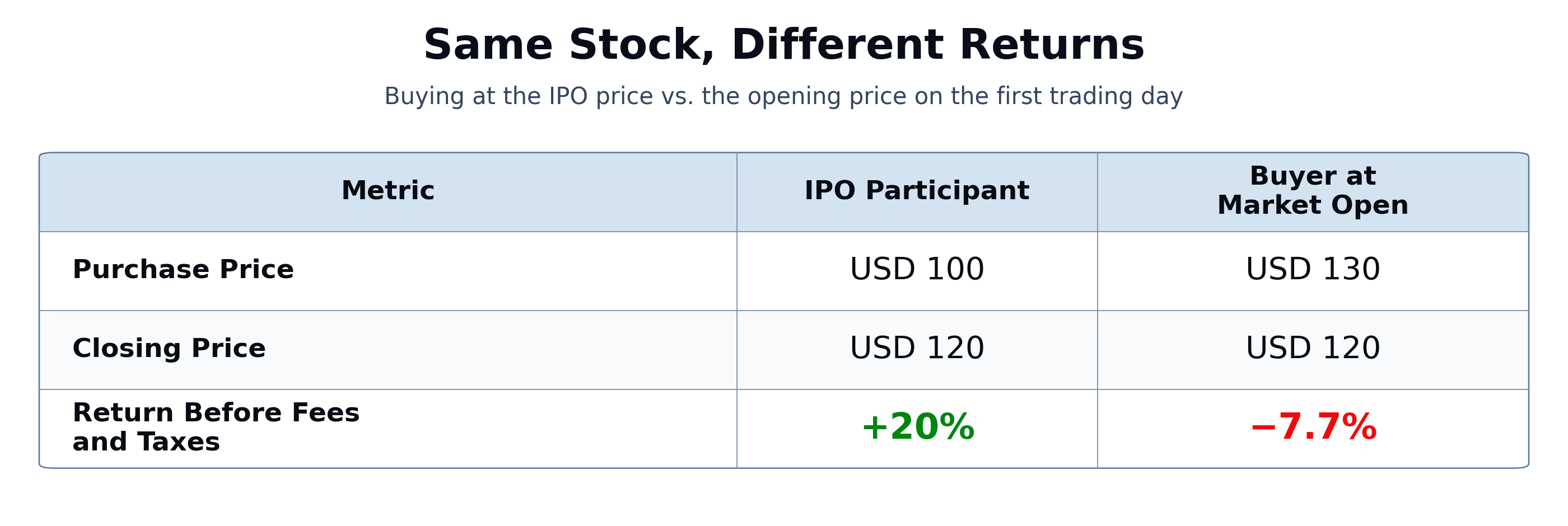
The headlines will say the stock gained 20% from the IPO price, yet the buyer at the open ends the day with a loss of 7.7%. A popular company does not protect against overpaying.
Trade Anthropic Stock on StocksTrader
ANT after the Nasdaq listing, with US stocks and ETFs on one platform at RoboForex.
Staged Unlocks Keep the Supply Risk Alive After Day One
The risk does not end with the first session. The S-1/A gives another group of shareholders staged releases: up to 6% of their locked-up securities on each of two dates, 27 and 48 days after the date of the prospectus, and up to a further 7% on each of 62 and 76 days. The days count from the prospectus date, so the first release falls a little under four weeks after the pricing, not after the first trade.
If early demand fades, these extra sales can add pressure on the price. Waiting out a weak first day does not guarantee a quick recovery, since the supply can grow in the following weeks.
Conclusion
The final IPO price will matter most to buyers of Anthropic stock. At talks of 1.2 to 1.3 trillion USD, covered in our post on the Anthropic IPO valuation, a lower price leaves more room for gains even with early insider sales and a large retail share. If current holders consider the value fair or low, they have a reason to keep their shares and wait for higher quotes. A listing near 2 trillion USD would price in far higher expectations and raise the risk of a drop when demand falls short.
The gap between the IPO price and the opening price is just as important. Even an attractive IPO valuation cannot protect a buyer who pays a large premium at the open. The chance to earn will depend on the terms of the IPO and also on the price at which an investor actually gets the shares.
FAQ
What is the Anthropic IPO lockup?
It is a period in which existing shareholders agree not to sell their shares, set out in the S-1/A of 2 November 2026. It is staged: non-founder directors, officers and some employees and consultants may sell up to 10% of their locked-up shares from the first trading day, and other holders unlock up to 6% at 27 and 48 days and up to a further 7% at 62 and 76 days after the prospectus date.
Can retail investors sell Anthropic shares on the first day?
Usually yes, because the lockup applies to existing holders and not to shares bought in the offering. Brokers set their own rules, though, and some limit access to later IPOs for quick resales or require a holding period. Check your broker's terms before you apply.
How much of the Anthropic IPO may go to retail investors?
On 28 October 2026 Bloomberg reported that Anthropic weighed about 15 to 20% of the shares in the IPO for retail investors, with JPMorgan leading US retail sales. The final size is not confirmed, and the report says details could change.
- Anthropic IPO: What the S-1 Shows and Should You Buy ANT Stock?: the listing, valuation scenarios and lessons from past IPOs.
- Anthropic IPO Valuation Slides Toward 1 Trillion USD: What Investors Want Before the Listing: why price talks fell in November.
- Is Anthropic Profitable? Why Q3 Turned Into a Loss and Where SpaceXAI Fits: what the Q3 figures show about margins.
Any forecasts contained herein are based on the author's independent analysis and reflect their personal opinion. These articles should not be construed as trading recommendations or a call to action. The authors and RoboForex accept no responsibility for the results of any trades made on the basis of these recommendations and reviews. Past performance is not indicative of future results. Trading stocks and CFDs involves a high risk of capital loss.