
EURUSD is weaker than usual: what could improve the situation
The EURUSD pair is hovering around 1.1537. The external backdrop offers some hope, but will it work? Discover more in our analysis for 9 June 2026.
EURUSD forecast: key takeaways
- The EURUSD pair has fallen noticeably, although the euro still has a chance to stabilise
- Strong data and overall demand for safe-haven assets are supporting the dollar
- EURUSD forecast for 9 June 2026: 1.1500
Fundamental analysis
The EURUSD rate is stabilising at 1.1537 on Tuesday after falling to a nine-week low. Reports of easing tensions in the Middle East put pressure on the US currency. Iran and Israel agreed to stop mutual attacks, and this reduced demand for the dollar as a safe-haven asset.
Additional positive signals came from Donald Trump’s statements that the sides are seeking an immediate ceasefire and that negotiations on settling the conflict have entered the final stage. Against this backdrop, investor interest in safe assets declined somewhat.
Nevertheless, the dollar remains near multi-month highs against the major currencies, bolstered by strong US labour market data. The May NFP report significantly exceeded market expectations and strengthened investor confidence that the Federal Reserve may consider a rate hike before the end of the year.
The market currently estimates the likelihood of a December rate hike at about 70%. This week, investors will focus on US CPI and PPI inflation data, which may adjust expectations regarding the Fed’s future actions.
The ECB meeting will become an additional factor for the currency market, with most market participants expecting a 25-basis-point rate hike. Therefore, the main focus will be on signals from the European regulator regarding the further path of monetary policy.
The EURUSD forecast is negative.
Technical outlook
The EURUSD H4 chart shows significant downward pressure persisting after a sharp breakout below the support level in the 1.1580–1.1600 area. At the end of last week, the pair generated strong downward momentum and reached new local lows in the 1.1500 area. After such a sharp decline, the market moved into a stabilisation phase and is now consolidating around 1.1535–1.1540, but there are still no signs of a full-fledged recovery.
The technical picture remains negative. The price is holding well below the middle Bollinger Band and remains in the lower part of the indicator range, confirming sellers’ advantage. The nearest resistance is located in the 1.1550–1.1570 area, while the key support level remains around 1.1500. As long as the quotes remain below the broken 1.1580–1.1600 zone, any growth attempts look more like a correction within the downward move.
Indicators are giving mixed signals. MACD remains in negative territory, suggesting continued bearish momentum, although the pace of decline is gradually slowing. The Stochastic Oscillator has risen from oversold territory and is approaching the upper part of the range, indicating the potential for a short-term rebound. Nevertheless, the baseline scenario remains consolidation below 1.1550 with the risk of a repeated test of the 1.1500 support level. If this level is broken, pressure on the euro may increase.
EURUSD overview
- Asset: EURUSD
- Timeframe: H4 (Intraday)
- Trend: downward
- Key resistance levels: 1.1570 and 1.1650
- Key support levels: 1.1500 and 1.1400
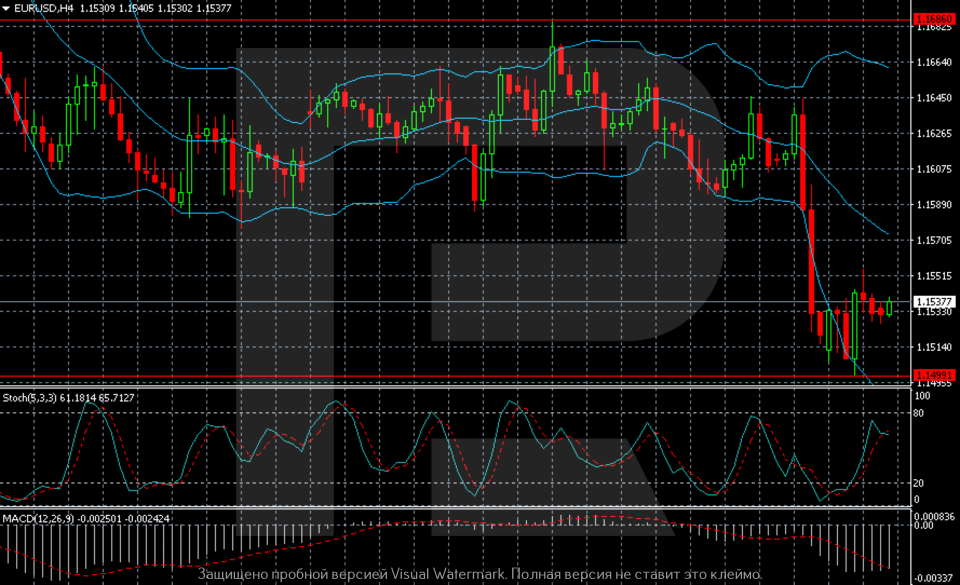
EURUSD trading scenarios for today
Main scenario (Sell Stop)
A breakout and consolidation below the 1.1500 support level would indicate continued selling pressure and create conditions for a further EURUSD decline.
- Take Profit: 1.1400
- Stop Loss: 1.1535
Alternative scenario (Buy Stop)
Consolidation above the 1.1570 resistance level would signal a corrective recovery after the recent decline and allow buyers to test the 1.1650 area.
- Take Profit: 1.1650
- Stop Loss: 1.1540
Risk factors
The main risk to the EURUSD downside scenario remains a further de-escalation of the conflict in the Middle East and lower demand for the dollar as a safe-haven asset. Soft US inflation data and hawkish signals from the ECB regarding further interest rate hikes will provide additional support for the euro.
Summary
The EURUSD pair fell to a nine-week low, but is now attempting to recoup at least some of its losses. The EURUSD forecast for today, 9 June 2026, suggests the risk of a retest of the 1.1500 level.
Editors’ picks
 EURUSD forecast 2026–2027: technical analysis, price levels & predictions
The ECB holds rates at 2.15% while the Fed stays at 3.75% — and that divergence is the central driver of EURUSD in 2026. The pair is range-bound between 1.1400 and 1.1915, with Deutsche Bank targeting 1.2500 and Morgan Stanley calling for 1.3000 by year-end. We analyse the technicals, break down the macro factors, and outline three trading scenarios with specific entry levels.
 Gold (XAUUSD) forecast 2026: predictions based on fundamental and technical analysis
Where is gold headed after pulling back from the all-time high of 5,597 USD? XAUUSD is consolidating near 4,518 USD between key levels 4,220 USD and 4,855 USD, with major banks targeting 5,243–6,200 USD by year-end. Read our comprehensive gold forecast: technical analysis across three timeframes, trading scenarios with specific entry levels, Fed policy and central bank demand outlook, and institutional predictions for 2026 and beyond.
Forecasts presented in this section only reflect the author’s private opinion and should not be considered as guidance for trading. RoboForex bears no responsibility for trading results based on trading recommendations described in these analytical reviews.