
EURUSD remains under pressure and may decline to 1.1500
Weak EU data is limiting the euro’s recovery, while the market is awaiting the Federal Reserve’s rate decision. The primary scenario suggests the EURUSD rate could fall to 1.1500. Find out more in our analysis for 16 June 2026.
EURUSD forecast: key takeaways
- A weak macroeconomic backdrop in the EU is putting pressure on the euro
- The trade balance for April came in negative
- Industrial production rose by only 0.1% month-on-month, compared to a forecast of 0.2% and the previous increase of 0.4%
- The EURUSD pair could decline to 1.1500
- EURUSD forecast for 16 June 2026: 1.1500
Fundamental analysis
The fundamental analysis for 16 June 2026 shows that the EURUSD pair remains under pressure and continues to move within a descending channel. The main reason for the euro’s weakness is the weak macroeconomic backdrop in the EU. Yesterday, the April trade balance came in negative at –1.0 billion EUR against a forecast of 7.8 billion EUR, while industrial production rose by only 0.1% month-on-month against a forecast of 0.2% and the previous increase of 0.4%. This shows that the recovery in European industry is progressing weakly and is not providing the euro with strong fundamental support.
US data also came out mixed, but it failed to weaken the dollar significantly. The NY Empire State manufacturing index fell to 5.7, below a forecast of 13.2; industrial production rose by only 0.1% month-on-month against expectations of 0.3%, and manufacturing output was unchanged after a rise of 0.7% a month earlier. At the same time, annual US industrial production growth accelerated to 1.67%, while capacity utilisation remained at 76.2%, which does not appear critical for the economy. Therefore, the market perceives the US data as moderately weak, but not as a reason for a strong dollar sell-off.
The Fed meeting tomorrow remains the main event for the EURUSD rate. The market expects the rate to remain at 3.75%, but the main focus will be on the regulator’s comments. If the Federal Reserve confirms a hawkish stance due to high inflation, the dollar may retain its advantage, and the EURUSD pair may continue to move within a descending channel. If the rhetoric proves softer than expected, the pair may attempt to break the trendline, but for now, weak EU data is limiting the euro’s recovery potential.
Technical outlook
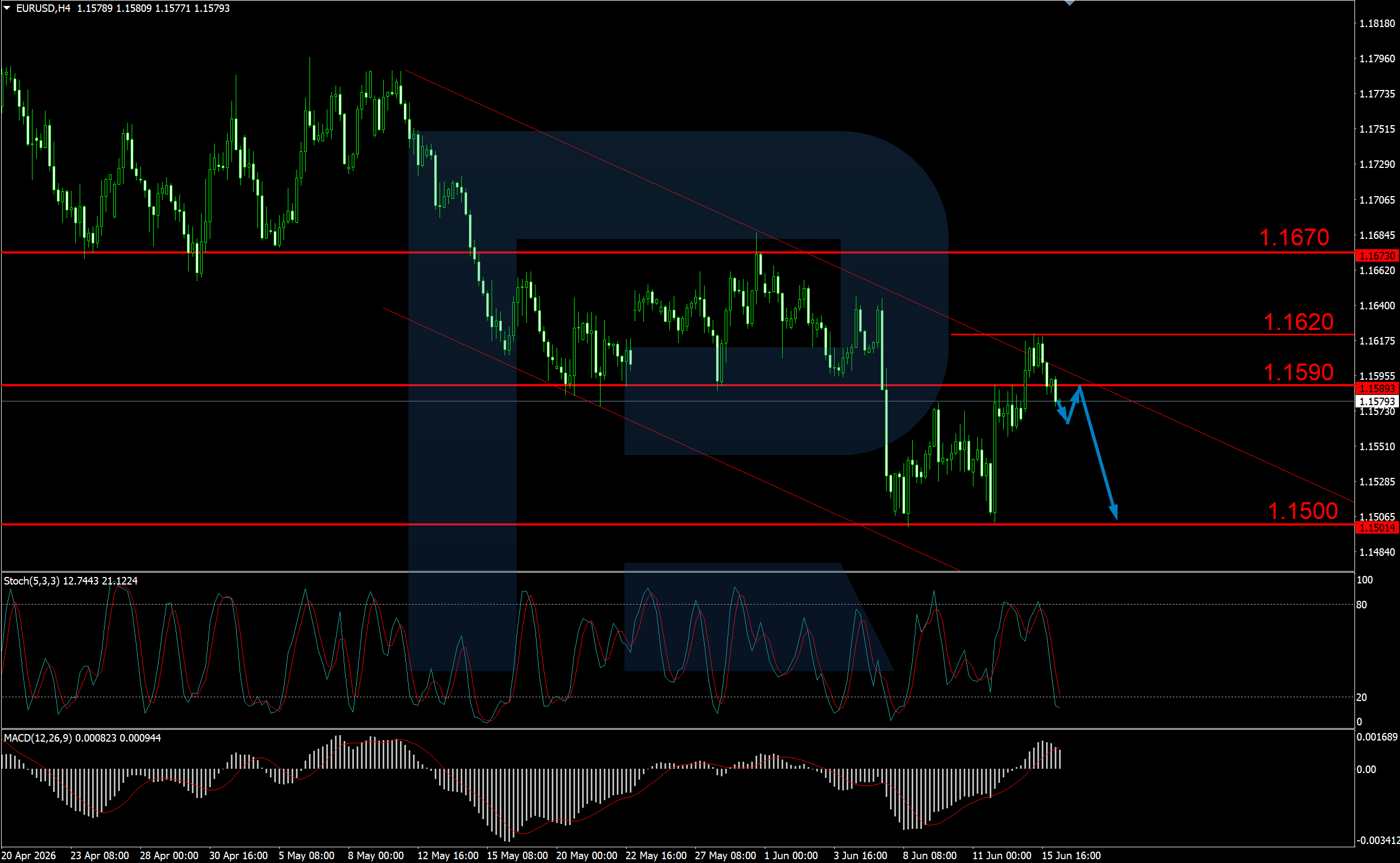
EURUSD technical analysis for 16 June shows that the pair continues to trade within a descending channel despite an improved external backdrop following the easing of tensions between the US and Iran. Against this backdrop, the EURUSD rate rose from 1.1500 to 1.1620, but this was not enough to break the descending trendline.
The MACD indicator has moved back into positive territory, signalling an attempted recovery. However, given the previous failed growth attempts, this move still looks more like a correction within the downtrend than a full-fledged market reversal.
At the same time, EURUSD quotes rebounded from the descending trendline yesterday, and today they are already breaking the 1.1590 support level, strengthening the bearish signal and increasing the probability of a further decline. At the same time, the Stochastic indicator is approaching oversold territory, so the downward momentum may weaken temporarily. In this case, after breaking below 1.1590, the pair may retest this level from below before continuing its move towards the main support level at 1.1500.
Overall, the EURUSD forecast remains moderately negative, with the primary forecast for today suggesting a decline towards the 1.1500 support level. A breakout above the 1.1620 resistance level would cancel the forecast for 16 June. In this case, the EURUSD rate can be expected to recover towards 1.1670.
EURUSD overview
- Asset: EURUSD
- Timeframe: H4 (Intraday)
- Trend: downward
- Key resistance levels: 1.1620 and 1.1670
- Key support levels: 1.1590 and 1.1500
EURUSD trading scenarios for today
Main scenario (Sell Limit)
A breakout below the 1.1590 support level, followed by a retest of this mark from below and a rebound, would strengthen bearish sentiment. As a result, EURUSD quotes may continue to decline towards support at 1.1500.
- Take Profit: 1.1500
- Stop Loss: 1.1615
Alternative scenario (Buy Stop)
A breakout above the 1.1620 resistance level would allow the pair to break out of the descending channel and continue to rise towards resistance at 1.1670
- Take Profit: 1.1670
- Stop Loss: 1.1595
Risk factors
The main risk to the EURUSD downside scenario today will be strong data from the EU, especially an improvement in the ZEW index and faster wage growth. If the statistics come in better than expected, the euro may receive support, and the pair may break out of the descending channel.
Summary
Despite growing interest in risk assets amid easing tensions in the Middle East, the EURUSD pair is still trading within a descending channel. A breakout below the 1.1590 support level, followed by a retest from below, would strengthen bearish sentiment, possibly sending the EURUSD rate down to 1.1500.
Editors’ picks
 EURUSD forecast 2026–2027: technical analysis, price levels & predictions
The ECB holds rates at 2.15% while the Fed stays at 3.75% — and that divergence is the central driver of EURUSD in 2026. The pair is range-bound between 1.1400 and 1.1915, with Deutsche Bank targeting 1.2500 and Morgan Stanley calling for 1.3000 by year-end. We analyse the technicals, break down the macro factors, and outline three trading scenarios with specific entry levels.
 Gold (XAUUSD) forecast 2026: predictions based on fundamental and technical analysis
Where is gold headed after pulling back from the all-time high of 5,597 USD? XAUUSD is consolidating near 4,518 USD between key levels 4,220 USD and 4,855 USD, with major banks targeting 5,243–6,200 USD by year-end. Read our comprehensive gold forecast: technical analysis across three timeframes, trading scenarios with specific entry levels, Fed policy and central bank demand outlook, and institutional predictions for 2026 and beyond.
Forecasts presented in this section only reflect the author’s private opinion and should not be considered as guidance for trading. RoboForex bears no responsibility for trading results based on trading recommendations described in these analytical reviews.