
EURUSD continues to decline under selling pressure
EURUSD continues to fall with a minor correction, while the global trend remains downward. The current price is 1.1482. Find out more in our analysis for 18 September 2026.
EURUSD forecast: key takeaways
- The US Federal Reserve raised the key interest rate to 4% per annum
- Market participants expect another key rate increase as early as October 2026
- EURUSD forecast for 18 September 2026: 1.1380
Fundamental analysis
The Federal Reserve's decision to raise the rate by 25 basis points to 3.75–4.00% is a negative factor for EURUSD, as it increases the attractiveness of US dollar-denominated assets. However, the regulator's updated forecast was more important than the rate hike itself. The Federal Reserve expects PCE inflation at 3.7% in 2026 and core inflation at around 3.4%, while raising its US GDP growth forecast to 2.3%. The median rate forecast is around 4.1% at the end of 2026 and 2027, 3.9% in 2028, and 3.6% in 2029. In effect, the regulator is signalling that, after another possible increase this year, a rapid shift to rate cuts is not expected.
On the other hand, pressure on the euro is partly limited by ECB policy. On 10 September, the European regulator also raised rates by 25 basis points, bringing the deposit rate to 2.50%. The ECB expects eurozone inflation at around 3.0% in 2026 and acknowledges the need to maintain sufficiently tight monetary policy. However, the gap between Federal Reserve and ECB rates remains significant.
The market has already reacted to the Federal Reserve's decision with a stronger US dollar: EURUSD fell by about 0.7% after the meeting. Part of the dollar's initial gains was subsequently reversed following declines in Treasury yields and oil prices. This suggests that a significant share of the Federal Reserve's tighter policy is already priced in.
Technical outlook
On the D1 chart, resistance is located at 1.1655, while support is at 1.1460. On the H4 chart, support nearly coincides with this level at 1.1455, while resistance has formed at 1.1545. The overall trend is downward, and the price is highly likely to continue falling. Otherwise, the price may form a sideways trend before the decline resumes.
At the same time, there remains a slight probability of an alternative scenario. A breakout above the 1.1545 resistance level would indicate weakening selling pressure. In this case, EURUSD could continue recovering towards the nearest target at 1.1595.
EURUSD overview
- Asset: EURUSD
- Timeframe: H4 (Intraday)
- Trend: bearish
- Key resistance levels: 1.1545 and 1.1655
- Key support levels: 1.1455 and 1.1460
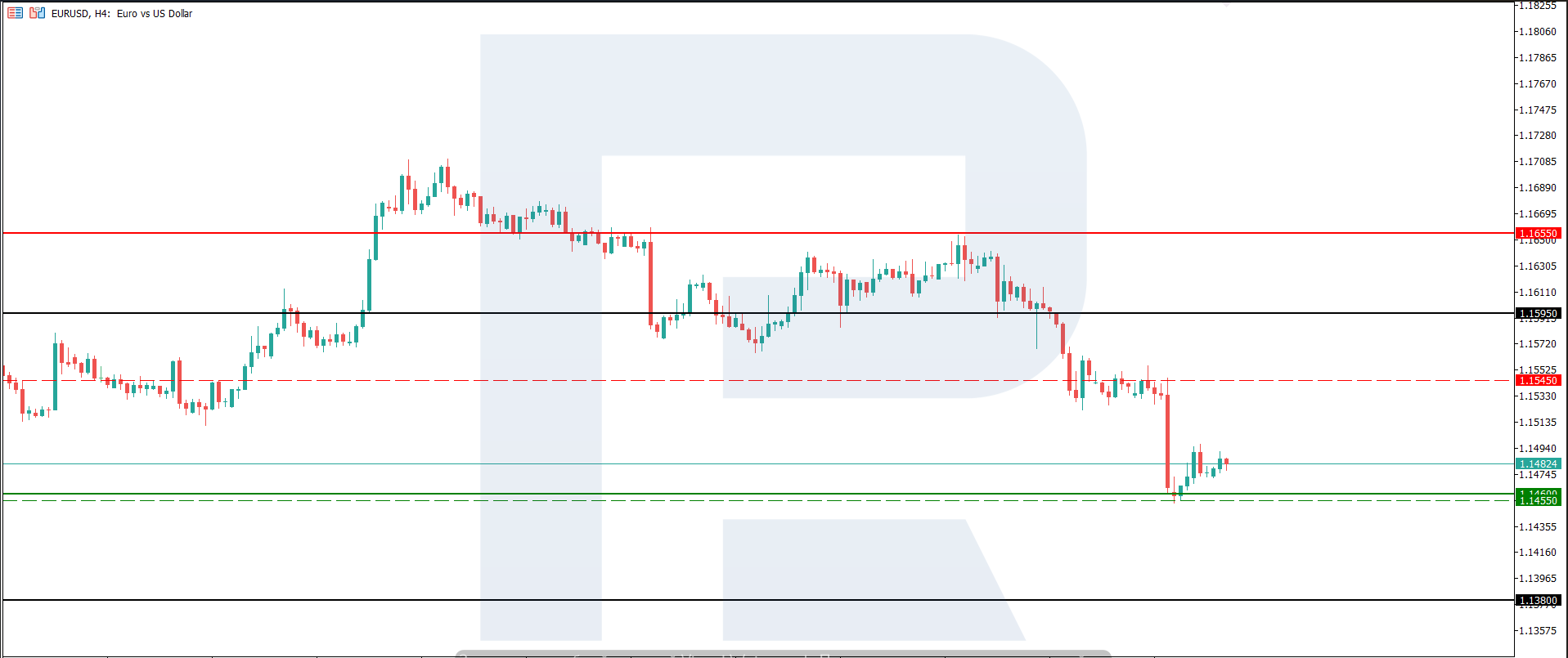
EURUSD trading scenario for today
Trading scenario (Sell Stop)
A breakout below the local support level, followed by consolidation below 1.1455, would create conditions for opening short positions and indicate a continuation of the EURUSD decline.
- Current price: 1.1482
- Entry level: 1.1455
- Take Profit: 1.1380
- Stop Loss: 1.1475
- Risk-to-reward ratio: above 1:3.4
The trade idea is valid until 08:00 AM on 21 September 2026 (server time, UTC+3).
Risk factors
The main risk factors for EURUSD remain possible deviations of actual inflation from the Federal Reserve's forecasts, changes in expectations for the future path of interest rates, and movements in US Treasury yields. More persistent inflationary pressure in the US and continued hawkish rhetoric from the Federal Reserve could strengthen the dollar and accelerate the pair's decline. Conversely, a sharp deterioration in US labour market or economic activity data could revive expectations of earlier rate cuts and support EURUSD.
Summary
The fundamental backdrop for EURUSD remains moderately negative. The Federal Reserve raised the rate to 4.00% and allows for further policy tightening. The combination of a resilient economy, elevated inflation, and the prospect of rates remaining high supports the dollar and limits EURUSD's upside potential. This scenario could weaken if US macroeconomic data deteriorate or the ECB adopts a more hawkish stance. Today's EURUSD forecast remains bearish.
Editors’ picks
 EURUSD forecast 2026–2027: technical analysis, price levels & predictions
EURUSD has recovered from the July lows and is trading near 1.1545 — back in bullish territory. The pair has reclaimed EMA65 on the daily, formed a bullish EMA crossover on H4, and the US-eurozone GDP gap has narrowed sharply (US 1.5% vs eurozone 1.0%). Goldman Sachs and Deutsche Bank both now target 1.2500 by year-end. A confirmed close above 1.1700 opens the path to 1.1805. We break down the key levels, three trading scenarios, and what the unprecedented 9-3 FOMC dissent vote means for EURUSD.
 Gold (XAUUSD) forecast 2026: technical analysis, price levels & predictions
Gold has reversed its downtrend and is trading near 4,360 USD, back above both EMA65 and EMA200. ETF flows turned positive in July with 3 billion USD of net inflows, and central banks bought 288.9 tonnes in Q2 — up 62% year-on-year. A breakout above 4,500 USD opens the path to 4,855 USD and the 5,597 USD all-time high. We break down the key levels, three trading scenarios with entry triggers, and what J.P. Morgan, Deutsche Bank and Goldman Sachs are forecasting for gold in 2026.
Forecasts presented in this section only reflect the author’s private opinion and should not be considered as guidance for trading. RoboForex bears no responsibility for trading results based on trading recommendations described in these analytical reviews.