
EURUSD weekly price forecast: the consolidation phase has dragged on
The EURUSD pair starts the week of 8–12 June around 1.1637. The US dollar is supported by uncertainty surrounding US-Iran negotiations, the resilience of the US economy, and expectations that the Federal Reserve will maintain tight policy. Robust data from the US services sector and labour market have increased the likelihood that the regulator will keep rates high for longer than previously expected.
The key events of the week will be the ECB meeting and US inflation components. Technically, the EURUSD pair remains in a broad consolidation phase within the 1.1580–1.1680 range. As long as the pair holds above the 1.1580 support level, there is still a chance of a recovery towards 1.1670–1.1740. Stronger US statistics will bring back demand for the dollar and increase pressure on the euro, with a risk of a decline towards 1.1500–1.1520.
EURUSD forecast for this week: quick overview
- Market focus: the EURUSD pair closed the week around 1.1637, with the dollar bolstered by uncertainty surrounding US-Iran negotiations, robust demand for safe-haven assets, and strong US data. The ISM services PMI rose to 54.5, the ADP report showed 122 thousand jobs were created, and US economic resilience strengthened expectations of a tight Fed stance and the likelihood of a rate hike before the end of the year
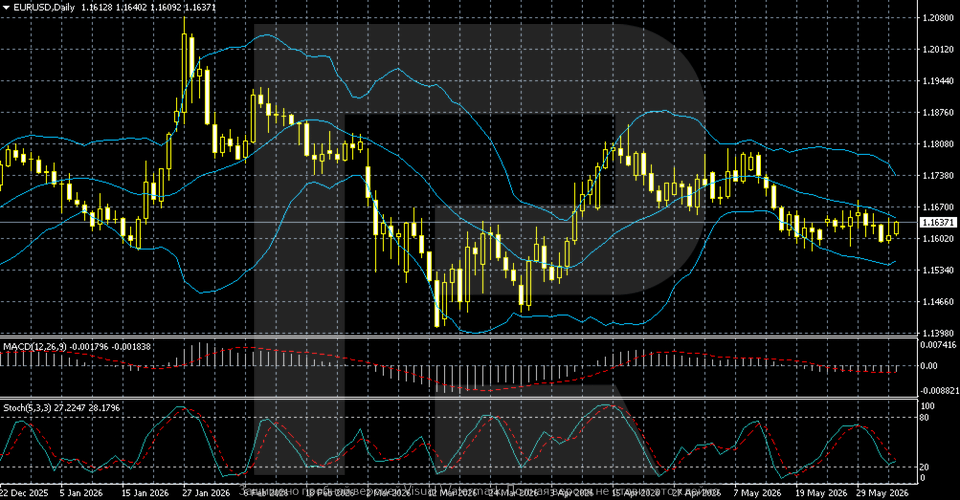
- Current trend: on the daily chart, the EURUSD pair remains in a broad consolidation phase after recovering from March lows around 1.1420. The pair is trading near the middle Bollinger Band within the 1.1580–1.1680 range. Selling pressure persists, but the downside momentum is gradually losing strength. Resistance is located around 1.1670–1.1740, with the support level near 1.1580
- Weekly outlook: the baseline scenario suggests continued consolidation within the current range. As long as the EURUSD pair holds below 1.1670–1.1740, the market remains neutral with a moderately negative bias and a risk of returning to the 1.1580 support level. A consolidation above the resistance level would enable renewed growth towards 1.1780, while a breakout below 1.1580 would open the way for a decline to the 1.1500–1.1520 area
EURUSD fundamental analysis
The EURUSD pair closed the week near 1.1637. Earlier, the US currency was supported by uncertainty in the Middle East and strong demand for safe-haven assets, but by the end of the week the story changed slightly.
Investors are closely watching negotiations between the US and Iran. Donald Trump stated that the sides are approaching the final stage of discussions and that Washington is not interested in returning to a full-scale conflict. However, Iranian officials note a lack of significant progress. Tehran-backed Hezbollah rejected the US-proposed ceasefire plan between Israel and Lebanon. This keeps a geopolitical premium in markets and drives demand for the dollar.
Additional support for the US currency came from strong macroeconomic data. The ISM services PMI rose to 54.5 in May versus 53.6 previously, confirming resilience in the largest segment of the US economy. The ADP report showed that 122 thousand jobs were created in the private sector, compared to the forecast of 118 thousand. The S&P Global composite index remained at a level consistent with economic growth.
The combination of a resilient labour market, stable business activity, and persistent inflation risks amid high energy prices has raised expectations that the Federal Reserve may keep a tight stance and even consider a rate hike before the end of the year.
EURUSD technical analysis
On the daily chart, the EURUSD pair continues to trade in a broad consolidation phase after rebounding from March lows around 1.1420. After failing to gain a foothold above 1.1780 in April, the market gradually lost upside momentum and has shifted into the 1.1580–1.1680 range in recent weeks. Quotes are currently hovering around 1.1630, almost at the middle Bollinger Band, indicating the absence of a clear trend.
The technical picture appears neutral with a moderately negative bias. The price remains below the local May highs, and each rise into the 1.1670–1.1740 area meets seller activity. At the same time, the 1.1580 support level is still holding, preventing a deeper decline. The EURUSD effectively continues to form a sideways range, awaiting a new fundamental driver.
The MACD indicator stays slightly below the zero line, suggesting a slight advantage for sellers, but the depth of negative values is gradually shrinking. This points more to a slowdown in downside pressure than to a new bearish impulse. At the same time, the Stochastic Oscillator is turning up from oversold territory, signalling a possibility of a local recovery in the coming sessions.
The baseline scenario remains consolidation between the 1.1580 support level and resistance at 1.1670–1.1740. A consolidation above the upper boundary would suggest renewed growth towards 1.1780, while a breakout below 1.1580 would increase pressure on the euro and open the way towards 1.1500–1.1520. For now, the market remains in wait-and-see mode ahead of the key US labour market data release.
EURUSD trading scenarios
The EURUSD pair closed the week around 1.1637, with uncertainty around US-Iran negotiations, strong demand for safe-haven assets, and robust US data supporting the US dollar. The ISM services PMI rose to 54.5 in May, the ADP report showed that 122 thousand jobs were created, and US economic resilience fuelled expectations of a tight Fed stance. An additional support factor for the dollar remains inflation risks amid high energy prices.
From a technical standpoint, the EURUSD pair continues to trade in a broad 1.1580–1.1680 range after recovering from March lows. The pair is near the middle Bollinger Band, indicating the absence of a clear trend. Resistance is located around 1.1670–1.1740, with the support level near 1.1580.
- Buy scenario
A consolidation above 1.1670–1.1740 would strengthen demand for the euro and open the way for a retest of the 1.1780 area.
- Sell scenario
A breakout below the 1.1580 support level would bring back pressure on the EURUSD rate and create conditions for a decline towards 1.1500–1.1520.
Conclusion: the EURUSD pair remains neutral within a sideways range, with further movement dependent on US labour market data and expectations for the Fed’s policy rate.
Summary
The EURUSD pair closed the week around 1.1637, with the dollar buoyed by complications around US-Iran negotiations, strong demand for safe-haven assets, and robust US data. The ISM Services PMI rose to 54.5, the ADP report showed that 122 thousand jobs were created, and US economic resilience broadened expectations of a tight Federal Reserve stance and the likelihood of a rate hike by year-end.
Technically, the EURUSD pair remains in broad consolidation within the 1.1580–1.1680 range after rebounding from March lows. The pair is trading near the middle Bollinger Band, indicating the absence of a clear trend. The baseline scenario suggests continued sideways movement: a consolidation above 1.1670–1.1740 would improve the recovery outlook and open the way to 1.1780. A breakout below 1.1580 would add to pressure on the euro and create conditions for a decline to the 1.1500–1.1520 area.
Editors’ picks
 EURUSD forecast 2026–2027: technical analysis, price levels & predictions
The ECB holds rates at 2.15% while the Fed stays at 3.75% — and that divergence is the central driver of EURUSD in 2026. The pair is range-bound between 1.1400 and 1.1915, with Deutsche Bank targeting 1.2500 and Morgan Stanley calling for 1.3000 by year-end. We analyse the technicals, break down the macro factors, and outline three trading scenarios with specific entry levels.
 Gold (XAUUSD) forecast 2026: technical analysis, price levels & predictions
Where is gold headed after pulling back from the all-time high of 5,597 USD? XAUUSD is consolidating near 4,518 USD between key levels 4,220 USD and 4,855 USD, with major banks targeting 5,243–6,200 USD by year-end. Read our comprehensive gold forecast: technical analysis across three timeframes, trading scenarios with specific entry levels, Fed policy and central bank demand outlook, and institutional predictions for 2026 and beyond.
Forecasts presented in this section only reflect the author’s private opinion and should not be considered as guidance for trading. RoboForex bears no responsibility for trading results based on trading recommendations described in these analytical reviews.