
EURUSD weekly forecast: the downward trend is confirmed
The EURUSD pair starts the week of 29 June-3 July near 1.1354. The dollar is supported by the strong US economy and stable expectations of Fed policy tightening. Despite neutral PCE inflation data, the overall backdrop remains unchanged: inflation is above target, while GDP came in stronger than forecast, giving the market confidence that high rates will remain in place.
Technically, EURUSD remains under pressure and is holding near lows around 1.1350, forming a downward trend with a sequence of lower highs and lower lows. While quotes remain below resistance at 1.1500–1.1550, risks remain tilted towards further decline. A break below support at 1.1300 will open the way to 1.1250–1.1200. A return above 1.1500 will allow the market to move into a corrective recovery.
EURUSD forecast for this week: quick overview
- Market focus: EURUSD closed the week at 1.1354 — near the lows of the past 13 months. The dollar is supported by a combination of the strong US economy and expectations of Fed policy tightening. PCE inflation for May came in line with forecasts, while Q1 GDP was revised upwards to +2.1% q/q. The market still expects a rate hike: 80% probability for December and 63% for September.
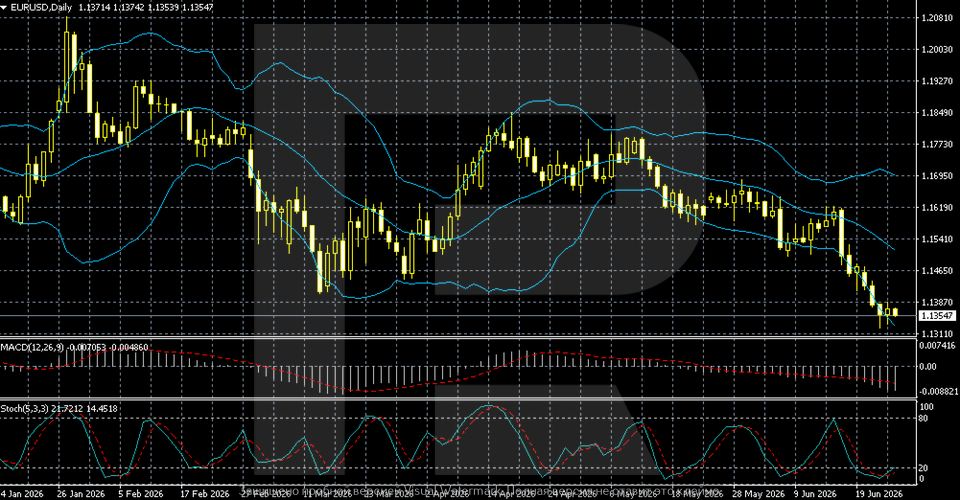
- Current trend: on the daily chart, EURUSD maintains a sustained downward impulse after the reversal in mid-April. The pair is forming a sequence of lower highs and lower lows and has settled near 1.1350. The Bollinger Bands are pointing downwards and widening, while the price holds near the lower boundary of the channel. MACD remains in negative territory, and the Stochastic signals oversold conditions and the probability of a short-term pause.
- Weekly outlook: the baseline scenario assumes continued pressure on the euro. While quotes remain below the 1.1500–1.1550 zone, risks are tilted towards further decline. A break below support at 1.1300 will open the way to the 1.1250–1.1200 area. To improve the picture, buyers need to return the price above 1.1500, which would allow for corrective growth towards 1.1600.
EURUSD fundamental analysis
The EURUSD pair closed the week near 1.1354. This is very close to the lows of the past 13 months. The overall trend remains positive for the US dollar: the market continues to price in the probability of a Fed rate hike later this year.
Local pressure on the dollar appeared after the release of May PCE inflation, which came in line with expectations: +0.4% m/m and +4.1% y/y, with core inflation at +3.4% y/y. These data reduced fears of a sharp acceleration in prices, but did not change the overall balance. Inflation still remains significantly above the Fed’s target.
The US economy became the key factor of the week. The final estimate of Q1 GDP showed growth of 2.1% q/q, compared with expectations of 1.6%. This points to a more resilient economic backdrop.
The market still expects policy tightening: the probability of a rate hike in December is estimated at around 80%, while the probability for September stands near 63%. As a result, the dollar receives support not so much from inflation as from the strong economy and expectations of further Fed action.
EURUSD technical analysis
On the daily chart, EURUSD has formed a sustained downward trend after the reversal in mid-April. The price is consistently forming lower highs and lower lows, confirming sellers’ control. In recent weeks, the decline has accelerated, and quotes have moved towards the 1.1350 area — the lows of the current move.
The Bollinger Bands are pointing downwards and widening, indicating increased volatility and the development of a trending impulse. The price is moving near the lower boundary of the channel, periodically attempting short-term pullbacks towards the middle line, but without consolidating above it.
The MACD indicator remains in negative territory, and the histogram points to persistent pressure, although the impulse is gradually smoothing out. The Stochastic is near oversold territory and is trying to turn upwards, signalling the probability of a short-term correction or consolidation.
The current technical picture remains negative: while the price holds below 1.1500–1.1550, the baseline scenario remains continued decline. The nearest support is located around 1.1300. Recovery attempts will be limited by resistance near the Bollinger Bands middle line.
EURUSD trading scenarios
The EURUSD pair ended the week near the lows of the past 13 months. Pressure on the euro persists against the backdrop of a strong dollar: the market continues to price in the probability of a Fed rate hike later this year. PCE inflation for May came in line with expectations, but remains above target, leaving the overall balance unchanged.
Against the backdrop of strong macro data, expectations of policy tightening remain in place: the probability of a December rate hike is estimated at around 80%, while the probability for September stands near 63%.
From a technical perspective, EURUSD maintains a pronounced downward trend after the reversal in mid-April. The pair updated its lows and settled near 1.1350. The Bollinger Bands are pointing downwards and widening, while the price remains near the lower boundary of the channel. MACD is in negative territory, and the Stochastic signals oversold conditions and a possible short-term pause in the decline.
- Buy scenario
Consolidation above 1.1500–1.1550 will open recovery potential with a target around 1.1600.
- Sell scenario
A break below 1.1300 will increase pressure on the pair and create conditions for a decline to 1.1250–1.1200.
Conclusion: EURUSD maintains a bearish bias. The key driver remains the strong US economy and expectations of a more restrictive Fed policy. This supports the dollar.
Summary
The EURUSD pair closed the week at 1.1354 — near the lows of the past 13 months. The dollar retains strong positions due to the resilient US economy and expectations of further Fed policy tightening.
Technically, EURUSD remains under pressure after the reversal in mid-April. The pair has settled near lows around 1.1350 and maintains a downward trend. While quotes remain below resistance at 1.1500–1.1550, risks are tilted towards decline. A break below support at 1.1300 will open the way to 1.1250–1.1200.
Editors’ picks
 EURUSD forecast 2026–2027: technical analysis, price levels & predictions
The ECB holds rates at 2.15% while the Fed stays at 3.75% — and that divergence is the central driver of EURUSD in 2026. The pair is range-bound between 1.1400 and 1.1915, with Deutsche Bank targeting 1.2500 and Morgan Stanley calling for 1.3000 by year-end. We analyse the technicals, break down the macro factors, and outline three trading scenarios with specific entry levels.
 Gold (XAUUSD) forecast 2026: predictions based on fundamental and technical analysis
Where is gold headed after pulling back from the all-time high of 5,597 USD? XAUUSD is consolidating near 4,518 USD between key levels 4,220 USD and 4,855 USD, with major banks targeting 5,243–6,200 USD by year-end. Read our comprehensive gold forecast: technical analysis across three timeframes, trading scenarios with specific entry levels, Fed policy and central bank demand outlook, and institutional predictions for 2026 and beyond.
Forecasts presented in this section only reflect the author’s private opinion and should not be considered as guidance for trading. RoboForex bears no responsibility for trading results based on trading recommendations described in these analytical reviews.