
EURUSD weekly forecast: the picture is complicated, but there is hope
The EURUSD pair enters the week of 20–24 July near 1.1439, with the dollar losing ground following soft US inflation data. The CPI and PPI figures came in below expectations, virtually ruling out a Federal Reserve rate hike in July, although robust retail sales and the labour market keep uncertainty around the September decision in place. Higher oil prices amid the conflict between the US and Iran remain an additional risk.
Technically, the EURUSD pair continues to recover after the June decline. The price is holding above 1.1400 but has not yet broken above resistance at 1.1480–1.1490. A breakout would open the way to 1.1545–1.1600, while a return below 1.1370 would increase the probability of another decline towards 1.1320.
EURUSD forecast for this week: quick overview
- Market focus: the EURUSD pair ended the week around 1.1439 amid a weaker dollar after softer US inflation data. The annual CPI slowed to 3.5%, while producer prices fell by 0.3% m/m and rose by 5.5% y/y, notably weaker than the forecast. The market virtually ruled out a Federal Reserve rate hike in July, although strong retail sales and a decline in jobless claims to 208 thousand confirmed the resilience of the US economy
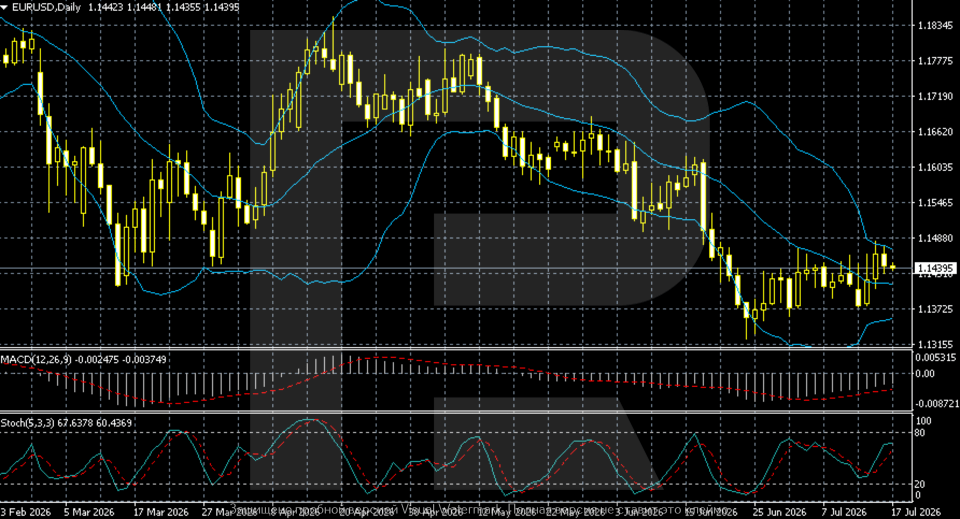
- Current trend: on the daily chart, the EURUSD rate is recovering after the June decline towards the 1.1320–1.1370 area. The pair has consolidated above 1.1400 and moved above the middle Bollinger Band. MACD remains in negative territory but is gradually turning upwards, reflecting weaker selling pressure. The Stochastic Oscillator is also rising and still has room for further correction
- Weekly outlook: expectations around the Fed’s September decision, oil price movements, and developments in the US-Iran conflict will remain the main drivers. The baseline scenario suggests movement within the 1.1370–1.1490 range with a moderately positive bias. Consolidation above 1.1490 will open the way to 1.1545–1.1600, while a return below 1.1370 will increase the risk of a decline towards 1.1320
EURUSD fundamental analysis
The EURUSD pair closed the week around 1.1439. The situation initially looked constructive, but softer inflation data then pressured the US currency. The annual CPI slowed to 3.5% in June from 4.2%, compared to the forecast of 3.8%, while prices fell by 0.4% month-on-month. Producer inflation also came in below expectations, with the PPI down 0.3% m/m and up 5.5% y/y against the forecast of 6.2%.
Weak data reduced expectations of an imminent Federal Reserve rate hike. The market had virtually ruled out such a move in July, although expectations around the September decision remain mixed. At the same time, retail sales rose by 0.2% m/m in line with the forecast, while initial jobless claims fell to a two-month low of 208 thousand. All these figures confirmed the resilience of the economy and the labour market.
The conflict between the US and Iran creates additional uncertainty. The exchange of strikes and rising oil prices are fuelling inflation risks, so weak June readings do not yet guarantee Fed policy easing. The baseline scenario remains pressure on the dollar, with the market highly sensitive to oil prices and new signals from the US regulator.
EURUSD technical analysis
On the daily chart, the EURUSD pair maintains a medium-term downtrend, although it began to recover after the June decline towards the 1.1320–1.1370 area. Quotes are now hovering around 1.1440 and trading above the middle Bollinger Band, indicating weakening selling pressure and an attempt to generate corrective momentum.
The nearest resistance level is located in the 1.1480–1.1490 zone. Consolidation above it will allow the pair to continue its upward trajectory towards 1.1545 and then towards 1.1600. Support levels lie at 1.1400 and 1.1370, while a return below 1.1370 will again increase the risk of a decline towards 1.1320.
MACD remains in negative territory but is gradually turning upwards, confirming that bearish momentum is waning. The Stochastic Oscillator is also rising and has not yet reached overbought territory, so there is still room for further recovery. The baseline scenario remains movement within the 1.1370–1.1490 range with a moderately positive bias.
EURUSD trading scenarios
The EURUSD pair ended the week around 1.1439. Weaker US consumer and producer inflation data weighed on the dollar and reduced expectations of an imminent Federal Reserve rate hike. At the same time, retail sales and jobless claims confirmed the resilience of the US economy, while rising oil prices amid the US-Iran conflict maintain inflation risks.
From a technical perspective, the EURUSD pair is recovering after the June decline towards the 1.1320–1.1370 area. The price is hovering above 1.1400 and the middle Bollinger Band. MACD remains in negative territory but is turning upwards, reflecting weaker selling pressure. The Stochastic Oscillator is also rising and still has room for further correction.
- Buy scenario
Consolidation above the 1.1480–1.1490 zone would open the way to 1.1545 and then to 1.1600.
- Sell scenario
A return below 1.1370 would add to pressure on the pair and increase the likelihood of another decline towards 1.1320.
Conclusion: the technical picture for the EURUSD pair is gradually improving, but a full-fledged reversal of the medium-term trend has not yet been confirmed. Further performance will depend on expectations for the Fed’s September decision, oil prices, and developments in the Middle East conflict.
Summary
The EURUSD pair closed the week around 1.1439 amid a weaker dollar after softer US inflation data. The CPI and PPI came in below expectations, virtually ruling out a Federal Reserve rate hike in July, although strong retail sales and the labour market kept uncertainty around the September decision in place. Rising oil prices amid the conflict between the US and Iran remain an additional risk.
Technically, the EURUSD rate continues its corrective recovery after the June decline. The pair is holding above 1.1400 and the middle Bollinger Band, although the medium-term trend remains downward. Consolidation above the 1.1480–1.1490 zone would open the way to 1.1545–1.1600, while a return below 1.1370 would increase the risk of another decline towards 1.1320.
Editors’ picks
 EURUSD forecast 2026–2027: technical analysis, price levels & predictions
EURUSD has pulled back from the 2026 high of 1.1915 and is now trading near 1.1450 — below both EMA65 and EMA200 — with the active scenario shifting from bullish to bearish. The ECB raised rates to 2.40%, but the Fed holds at 3.75%, and US inflation (3.5%) continues to outpace the eurozone (2.8%). A confirmed break below 1.1280 opens the next downward wave toward 1.1080. We break down the key levels, three trading scenarios with entry triggers, and what Deutsche Bank, Morgan Stanley and UBS are forecasting for EURUSD in 2026.
 Gold (XAUUSD) forecast 2026: predictions based on fundamental and technical analysis
Gold has corrected over 25% from its all-time high of 5,597 USD and is now trading near 4,100 USD — testing a critical support zone. Is this the bottom, or will the downtrend continue? We break down the key levels (support 3,920 USD, breakout trigger 4,500 USD), three trading scenarios with entry levels, and what J.P. Morgan, Goldman Sachs and Deutsche Bank are forecasting for gold in 2026.
Forecasts presented in this section only reflect the author’s private opinion and should not be considered as guidance for trading. RoboForex bears no responsibility for trading results based on trading recommendations described in these analytical reviews.