
EURUSD weekly forecast: a moderately bearish outlook back in fashion
The EURUSD pair enters the week of 27–31 July at around 1.1383, under pressure from a strong US dollar. New US tariffs are heightening concerns about rising costs and inflation, while high energy prices and a resilient labour market are supporting expectations of tighter Federal Reserve policy. Following the ECB’s recent meeting, the focus is shifting entirely to the US regulator, with the market estimating the likelihood of a rate hike at the upcoming meeting at around 34% and fully pricing in at least one increase by September.
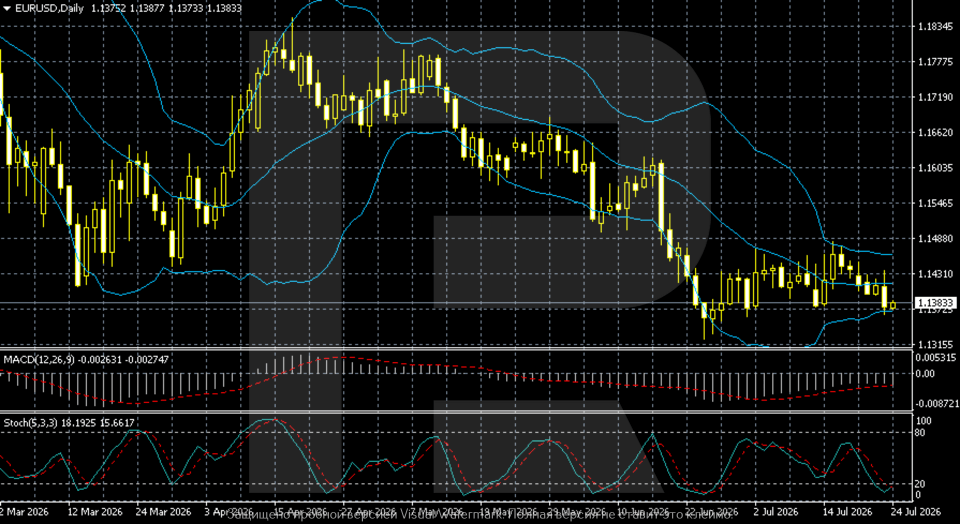
Technically, the EURUSD rate remains in a downtrend after reversing from the April highs. The pair is trading below the middle Bollinger Band and holding near the 1.1360–1.1315 support area. A breakout below it would increase pressure and open the way for a further decline. The nearest resistance level is located at 1.1430, followed by 1.1480. As long as the price remains below 1.1430, the baseline scenario suggests movement within the 1.1315–1.1430 range with a moderately negative bias.
EURUSD forecast for this week: quick overview
- Market focus: the EURUSD pair enters the week of 27–31 July at around 1.1383, pressured by a strong US dollar. New US tariffs on the country’s largest trading partners are increasing concerns about rising costs and inflation. The US currency is also bolstered by high energy prices amid the conflict in the Middle East and the resilience of the US labour market. The market estimates the likelihood of a Federal Reserve rate hike at the upcoming meeting at around 34%, fully pricing in at least one increase by September and allowing for another hike before the end of the year
- Current trend: on the daily chart, the EURUSD pair remains in a downtrend after reversing from the April highs. The pair is trading below the middle Bollinger Band and near the indicator’s lower boundary. MACD remains in negative territory, although selling pressure is gradually easing. The Stochastic Oscillator is in oversold territory, suggesting a short-term rebound. The nearest support lies in the 1.1360–1.1315 area, while resistance levels are located at 1.1430 and 1.1480
- Weekly forecast: the Federal Reserve meeting will be the main event. Signals that the regulator is prepared to keep rates higher for longer or resume rate hikes would increase pressure on the EURUSD pair. The baseline scenario suggests movement within the 1.1315–1.1430 range with a moderately negative bias. A breakout below the 1.1315 level would open the door for a continued decline, while a consolidation above 1.1430 would allow the pair to recover towards 1.1480
EURUSD fundamental analysis
The EURUSD pair enters the week of 27–31 July at 1.1383, with the US currency supported by new US tariffs on the country’s largest trading partners. Import duties on goods from Mexico, Canada, the UK, and India are fuelling concerns about rising costs. The tariff on goods from the EU and Taiwan is capped at 10%. Products from Japan, South Korea, and Switzerland will mostly be subject to tariffs of up to 12.5%.
The US dollar is also benefitting from rising energy prices amid the conflict in the Middle East and the resilience of the US labour market, as these factors support expectations of tighter Federal Reserve policy. The market estimates the likelihood of a rate hike at the upcoming meeting at around 34%, fully pricing in at least one increase by September and expecting another move before the end of the year.
The latest ECB meeting has already set the direction for the euro and helped the market assess the divergence between European and US monetary policy. Now attention shifts entirely to the Federal Reserve. Any hint that it is prepared to keep rates higher for longer or resume rate hikes would strengthen the US dollar’s advantage over other major currencies.
The Federal Reserve meeting will be the key event of the week. The baseline scenario for the US Dollar Index remains moderately positive while tariff, energy, and inflation risks continue to support expectations of tight monetary policy. However, leaving the rate unchanged without stronger signals of a future increase could trigger profit-taking and a correction from three-week highs.
EURUSD technical analysis
On the daily chart, the EURUSD pair remains in a downtrend after reversing from the April highs. The pair is currently trading at around 1.1383, below the middle Bollinger Band and near the indicator’s lower boundary, confirming that sellers have the upper hand.
The nearest support lies in the 1.1360–1.1315 area. A breakout below it would increase the risk of a continued decline. Resistance levels are located at 1.1430 and 1.1480. As long as quotes remain below 1.1430, the current move appears to be a consolidation within the broader downtrend.
MACD remains in negative territory, although bearish momentum is gradually losing strength. The Stochastic Oscillator is in oversold territory and is beginning to turn upwards, so a short-term rebound may occur before another decline. The baseline scenario remains movement within the 1.1315–1.1430 range with a moderately negative bias.
EURUSD trading scenarios
The EURUSD pair enters the week of 27–31 July at around 1.1383, under pressure from a strong US dollar. New US tariffs on the country’s largest trading partners are increasing concerns about rising costs and inflation. The US currency is also supported by high energy prices amid the conflict in the Middle East and the resilience of the US labour market. Following the ECB’s latest meeting, market attention is now fully focused on the Federal Reserve.
From a technical perspective, the EURUSD pair remains in a downtrend after reversing from the April highs. The pair is trading below the middle Bollinger Band and near the indicator’s lower boundary. MACD remains in negative territory, although selling pressure is gradually easing. The Stochastic Oscillator is in oversold territory, suggesting a short-term rebound.
- Buy scenario
A consolidation above 1.1430 would allow the pair to continue its recovery towards 1.1480. A stronger move may follow if the Federal Reserve holds rates steady without providing hawkish signals about further hikes.
- Sell scenario
A breakout below the 1.1360–1.1315 support area would confirm renewed downward movement and increase the risk of a further decline.
Conclusion: sellers continue to have the upper hand in the EURUSD pair. The baseline scenario for the week suggests movement within the 1.1315–1.1430 range with a moderately negative bias. The key driver will be the Federal Reserve meeting: hawkish rhetoric would strengthen the US dollar, while the lack of clear signals about another rate hike could trigger a corrective recovery.
Summary
The EURUSD pair enters the week of 27–31 July at around 1.1383, pressured by a strong US dollar. New US tariffs are fuelling concerns about rising costs and inflation, while high energy prices and a resilient labour market are supporting expectations of tighter Federal Reserve policy. Following the ECB’s latest meeting, attention is now fully focused on the US regulator: the market estimates the probability of a rate hike at the upcoming meeting at around 34%, fully pricing in at least one increase by September.
Technically, the EURUSD pair remains in a downtrend after reversing from the April highs. The pair is trading below the middle Bollinger Band and near the indicator’s lower boundary. The nearest support lies in the 1.1360–1.1315 area, with resistance levels at 1.1430 and 1.1480. As long as the price remains below 1.1430, the baseline scenario suggests movement within the 1.1315–1.1430 range with a moderately negative bias.
Editors’ picks
 EURUSD forecast 2026–2027: technical analysis, price levels & predictions
EURUSD has pulled back from the 2026 high of 1.1915 and is now trading near 1.1450 — below both EMA65 and EMA200 — with the active scenario shifting from bullish to bearish. The ECB raised rates to 2.40%, but the Fed holds at 3.75%, and US inflation (3.5%) continues to outpace the eurozone (2.8%). A confirmed break below 1.1280 opens the next downward wave toward 1.1080. We break down the key levels, three trading scenarios with entry triggers, and what Deutsche Bank, Morgan Stanley and UBS are forecasting for EURUSD in 2026.
 Gold (XAUUSD) forecast 2026: predictions based on fundamental and technical analysis
Gold has corrected over 25% from its all-time high of 5,597 USD and is now trading near 4,100 USD — testing a critical support zone. Is this the bottom, or will the downtrend continue? We break down the key levels (support 3,920 USD, breakout trigger 4,500 USD), three trading scenarios with entry levels, and what J.P. Morgan, Goldman Sachs and Deutsche Bank are forecasting for gold in 2026.
Forecasts presented in this section only reflect the author’s private opinion and should not be considered as guidance for trading. RoboForex bears no responsibility for trading results based on trading recommendations described in these analytical reviews.