
EURUSD weekly forecast: euro seizes the opportunity to rise
The EURUSD pair enters the week of 3–7 August at around 1.1510 after a three-day decline in the US dollar. The main focus of the week will be the US labour market report: weak data would support the EURUSD rate, while steady employment and wage growth would revive demand for the dollar.
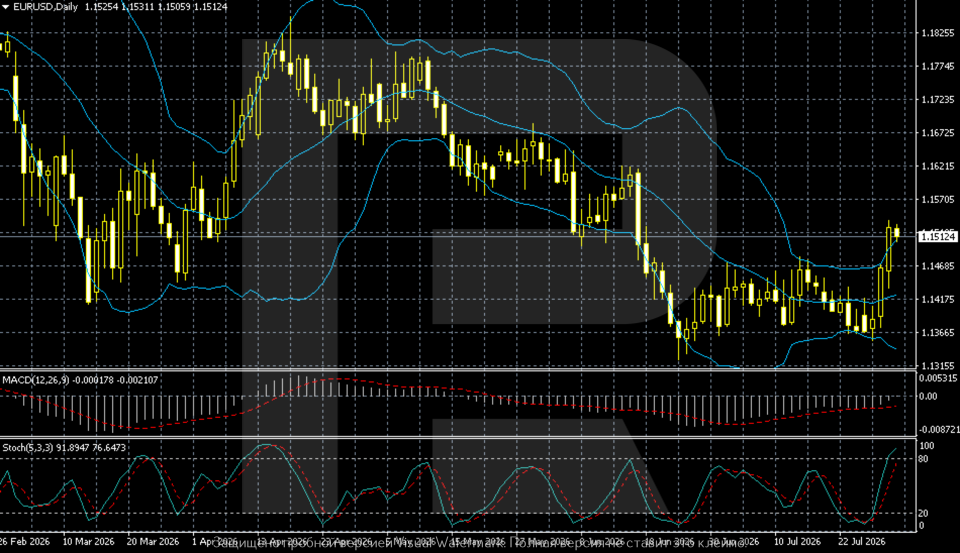
Technically, the EURUSD pair rebounded sharply from the July support level of 1.1366 and moved above the middle and upper Bollinger Bands. The nearest resistance zone is 1.1530–1.1570, and a breakout above it would open the way towards 1.1622. The support level lies at 1.1469, with the next ones at 1.1418 and 1.1366. The Stochastic Oscillator indicates overbought conditions, so a correction may follow the strong rise. As long as the pair remains above 1.1469, the baseline scenario suggests movement within the 1.1469–1.1570 range with a moderately positive bias.
EURUSD forecast for this week: quick overview
- Market focus: the EURUSD pair enters the week of 3–7 August at around 1.1510. The US dollar came under pressure following the Federal Reserve's decision to keep rates unchanged and a suspected Japanese currency intervention. Three FOMC members supported a rate hike, with the probability of a 25-basis-point move in September estimated at around 63%. The main benchmark for the week will be the US labour market report
- Current trend: on the daily chart, the EURUSD rate rebounded sharply from the July support level of 1.1366 and moved above the middle and upper Bollinger Bands. MACD remains in negative territory, but bearish momentum is weakening rapidly. The Stochastic has entered overbought territory, increasing the likelihood of a pause or corrective pullback. The nearest resistance zone is 1.1530–1.1570, followed by 1.1622 and 1.1673. Support levels are located at 1.1469, 1.1418, and 1.1366
- Weekly outlook: signs of cooling employment, rising unemployment, or slower wage growth in the US would support EURUSD and allow the pair to consolidate above 1.1570, potentially moving towards 1.1622. Strong data would revive expectations of a September Federal Reserve rate hike and create a risk of a correction below 1.1469 towards 1.1418. The baseline scenario is movement within the 1.1469–1.1570 range with a moderately positive bias, although the broader downtrend would only be finally broken after a firm consolidation above 1.1570
EURUSD fundamental analysis
The EURUSD pair enters the week of 3–7 August at around 1.1510 after strengthening noticeably amid a three-day decline in the US dollar. The US currency came under pressure after the Federal Reserve kept rates unchanged and amid a suspected Japanese intervention, which triggered a sharp rise in the yen and accelerated dollar selling across the market. However, EURUSD gains are so far driven primarily by USD weakness rather than a marked improvement in the eurozone economic outlook.
The outcome of the Federal Reserve meeting left room for further policy tightening. Three FOMC members voted for a rate hike, while the market estimates the likelihood of a 25-basis-point move in September at around 63%. The current decline in the dollar may therefore prove limited: strong inflation or economic data could quickly revive expectations of a rate hike and support the US currency.
The main focus of the week will be the US labour market report, including employment, unemployment, and wages. Signs of a cooling labour market would strengthen the EURUSD pair. Strong data, by contrast, would strengthen the case for a Fed rate hike in September and create a risk of the pair moving lower again.
EURUSD technical analysis
On the daily chart, the EURUSD rate rebounded sharply from the July support level at 1.1366 and is trading near 1.1512. The price moved above the middle and upper Bollinger Bands, confirming strong short-term buying momentum. However, the broader downtrend formed after the April highs has not yet been fully broken.
The nearest resistance zone is 1.1530–1.1570. A consolidation above it would open the way towards 1.1622 and then 1.1673. The first support level is 1.1469, followed by the middle Bollinger Band near 1.1418 and the key area at 1.1366.
MACD remains in negative territory, but bearish momentum is weakening rapidly, and the histogram is approaching the zero line. The Stochastic has risen above 80, indicating overbought conditions, so a pause or corrective pullback may follow the sharp rise.
The baseline scenario remains consolidation within the 1.1469–1.1570 range with a moderately positive bias. To confirm a more sustainable reversal, buyers need to gain a foothold above 1.1570, while a return below 1.1469 would increase the risk of a correction towards 1.1418.
EURUSD trading scenarios
The EURUSD pair enters the week of 3–7 August at around 1.1510. The US currency came under pressure after the Federal Reserve kept rates unchanged and amid a suspected Japanese currency intervention, which triggered a sharp rise in the yen and intensified dollar selling across the market. However, the EURUSD rally is still driven primarily by USD weakness rather than a clear improvement in the eurozone economic outlook.
From a technical perspective, the EURUSD pair rebounded sharply from the July support level of 1.1366 and moved above the middle and upper Bollinger Bands. MACD remains in negative territory, but bearish momentum is weakening rapidly. The Stochastic has entered overbought territory, so consolidation or a local correction may follow the strong rise. The broader downtrend that emerged after the April highs has not yet been fully broken.
- Buy scenario
A consolidation above the 1.1530–1.1570 resistance zone would confirm continued bullish momentum and open the way towards 1.1622 and then 1.1673. Weak US labour market data, which would reduce the likelihood of a Federal Reserve rate hike in September, could provide additional support for the pair.
- Sell scenario
A return below the 1.1469 support level would signal a developing correction and create a risk of a decline towards 1.1418. A breakout below this level would bring the key July support at 1.1366 back into focus.
Conclusion: the short-term advantage in EURUSD has shifted to buyers, but overbought conditions and expectations of a Federal Reserve rate hike are limiting the upside potential. The baseline scenario for the week is movement within the 1.1469–1.1570 range with a moderately positive bias. The main driver will be the US labour market report: signs of cooling employment would support further gains in the pair, while strong data could push EURUSD back into a correction.
Summary
The EURUSD pair is hovering around 1.1510 after rising noticeably amid a three-day decline in the US dollar. The US currency came under pressure after the Federal Reserve kept rates unchanged and amid a suspected Japanese intervention. Attention now turns to US labour market data.
On the daily chart, the EURUSD rate rebounded sharply from 1.1366 and moved above the middle and upper Bollinger Bands. The nearest resistance zone is 1.1530–1.1570, and a breakout above it would open the way towards 1.1622. The support level lies at 1.1469, followed by 1.1418 and 1.1366. As long as the pair remains above 1.1469, the baseline scenario is movement within the 1.1469–1.1570 range with a moderately positive bias.
Editors’ picks
 EURUSD forecast 2026–2027: technical analysis, price levels & predictions
EURUSD has pulled back from the 2026 high of 1.1915 and is now trading near 1.1450 — below both EMA65 and EMA200 — with the active scenario shifting from bullish to bearish. The ECB raised rates to 2.40%, but the Fed holds at 3.75%, and US inflation (3.5%) continues to outpace the eurozone (2.8%). A confirmed break below 1.1280 opens the next downward wave toward 1.1080. We break down the key levels, three trading scenarios with entry triggers, and what Deutsche Bank, Morgan Stanley and UBS are forecasting for EURUSD in 2026.
 Gold (XAUUSD) forecast 2026: predictions based on fundamental and technical analysis
Gold has corrected over 25% from its all-time high of 5,597 USD and is now trading near 4,100 USD — testing a critical support zone. Is this the bottom, or will the downtrend continue? We break down the key levels (support 3,920 USD, breakout trigger 4,500 USD), three trading scenarios with entry levels, and what J.P. Morgan, Goldman Sachs and Deutsche Bank are forecasting for gold in 2026.
Forecasts presented in this section only reflect the author’s private opinion and should not be considered as guidance for trading. RoboForex bears no responsibility for trading results based on trading recommendations described in these analytical reviews.