
EURUSD weekly forecast: baseline scenario remains moderately positive
The EURUSD pair enters the week of 31 August–4 September near 1.1604 after a slight decline over the previous week. The dollar was supported by higher-than-expected US inflation: the likelihood of a Fed rate hike by December remains above 70%, although the market still largely expects a pause at the September meeting. More hawkish rate expectations bolster the USD, while the expansion of the US Treasury’s bond buyback program and concerns over the country’s debt sustainability limit its upside potential.
On the daily chart, the EURUSD pair retains a broader bullish structure, but after testing 1.1719, it has entered a correction phase. The nearest support level is located at 1.1603, followed by 1.1547 and 1.1498. The key resistance level remains at 1.1719; a breakout above it would open the door for a move towards 1.1778 and then 1.1835. MACD remains in positive territory, while the Stochastic Oscillator has approached oversold territory, so a local rebound remains likely. As long as the pair holds above 1.1603, the baseline scenario remains neutral with a moderately positive bias.
EURUSD forecast for this week: quick overview
- Market focus: the EURUSD pair enters the week of 31 August–4 September near 1.1604 after a slight decline over the previous week. The dollar was supported by higher-than-expected US inflation: the likelihood of a Fed rate hike by December remains above 70%, although the market largely expects a pause at the September meeting. More hawkish rate expectations support the USD, while the expansion of the US Treasury’s bond buyback program keeps concerns over the country’s debt sustainability in focus
- Current trend: on the daily chart, the EURUSD pair maintains a broader bullish structure after recovering from the July lows, although it has been correcting in recent sessions. The price remains above the middle Bollinger Band, MACD stays in positive territory, while the Stochastic Oscillator has moved towards oversold territory, increasing the likelihood of a local rebound. The key resistance level is located at 1.1719, followed by 1.1778 and 1.1835. Support levels are at 1.1603, 1.1547, and 1.1498
- Weekly outlook: more hawkish Fed signals and strong US data could support the dollar and extend the EURUSD correction below 1.1603, opening the way towards 1.1547. At the same time, US debt risks and pressure on the dollar preserve the pair’s recovery potential. The baseline scenario remains neutral with a moderately positive bias: buy after a consolidation above 1.1719, with an entry at 1.1720, a target at 1.1778, and a stop loss at 1.1680. The risk-to-reward ratio is approximately 1:1.5, and the idea remains valid until 4 September 2026
EURUSD fundamental analysis
The EURUSD pair enters the week of 31 August–4 September near 1.1604 after a slight decline over the previous week. The US currency was supported by higher-than-expected US inflation, which fuelled expectations of a Fed rate hike before the end of the year. The likelihood of such a move by December remains above 70%. For the September meeting, the market still largely expects a pause, with the probability of rates remaining unchanged estimated at around 65%.
In the new week, the fundamental backdrop for the dollar remains mixed. More hawkish rate expectations and comments from Kansas City Fed President Jeff Schmid that current policy is not exerting a noticeable restraining effect on the economy support the USD.
At the same time, the expansion of the US Treasury’s bond buyback program continues to fuel concerns over the country’s debt sustainability and potential pressure on the dollar. The baseline outlook for the EURUSD pair for the week remains neutral with a moderately positive bias.
EURUSD technical analysis
On the daily chart, the EURUSD rate retains a broader bullish structure after recovering from the July lows, although recent sessions have been marked by a correction. The pair declined from the 1.1719 area towards 1.1650 but remains above the middle Bollinger Band. As long as the price holds above 1.1603, buyers retain the advantage over the longer term.
The key resistance level lies at 1.1719; a breakout above this mark would open the way towards 1.1778 and then 1.1835. The nearest support level is located at 1.1603, followed by 1.1547 and 1.1498. MACD remains in positive territory, although momentum is stabilising, while the Stochastic Oscillator has fallen towards oversold territory. This indicates ongoing corrective pressure but also increases the likelihood of a local rebound.
The baseline trading idea suggests buying only after a consolidation above 1.1719, with an entry level – buy stop – at 1.1720, a take profit at 1.1778, and a stop loss at 1.1680. Potential profit is around 58 pips with a risk of 40 pips, giving a risk-to-reward ratio of approximately 1:1.5. The idea remains valid until 4 September 2026, provided the EURUSD rate does not consolidate below 1.1603.
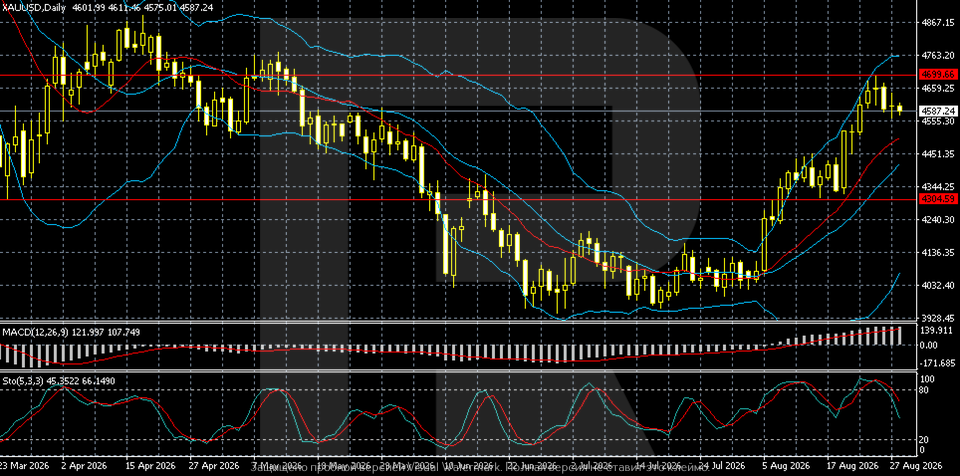
EURUSD trading scenarios
The EURUSD pair enters the week of 31 August–4 September near 1.1650 after a moderate decline over the previous week. The dollar was bolstered by higher US inflation: the probability of a Fed rate hike by December remains above 70%, although the market still predominantly expects a pause at the September meeting.
From a technical perspective, the EURUSD pair maintains a broader bullish structure but has entered a correction after testing the 1.1719 mark. The pair remains above the middle Bollinger Band, MACD holds in positive territory, and the Stochastic Oscillator has approached oversold territory, increasing the likelihood of a local rebound. The key resistance level is located at 1.1719, with support at 1.1603 and 1.1547.
- Buy scenario
A consolidation above 1.1719 would confirm renewed bullish momentum and open the way towards 1.1778. Dollar weakness amid US debt risks could provide additional support for the move.
- Entry level: Buy Stop 1.1720
- Take profit: 1.1778
- Stop loss: 1.1680
- Risk-to-reward ratio: approximately 1:1.5
Valid until: 4 September 2026
- Sell scenario
A breakout below the 1.1603 support level would confirm a deeper correction and create conditions for a decline towards 1.1547. More hawkish Fed expectations and strong US data could increase pressure on EURUSD.
- Entry level: Sell Stop 1.1602
- Take Profit: 1.1547
- Stop Loss: 1.1632
- Risk-to-reward ratio: approximately 1:1.8
Valid until: 4 September 2026
Conclusion: the broader trend still favours buyers, although the short-term correction has not yet ended. Holding above 1.1603 keeps the moderately positive scenario intact, while a breakout above 1.1719 would confirm new upward momentum.
Summary
The EURUSD pair enters the week of 31 August–4 September near 1.1604 after a slight decline over the previous week. The dollar was supported by higher-than-expected US inflation: the probability of a Fed rate hike by December remains above 70%, although the market still largely expects a pause at the September meeting. More hawkish rate expectations provide additional support for the USD, while the expansion of the US Treasury’s bond buyback program and concerns over the country’s debt sustainability limit its upside potential.
On the daily chart, the EURUSD pair retains a broader bullish structure, although recent sessions have been marked by a correction. The nearest support level is located at 1.1603, followed by 1.1547 and 1.1498. The key resistance level remains at 1.1719; a breakout above it would open the way towards 1.1778 and then 1.1835. MACD remains in positive territory, while the Stochastic Oscillator has approached oversold territory, so a local rebound remains likely. As long as the pair holds above 1.1603, the baseline scenario remains neutral with a moderately positive bias.
Editors’ picks
 EURUSD forecast 2026–2027: technical analysis, price levels & predictions
EURUSD has recovered from the July lows and is trading near 1.1545 — back in bullish territory. The pair has reclaimed EMA65 on the daily, formed a bullish EMA crossover on H4, and the US-eurozone GDP gap has narrowed sharply (US 1.5% vs eurozone 1.0%). Goldman Sachs and Deutsche Bank both now target 1.2500 by year-end. A confirmed close above 1.1700 opens the path to 1.1805. We break down the key levels, three trading scenarios, and what the unprecedented 9-3 FOMC dissent vote means for EURUSD.
 Gold (XAUUSD) forecast 2026: technical analysis, price levels & predictions
Gold has reversed its downtrend and is trading near 4,360 USD, back above both EMA65 and EMA200. ETF flows turned positive in July with 3 billion USD of net inflows, and central banks bought 288.9 tonnes in Q2 — up 62% year-on-year. A breakout above 4,500 USD opens the path to 4,855 USD and the 5,597 USD all-time high. We break down the key levels, three trading scenarios with entry triggers, and what J.P. Morgan, Deutsche Bank and Goldman Sachs are forecasting for gold in 2026.
Forecasts presented in this section only reflect the author’s private opinion and should not be considered as guidance for trading. RoboForex bears no responsibility for trading results based on trading recommendations described in these analytical reviews.