
GBPUSD recovered, but the outlook remains minor
The GBPUSD pair returned to 1.3381, with broader prospects for the pound remaining negative. Find more details in our analysis for 10 June 2026.
GBPUSD forecast: key takeaways
- The GBPUSD pair recouped some of its losses, but its further trend remains uncertain
- Tension in the oil market and US dollar strength are preventing a full-fledged rebound
- GBPUSD forecast for 10 June 2026: 1.3300 or 1.3485
Fundamental analysis
The GBPUSD rate recovered to 1.3381 after falling to a two-month low shortly before. The primary reason for the previous drop was the strengthening of the US dollar, which is supported by growing expectations of a Federal Reserve rate hike and demand for safe-haven assets amid the escalating conflict in the Middle East.
Rising oil prices are putting additional pressure on the British currency. Following new Israeli strikes on targets in Iran, Brent prices rose by more than 5%, fuelling concerns about inflation and possible disruptions in global supply chains. This factor is especially sensitive for the UK due to its heavy dependence on energy imports.
Just a few months ago, the market anticipated the Bank of England could raise interest rates twice before the end of the year to curb inflation. However, after strong US statistics and the growing likelihood of tighter Fed policy, the GBP advantage has narrowed noticeably. Investors are now focusing more on the risks to the British economy related to expensive energy and slowing business activity.
At the same time, the Bank of England’s latest surveys showed that British businesses expect very moderate price growth over the next 12 months. This strengthened the market view that the regulator may delay the next rate hike until at least September.
Therefore, expectations for the GBPUSD pair remain moderately negative, with the dollar supported by strong US economic performance, high interest rates, and ongoing geopolitical uncertainty.
The GBPUSD forecast is bearish.
Technical outlook
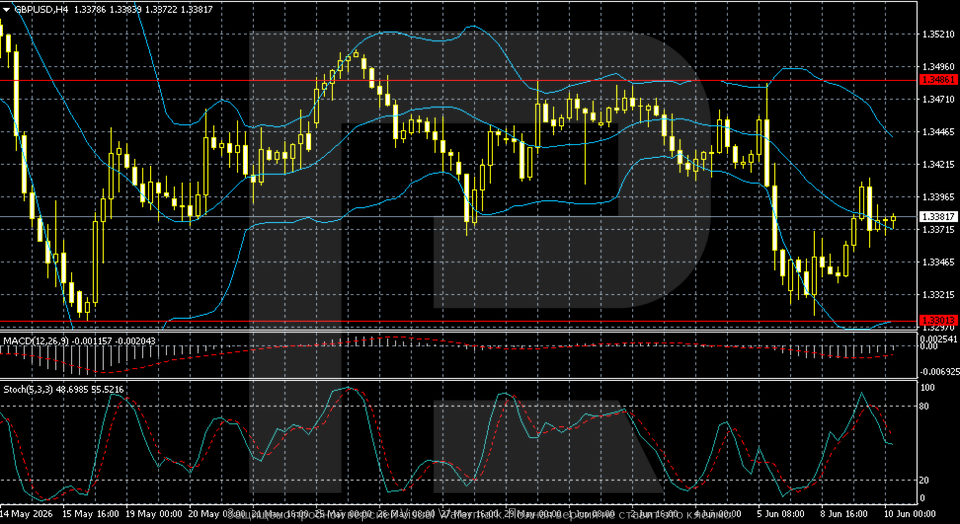
On H4, the GBPUSD pair is trading in a sideways range, capped by the 1.3485 resistance level and the 1.3300 support level. After a sharp decline in early June, quotes stabilised and entered a consolidation phase, holding near the middle Bollinger Band. The current price around 1.3380 reflects the absence of a clear trend.
Bollinger Bands are narrowing, indicating lower volatility and possible preparation for a stronger move. The price is periodically testing the range’s lower boundary, but a confident breakout has not yet occurred. The short-term structure remains neutral with a sideways bias.
Indicators confirm uncertainty: MACD is near the zero line without clear momentum, while the Stochastic Oscillator is turning downwards from overbought territory. This may signal the risk of a local decline, but the market will need a move beyond the range boundaries to form a sustainable direction.
GBPUSD overview
- Asset: GBPUSD
- Timeframe: H4 (Intraday)
- Trend: sideways with a moderately negative bias
- Key resistance levels: 1.3485 and 1.3550
- Key support levels: 1.3300 and 1.3250
GBPUSD trading scenarios for today
Main scenario (Sell Stop)
A breakout and consolidation below the 1.3300 support level would confirm stronger pressure on the pound amid strong US statistics, growing Fed rate expectations, and continuing risks to the British economy due to high energy prices.
- Take Profit: 1.3250
- Stop Loss: 1.3345
Alternative scenario (Buy Stop)
Consolidation above the 1.3485 resistance level would signal corrective growth and allow buyers to test the 1.3550 area.
- Take Profit: 1.3550
- Stop Loss: 1.3445
Risk factors
The GBPUSD pair remains in a consolidation phase after recovering from two-month lows. High oil prices remain an additional risk factor for the pound. The pair’s further direction will depend on the situation in the Middle East and new signals from the Federal Reserve and the Bank of England.
Summary
The GBPUSD pair is moving without direction after falling to lows and rebounding. The GBPUSD forecast for today, 10 June 2026, suggests it will remain in the 1.3300-1.3485 range until a new driver appears.
Editors’ picks
 EURUSD forecast 2026–2027: technical analysis, price levels & predictions
The ECB holds rates at 2.15% while the Fed stays at 3.75% — and that divergence is the central driver of EURUSD in 2026. The pair is range-bound between 1.1400 and 1.1915, with Deutsche Bank targeting 1.2500 and Morgan Stanley calling for 1.3000 by year-end. We analyse the technicals, break down the macro factors, and outline three trading scenarios with specific entry levels.
 Gold (XAUUSD) forecast 2026: predictions based on fundamental and technical analysis
Where is gold headed after pulling back from the all-time high of 5,597 USD? XAUUSD is consolidating near 4,518 USD between key levels 4,220 USD and 4,855 USD, with major banks targeting 5,243–6,200 USD by year-end. Read our comprehensive gold forecast: technical analysis across three timeframes, trading scenarios with specific entry levels, Fed policy and central bank demand outlook, and institutional predictions for 2026 and beyond.
Forecasts presented in this section only reflect the author’s private opinion and should not be considered as guidance for trading. RoboForex bears no responsibility for trading results based on trading recommendations described in these analytical reviews.