
USDCAD frozen before the storm: the market is waiting for a single signal to break loose
Rising oil prices continue to support the CAD, with the USDCAD rate testing the 1.3660 level. Discover more in our analysis for 27 April 2026.
USDCAD forecast: key takeaways
- US-Iran negotiations have finally reached a dead end
- Oil prices are rising amid the blockade, supporting the CAD
- The release of US inflation (PCE) data will be the day’s main trigger
- USDCAD forecast for 27 April 2026: 1.3750 or 1.3630
Fundamental analysis
Today’s USDCAD price forecast, for 27 April 2026, shows that the pair is moving in a narrow range, squeezed between the USD, which is strengthening on fears, and the CAD, which is supported by high oil prices. On Monday morning, quotes are consolidating around 1.3660, showing minimal intraday volatility after the pair hit new lows last week.
The main driver of today’s stagnation is the deadlock in the Strait of Hormuz, which has created a unique market parity: escalation is simultaneously pushing up both the US dollar, as a safe haven, and the Canadian dollar, through rising oil prices.
Drivers of volatility in USDCAD quotes:
- US-Iran negotiations have finally reached a dead end: Trump cancelled the delegation’s trip to Pakistan, stating that the Iranians had offered a lot, but not enough. Iranian President Masoud Pezeshkian, in turn, rejected negotiations imposed under threats or blockade. This put a damper on hopes for a quick reopening of the strait
- Oil prices are rising amid the blockade: WTI is trading around 94.00 USD per barrel, while Brent is trading around 101.00 USD, supporting the Canadian currency. The strategic strait remains effectively locked by Iranian control and the US naval blockade, which is creating risks of prolonged disruptions in oil supplies
- The dollar is balancing between rates and geopolitics: the DXY index is holding around 98.50, bolstered as a safe haven; however, investors are biding their time ahead of this evening’s release of the US core PCE (inflation) index, which may shed light on the Fed’s next moves
The market is in a tug-of-war position. Goldman Sachs notes that while the energy shock remains in the foreground, domestic Canadian factors are receding into the background, and CAD dynamics will be shaped by oil and USD movements.
Canada, as the largest energy exporter to the US, is receiving strong support from high oil prices. However, that same geopolitics and uncertainty over the USMCA agreement are restraining risk appetite and preventing the CAD from strengthening.
The evening release of US inflation (PCE) data will be the day’s main trigger: strong figures will weaken expectations of a Fed rate cut and may push the pair higher, while weak data will strengthen the Canadian dollar amid the oil rally.
Technical outlook
On the H4 chart, the USDCAD pair formed a Hammer reversal pattern near the lower Bollinger Band. At this stage, following the correction, it may continue the upward wave as the signal plays out. Since quotes remain within an ascending channel, prices are expected to rise towards the nearest resistance level at 1.3750. A breakout above this level will open the way for continued upward momentum.
At the same time, the forecast for 27 April 2026 also includes a market scenario in which the USDCAD rate dips to the 1.3630 level.
USDCAD overview
- Asset: USDCAD
- Timeframe: H4 (Intraday)
- Trend: downward
- Key resistance levels: 1.3750 and 1.4000
- Key support levels: 1.3630 and 1.3555
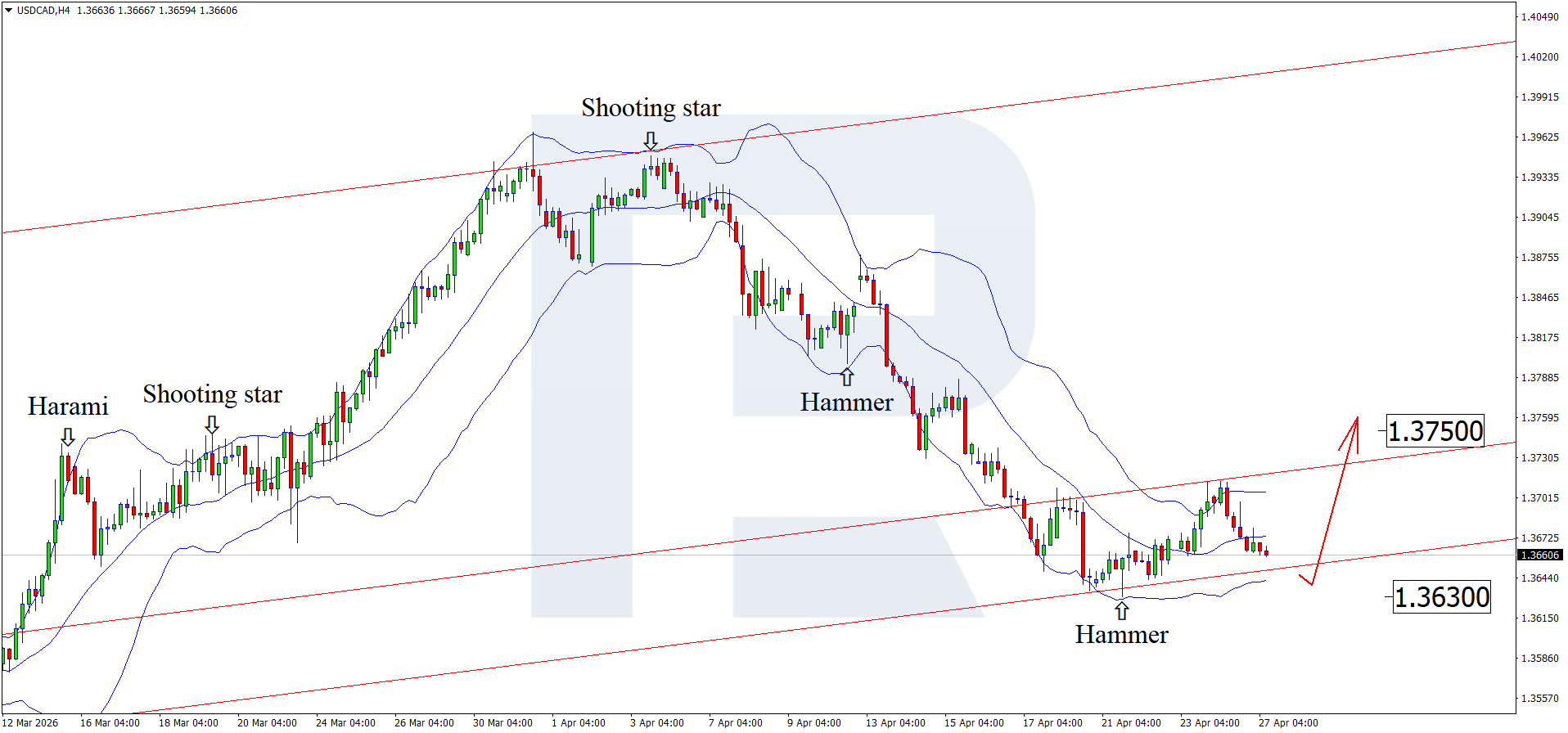
USDCAD trading scenarios for today
Main scenario (Buy Stop)
Consolidation above 1.3750 would confirm the start of an uptrend and open the way to the 1.4000 level if external pressure on the CAD remains.
- Take Profit: 1.4000
- Stop Loss: 1.3710
Alternative scenario (Sell Stop)
A breakout below the 1.3630 support level would indicate stronger pressure on the USD and the continued downward wave, with the potential for quotes to fall towards the 1.3555 area.
- Take Profit: 1.3555
- Stop Loss: 1.3675
Risk factors
Geopolitics and oil prices remain factors influencing the USDCAD rate. Rising energy prices are supporting the CAD, but demand for the dollar as a safe-haven asset and expectations of hawkish Fed policy are keeping the USD strong. An additional factor will be the release of US inflation (PCE) data, which may either strengthen or weaken the USD.
Summary
The market is awaiting the release of US inflation (PCE) data, which will bring some clarity to the Fed’s future decisions. USDCAD technical analysis suggests growth towards the 1.3750 resistance level after a correction.
Editors’ picks
 EURUSD 2026-2027 forecast: key market trends and future predictions
This article provides the EURUSD forecast for 2026 and 2027 and highlights the main factors determining the direction of the pair’s movements. We will apply technical analysis, take into account the opinions of leading experts, large banks, and financial institutions, and study AI-based forecasts. This comprehensive insight into EURUSD predictions should help investors and traders make informed decisions.
 Gold (XAUUSD) forecast 2026 and beyond: expert insights, price predictions, and analysis
Dive deep into the Gold (XAUUSD) price outlook for 2026 and beyond, combining technical analysis, expert forecasts, and key macroeconomic factors. It explains the drivers behind gold’s recent surge, explores potential scenarios including a move toward 4,500 to 5,000 USD per ounce, and highlights why the metal remains a strong hedge during global uncertainty.
Forecasts presented in this section only reflect the author’s private opinion and should not be considered as guidance for trading. RoboForex bears no responsibility for trading results based on trading recommendations described in these analytical reviews.