
USDJPY in a precarious position: no one is taking responsibility
The USDJPY pair is hovering around 159.96, with the market waiting to see what decisions the Japanese authorities will take. Find out more in our analysis for 5 June 2026.
USDJPY forecast: key takeaways
- The USDJPY pair continues to build strength and remains close to the 160.00 area
- The pace of growth on the technical chart is gradually slowing
- USDJPY forecast for 5 June 2026: 160.00 or 160.25
Fundamental analysis
The USDJPY rate remains hovering around 160.00 on Friday, with the picture unchanged for the third consecutive day. This level remains sensitive for the Japanese authorities, and its proximity is prompting verbal interventions from officials.
Prime Minister Sanae Takaichi stated that the government intends to strengthen confidence in the yen by improving economic fundamentals. Priorities include stimulating domestic investment, strengthening production chains, and increasing the country’s long-term growth potential.
Finance Minister Satsuki Katayama, in turn, reiterated the authorities’ readiness to intervene in the foreign exchange market if necessary. She stated that Tokyo maintains close contact with its US counterparts on exchange rate dynamics.
Published statistics showed that Japan’s international reserves fell at a record pace in May, driven by the sale of foreign assets to finance the largest currency intervention in history, carried out a month earlier to support the yen.
Against this backdrop, the market continues to assess the prospects for Bank of Japan monetary policy. BoJ Governor Kazuo Ueda stated that the central bank will carefully weigh the benefits and risks of raising interest rates if inflation threats begin to outweigh the risks of an economic slowdown.
The USDJPY forecast is positive.
Technical outlook
The USDJPY pair maintains a stable upward momentum on the H4 chart, trading directly below the key psychological level of 160.00. After a confident rise from the 157.50–158.00 area, the pair formed a series of higher highs and higher lows, confirming buyer control. Quotes are now consolidating in the 159.80–160.00 range, testing the crucial resistance level.
The technical picture remains positive. The price is holding in the upper part of Bollinger Bands, while the indicator’s middle line continues to rise, reflecting persistent bullish momentum. MACD remains in positive territory, although the pace of growth is gradually slowing. This suggests that the uptrend remains intact, but the market may need a short-term pause before the next move.
The Stochastic Oscillator remains in overbought territory, indicating a high probability of a local correction or sideways consolidation. The nearest resistance is located at 160.00–160.10, where the risks of verbal or actual intervention by the Japanese authorities remain. Support lies in the 159.35–159.40 area. As long as the USDJPY pair holds above this zone, the baseline scenario suggests another attempt to consolidate above 160.00, with further gains likely.
USDJPY overview
- Asset: USDJPY
- Timeframe: H4 (Intraday)
- Trend: upward
- Key resistance levels: 160.00 and 160.25
- Key support levels: 159.35 and 158.80
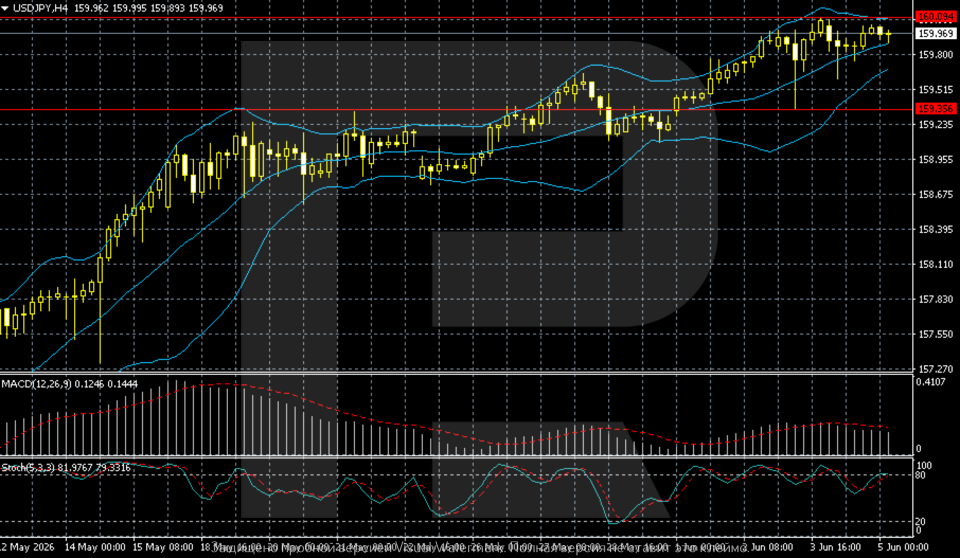
USDJPY trading scenarios for today
Main scenario (Buy Stop)
A breakout and consolidation above 160.00 would confirm continued upward momentum and open the way to further growth.
- Take Profit: 160.25
- Stop Loss: 159.80
Alternative scenario (Sell Stop)
A breakout and consolidation below the 159.35 support level would signal a corrective decline after the prolonged rise.
- Take Profit: 158.80
- Stop Loss: 159.60
Risk factors
Risks to the USDJPY upside scenario remain near 160.00, as further yen weakness could trigger verbal or actual currency interventions by the Japanese authorities. Expectations of a Bank of Japan rate hike and signs of easing geopolitical tensions could further pressure the pair, potentially supporting demand for the JPY.
Summary
The USDJPY pair continues to attempt to break above 160.00. The USDJPY forecast for today, 5 June 2026, does not rule out another attack on 160.00 and consolidation higher near 160.25.
Editors’ picks
 EURUSD 2026-2027 forecast: key market trends and future predictions
This article provides the EURUSD forecast for 2026 and 2027 and highlights the main factors determining the direction of the pair’s movements. We will apply technical analysis, take into account the opinions of leading experts, large banks, and financial institutions, and study AI-based forecasts. This comprehensive insight into EURUSD predictions should help investors and traders make informed decisions.
 Gold (XAUUSD) forecast 2026 and beyond: expert insights, price predictions, and analysis
Dive deep into the Gold (XAUUSD) price outlook for 2026 and beyond, combining technical analysis, expert forecasts, and key macroeconomic factors. It explains the drivers behind gold's historic rally to 4,381 USD, details the impact of the Fed's easing cycle and record central bank buying, and explores potential scenarios as the metal consolidates near 4,000 USD before a projected technical breakout toward 4,500 USD and higher.
Forecasts presented in this section only reflect the author’s private opinion and should not be considered as guidance for trading. RoboForex bears no responsibility for trading results based on trading recommendations described in these analytical reviews.