
USDJPY maintains its rally: how long will the yen keep falling
The USDJPY pair is holding near the highs around 160.35, with the yen looking for a lifeline. Discover more in our analysis for 10 June 2026.
USDJPY forecast: key takeaways
- The USDJPY pair remains very expensive, and little can change the trend
- Neither interventions nor Bank of Japan interest rate expectations helped the yen
- USDJPY forecast for 10 June 2026: 160.40 or 160.55
Fundamental analysis
The USDJPY rate is hovering near 160.35, very close to the highest level since July 2024. The yen remains weak despite accelerating inflation in Japan.
The published statistics showed that producer prices in May rose by 6.1% year-on-year following a revised increase of 5.3% a month earlier. The figure came in well above the market forecast of 5.5%, marking the highest level in the past three years.
The main drivers of accelerating inflation remain high energy prices amid the conflict in the Middle East, as well as the weaker yen. These factors increase the cost of imported goods and raw materials.
Strong inflation data fuelled expectations that the Bank of Japan may raise the interest rate as early as the next meeting. The market is also expecting more hawkish signals from BoJ Governor Kazuo Ueda, with the possibility of another rate hike in September and an additional move in December.
Nevertheless, the yen is still not receiving significant support. Investors continue to prefer the dollar amid strong US statistics and expectations that the Federal Reserve will keep its policy tight. As a result, the USDJPY pair remains near multi-month highs and retains the potential for further volatility.
The USDJPY forecast is positive.
Technical outlook
On the H4 timeframe, the USDJPY pair maintains its upward momentum, forming a sequence of higher highs and higher lows. Quotes have approached the 160.40 resistance level, with the nearest support at 159.35.
The price is moving in the upper part of Bollinger Bands, indicating continued buying pressure. However, the range itself is not expanding sharply: momentum remains moderate. The price has tested the resistance zone several times, but has not yet firmly settled above it.
Indicators point to weakening momentum. MACD is flattening, while the Stochastic Oscillator remains in overbought territory and is beginning to turn downwards. This could indicate a possible short-term correction. However, as long as the price remains above 159.35, the overall upward scenario remains valid.
USDJPY overview
- Asset: USDJPY
- Timeframe: H4 (Intraday)
- Trend: upward
- Key resistance levels: 160.40 and 160.55
- Key support levels: 159.35 and 158.80
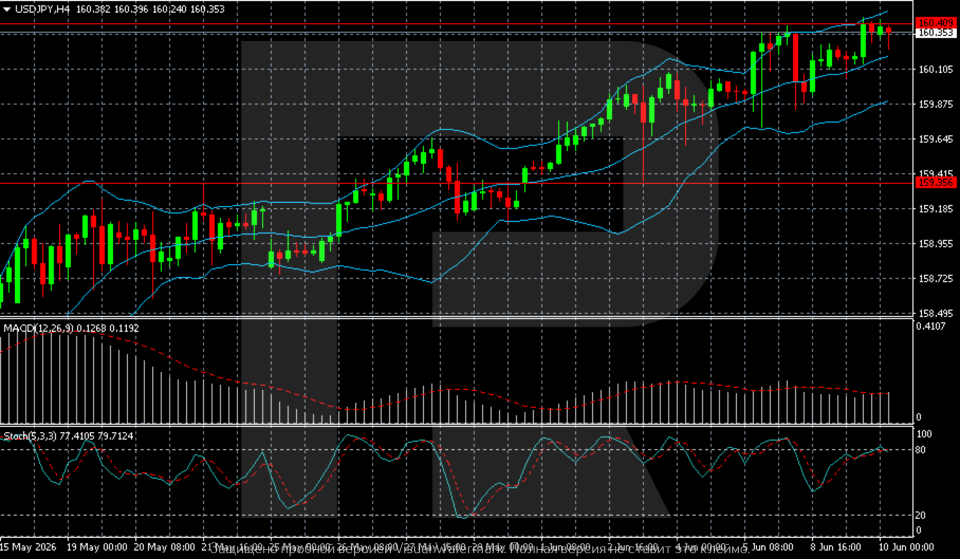
USDJPY trading scenarios for today
Main scenario (Buy Stop)
Consolidation above the 160.40 resistance level would confirm continued upward momentum amid a strong dollar, expectations of tight Fed policy, and yen weakness despite rising inflation in Japan.
- Take Profit: 160.55
- Stop Loss: 160.10
Alternative scenario (Sell Stop)
A breakout below the 159.35 support level would indicate a corrective wave after the prolonged rise and allow sellers to test the 158.80 area.
- Take Profit: 158.80
- Stop Loss: 159.65
Risk factors
Risks to the USDJPY upside scenario remain in place near the 160.00–160.50 level. Further inflation acceleration, more hawkish Bank of Japan rhetoric, and expectations of rate hikes at upcoming meetings may support the yen. However, the baseline scenario remains a move towards new local highs.
Summary
The USDJPY pair remains at its April 2024 highs. The USDJPY forecast for today, 10 June 2026, suggests the trend could develop towards 160.40 and then to 160.55.
Editors’ picks
 EURUSD forecast 2026–2027: technical analysis, price levels & predictions
The ECB holds rates at 2.15% while the Fed stays at 3.75% — and that divergence is the central driver of EURUSD in 2026. The pair is range-bound between 1.1400 and 1.1915, with Deutsche Bank targeting 1.2500 and Morgan Stanley calling for 1.3000 by year-end. We analyse the technicals, break down the macro factors, and outline three trading scenarios with specific entry levels.
 Gold (XAUUSD) forecast 2026: predictions based on fundamental and technical analysis
Where is gold headed after pulling back from the all-time high of 5,597 USD? XAUUSD is consolidating near 4,518 USD between key levels 4,220 USD and 4,855 USD, with major banks targeting 5,243–6,200 USD by year-end. Read our comprehensive gold forecast: technical analysis across three timeframes, trading scenarios with specific entry levels, Fed policy and central bank demand outlook, and institutional predictions for 2026 and beyond.
Forecasts presented in this section only reflect the author’s private opinion and should not be considered as guidance for trading. RoboForex bears no responsibility for trading results based on trading recommendations described in these analytical reviews.