
USDJPY hits a new high: it looks like this may last
The USDJPY pair continues its rally and rises towards 162.78. The interest rate differential is leaving the yen with no chance. Discover more in our analysis for 1 July 2026.
USDJPY forecast: key takeaways
- The USDJPY pair has reached another 40-year high
- The market is expecting intervention, but it is unlikely to have the desired effect
- USDJPY forecast for 1 July 2026: 163.00
Fundamental analysis
The USDJPY rate rose to 162.78 on Wednesday, hitting a new high in nearly four decades. The rapid depreciation of the Japanese currency has increased expectations of possible intervention by the Bank of Japan.
Market attention is focused particularly on Friday, when US markets will be closed for Independence Day. In conditions of low liquidity, the effectiveness of currency interventions traditionally increases. During such periods, the Japanese authorities have already made attempts to stabilise the yen exchange rate.
Robust US economic data remains the main factor weighing on the Japanese currency, supporting expectations of further Fed rate hikes. At the same time, the Bank of Japan maintains a cautious approach to monetary policy normalisation. This is widening the yield gap between US and Japanese assets.
The dollar is further supported by strong demand for safe-haven assets and the continued attractiveness of the carry trade strategy. At the same time, Japan’s dependence on energy imports from the Middle East makes the national currency more sensitive to any escalation in the geopolitical situation in the region.
The USDJPY forecast is positive.
Technical outlook
On the H4 chart, the USDJPY pair remains in a steady uptrend. After breaking confidently above the 161.10 resistance level, quotes accelerated their growth towards 162.78, reaching a new high in nearly 40 years. The price is confidently holding above the middle Bollinger Band, while the bands themselves are expanding upwards, confirming strengthening bullish momentum.
The technical picture remains positive for buyers. The nearest support level is located in the 161.80–162.10 area, where the zone of the latest consolidations lies. The main resistance level now stands in the 162.90–163.00 area, a psychologically important mark beyond which the market may accelerate towards fresh highs. As long as the USDJPY rate holds above 161.10, the advantage lies entirely with buyers.
The indicators confirm continued upward momentum. MACD is in positive territory and continues to rise, signalling stronger buying activity. The Stochastic Oscillator remains in overbought territory, indicating the risk of a short-term correction or profit-taking, but it is not yet giving reversal signals. The baseline scenario suggests further growth with a test of the 163.00 zone, while the likelihood of increased volatility remains high amid expectations of possible currency intervention by the Bank of Japan.
USDJPY overview
- Asset: USDJPY
- Timeframe: H4 (Intraday)
- Trend: upward
- Key resistance levels: 162.90 and 163.00
- Key support levels: 162.10 and 161.80
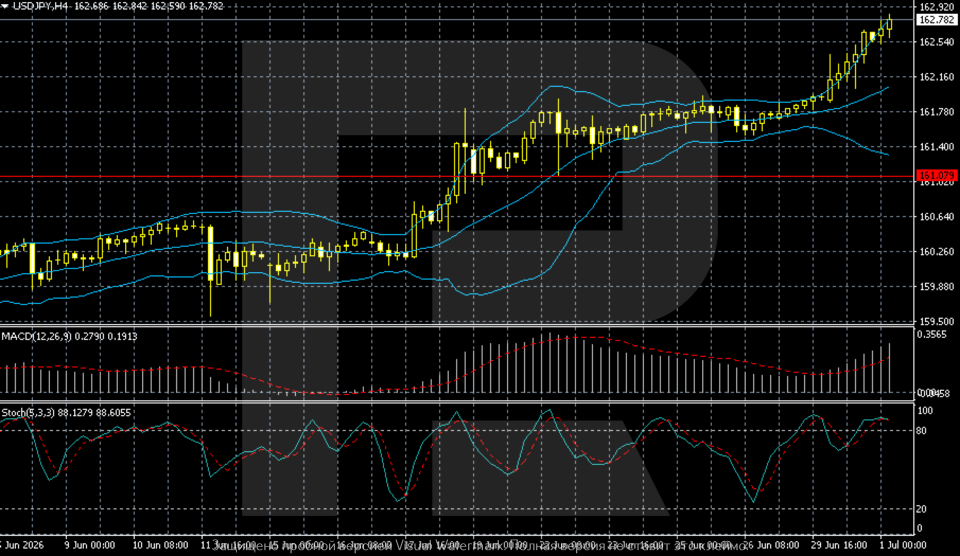
USDJPY trading scenarios for today
Main scenario (Buy Stop)
Consolidation above 162.90 would confirm continued strong upward momentum and open the way to a test of the psychologically important 163.00 level.
- Take Profit: 163.00
- Stop Loss: 162.30
Alternative scenario (Sell Stop)
A breakout below the 162.10 support level would signal a correction after a prolonged rally and may lead to a decline towards 161.80 amid profit-taking and growing expectations of currency intervention by the Japanese authorities.
- Take Profit: 161.80
- Stop Loss: 162.50
Risk factors
The main risk to the USDJPY upside scenario remains possible currency intervention by the Bank of Japan, which becomes more likely as the pair reaches new multi-year highs. An additional factor of volatility will be Friday’s closure of US markets: given low liquidity, any action by the Japanese authorities may trigger sharp price movements.
Summary
The USDJPY pair continues its rally, hitting new multi-year peaks. The USDJPY forecast for today, 1 July 2026, does not rule out a test of the 163.00 level.
Editors’ picks
 EURUSD forecast 2026–2027: technical analysis, price levels & predictions
The ECB holds rates at 2.15% while the Fed stays at 3.75% — and that divergence is the central driver of EURUSD in 2026. The pair is range-bound between 1.1400 and 1.1915, with Deutsche Bank targeting 1.2500 and Morgan Stanley calling for 1.3000 by year-end. We analyse the technicals, break down the macro factors, and outline three trading scenarios with specific entry levels.
 Gold (XAUUSD) forecast 2026: predictions based on fundamental and technical analysis
Where is gold headed after pulling back from the all-time high of 5,597 USD? XAUUSD is consolidating near 4,518 USD between key levels 4,220 USD and 4,855 USD, with major banks targeting 5,243–6,200 USD by year-end. Read our comprehensive gold forecast: technical analysis across three timeframes, trading scenarios with specific entry levels, Fed policy and central bank demand outlook, and institutional predictions for 2026 and beyond.
Forecasts presented in this section only reflect the author’s private opinion and should not be considered as guidance for trading. RoboForex bears no responsibility for trading results based on trading recommendations described in these analytical reviews.