
Rising oil prices put further pressure on the Japanese yen
The USDJPY pair continues to rise, supported by geopolitical tensions and the weakness of the Japanese yen, with the rate currently at 162.26. Discover more in our analysis for 8 July 2026.
USDJPY forecast: key takeaways
- The Japanese yen remains under pressure due to growing geopolitical tensions in the Middle East
- Japan’s Leading Economic Index rose to 116.8 points in May from 116.1 in April, reaching the highest level since July 2021
- Employment in Japan reached a new all-time high, confirming labour market resilience
- USDJPY forecast for 8 July 2026: 163.05
Fundamental analysis
The USDJPY rate is strengthening for the fourth consecutive trading session. Buyers are testing the key resistance level at 162.40. Consolidation above this mark may strengthen the upward momentum, paving the way for further gains.
The Japanese yen remains under pressure amid growing demand for safe-haven assets following new US air strikes on Iran in response to recent attacks on ships in the Strait of Hormuz. The escalation in geopolitical tensions triggered a sharp rise in oil prices, increasing inflation risks. For Japan, more expensive energy imports are creating additional pressure on the economy and the national currency.
At the same time, Japan’s macroeconomic statistics remain mixed. The Leading Economic Index, reflecting the outlook for business activity in the coming months, rose to 116.8 points in May 2026 from 116.1 a month earlier. Despite the increase, the figure came in slightly below the market forecast of 116.9 points, although it reached its highest level since July 2021.
The labour market remains resilient. The unemployment rate remained at 2.5% in May, its lowest level since July 2025, while employment reached a new all-time high, confirming stable labour demand.
At the same time, consumer activity remains weak. Household spending fell by 0.4% year-on-year after declining by 0.5% a month earlier. Although the result came in significantly better than the forecast, the indicator declined for the sixth consecutive month, pointing to restrained domestic demand.
Technical outlook
The USDJPY rate is correcting after rebounding from a key resistance level, but it continues to trade within an ascending channel, which keeps the advantage with buyers. Today’s USDJPY forecast suggests renewed growth with a target at 163.05.
The technical picture remains favourable for further strengthening of the pair. The Stochastic Oscillator has moved out of overbought territory, indicating weaker selling pressure and the potential for a new upward momentum. A breakout and consolidation above the 162.45 resistance level would further confirm the bullish scenario.
An alternative scenario suggests a deeper downward correction if the price breaks below the lower boundary of the ascending channel and consolidates below 162.05. This signal will cancel the scenario of further growth and open the way for the pair to decline.
USDJPY overview
- Asset: USDJPY
- Timeframe: M15 (Intraday)
- Trend: upward
- Key resistance levels: 162.45 and 162.85
- Key support levels: 162.10 and 161.70
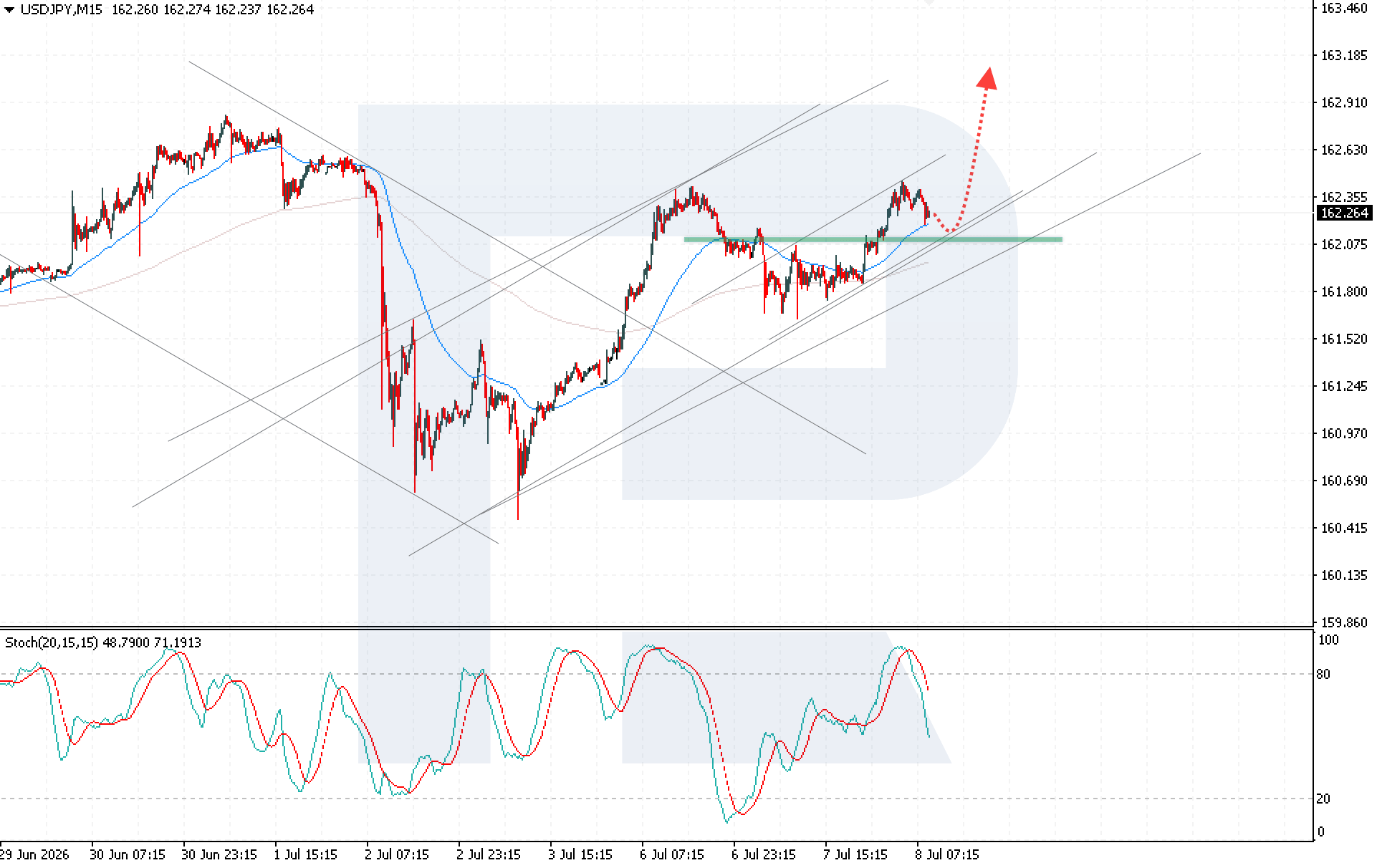
USDJPY trading scenarios for today
Main scenario (Buy Limit)
A rebound from the lower boundary of the bullish channel at 162.10 would create conditions for opening long positions and indicate continued upward momentum.
- Take Profit: 163.04
- Stop Loss: 161.90
Alternative scenario (Sell Stop)
A breakout below the lower boundary of the bullish channel, with the price consolidating below 162.05, would signal stronger bearish pressure and a decline.
- Take Profit: 162.10
- Stop Loss: 161.55
Risk factors
The risk to the USDJPY upside scenario remains in place if demand for the Japanese yen as a safe-haven asset strengthens amid easing geopolitical tensions. More hawkish BoJ rhetoric and expectations of further interest rate hikes may become an additional pressure factor for the pair, limiting the upward move.
Summary
As long as the USDJPY rate remains above the 162.05 support level, buyers have the upper hand, while the most likely scenario remains continued growth, with the price retesting the 162.45 resistance level and moving towards 163.05.
Editors’ picks
 EURUSD forecast 2026–2027: technical analysis, price levels & predictions
The ECB holds rates at 2.15% while the Fed stays at 3.75% — and that divergence is the central driver of EURUSD in 2026. The pair is range-bound between 1.1400 and 1.1915, with Deutsche Bank targeting 1.2500 and Morgan Stanley calling for 1.3000 by year-end. We analyse the technicals, break down the macro factors, and outline three trading scenarios with specific entry levels.
 Gold (XAUUSD) forecast 2026: predictions based on fundamental and technical analysis
Where is gold headed after pulling back from the all-time high of 5,597 USD? XAUUSD is consolidating near 4,518 USD between key levels 4,220 USD and 4,855 USD, with major banks targeting 5,243–6,200 USD by year-end. Read our comprehensive gold forecast: technical analysis across three timeframes, trading scenarios with specific entry levels, Fed policy and central bank demand outlook, and institutional predictions for 2026 and beyond.
Forecasts presented in this section only reflect the author’s private opinion and should not be considered as guidance for trading. RoboForex bears no responsibility for trading results based on trading recommendations described in these analytical reviews.