
USDJPY back at 162.00, the yen loses its last advantages
The yen continues to lose ground amid the escalation of the conflict in the Middle East, with the USDJPY rate currently at 162.00. Find out more in our analysis for 13 July 2026.
USDJPY forecast: key takeaways
- Geopolitical shock in the Strait of Hormuz
- The threat of intervention by the Japanese government remains
- USDJPY forecast for 13 July 2026: 161.30 and 162.70
Fundamental analysis
Fundamental analysis for 13 July 2026 shows that the pair continues to rise and is trading around 162.00.
The main drivers of USDJPY growth today are the geopolitical shock in the Strait of Hormuz and the interest rate gap between the US and Japan.
Over the weekend, the conflict between the US and Iran escalated again. The US launched strikes on Iran after Tehran announced the closure of the Strait of Hormuz. Iran responded with missile strikes on US military bases in the Persian Gulf. This round of conflict hit the yen directly, as Japan imports more than 90% of its oil through the strait. Uncertainty around energy supplies heightened concerns about the Japanese economy, which immediately weakened its currency.
The key structural factor is the huge interest rate gap between the US and Japan. The Federal Reserve is expected to keep the interest rate at 3.50-3.75% at its next meeting. The Bank of Japan, although it has raised its rate to 1.0% (the highest since 1995), is still lagging behind.
Two factors are keeping the JPY afloat: the threat of intervention by the Japanese government and the stimulation of GPIF pension fund investment in Japanese assets.
Technical outlook
On the H4 chart, the USDJPY pair formed a Hammer reversal pattern near the lower Bollinger Band, trading around 162.00. Since the price remains within an ascending channel, it may continue its upward trajectory following the pattern signal, with the upside target at 162.70.
At the same time, the USDJPY forecast also suggests another market scenario, where the USDJPY rate may form a corrective wave towards 161.30 before growth resumes.
USDJPY overview
- Asset: USDJPY
- Timeframe: H4 (Intraday)
- Trend: upward
- Key resistance levels: 162.20 and 162.70
- Key support levels: 161.30 and 160.55
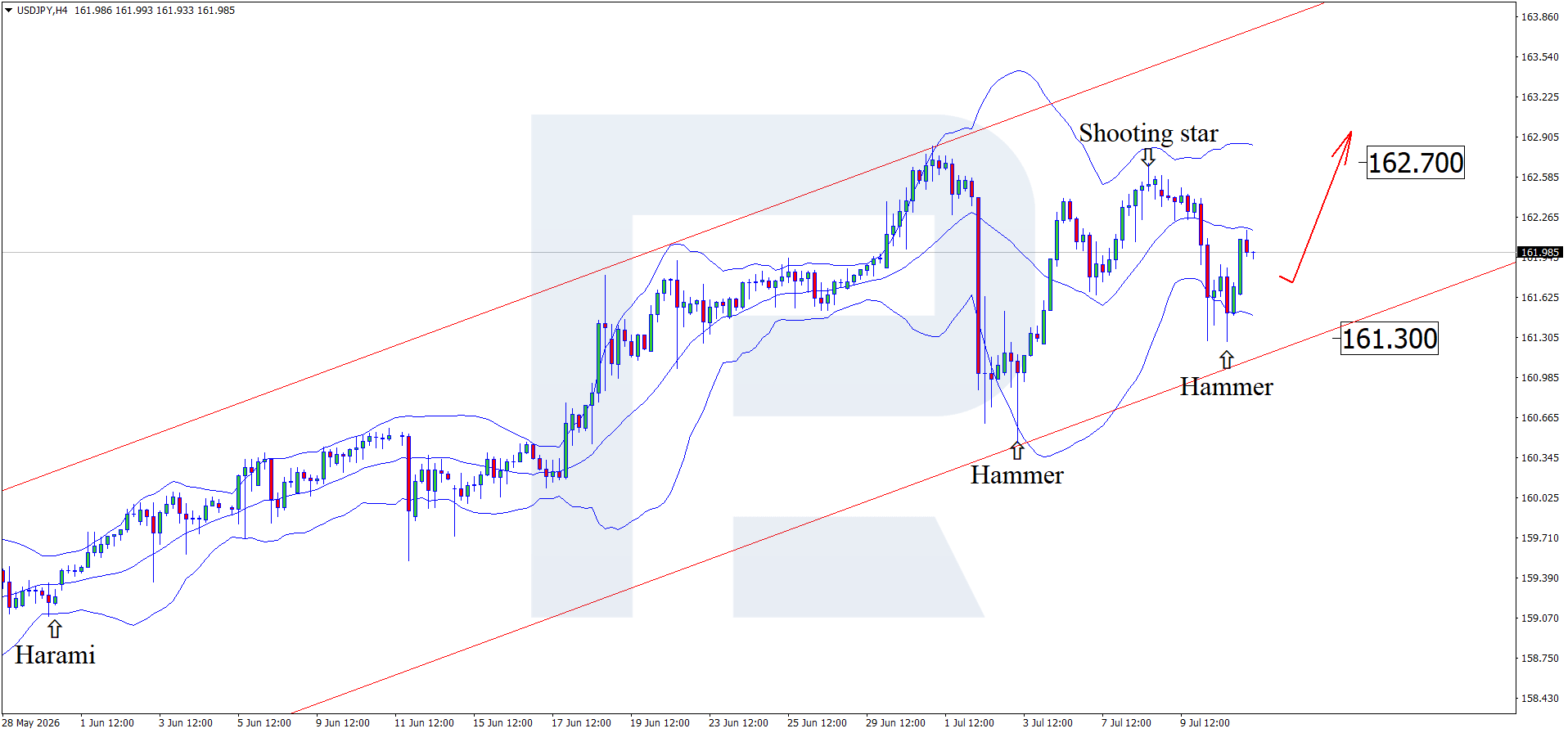
USDJPY trading scenarios for today
Main scenario (Buy Stop)
A breakout above the 162.20 resistance level would create conditions for opening long positions and indicate a continuation of the uptrend.
- Take Profit: 162.70
- Stop Loss: 161.95
Alternative scenario (Sell Stop)
A breakout below the lower boundary of the ascending channel, with the price consolidating below 161.30, would signal increased bearish pressure and a decline.
- Take Profit: 160.55
- Stop Loss: 161.50
Risk factors
The risk to the USDJPY upside scenario remains if demand for the Japanese yen as a safe-haven asset strengthens amid easing geopolitical tensions. More hawkish BoJ rhetoric, currency intervention, and expectations of further interest rate hikes may become additional pressure factors for the pair, limiting the upward movement.
Summary
The forecast for 13 July 2026 is not favourable for the yen, which continues to lose ground amid the escalating conflict in the Middle East. USDJPY technical analysis suggests growth towards 162.70.
Editors’ picks
 EURUSD forecast 2026–2027: technical analysis, price levels & predictions
The ECB holds rates at 2.15% while the Fed stays at 3.75% — and that divergence is the central driver of EURUSD in 2026. The pair is range-bound between 1.1400 and 1.1915, with Deutsche Bank targeting 1.2500 and Morgan Stanley calling for 1.3000 by year-end. We analyse the technicals, break down the macro factors, and outline three trading scenarios with specific entry levels.
 Gold (XAUUSD) forecast 2026: predictions based on fundamental and technical analysis
Gold has corrected over 25% from its all-time high of 5,597 USD and is now trading near 4,100 USD — testing a critical support zone. Is this the bottom, or will the downtrend continue? We break down the key levels (support 3,920 USD, breakout trigger 4,500 USD), three trading scenarios with entry levels, and what J.P. Morgan, Goldman Sachs and Deutsche Bank are forecasting for gold in 2026.
Forecasts presented in this section only reflect the author’s private opinion and should not be considered as guidance for trading. RoboForex bears no responsibility for trading results based on trading recommendations described in these analytical reviews.