
USDJPY hits new high: the yen has little chance of improvement
The USDJPY pair rose to 163.16. The outlook for the yen looks very bleak. Discover more in our analysis for 22 July 2026.
USDJPY forecast: key takeaways
- The USDJPY pair is rising confidently, with high oil prices and the interest rate differential playing against the yen
- A minor correction is possible before a new upward move
- USDJPY forecast for 22 July 2026: 163.70
Fundamental analysis
The USDJPY rate soared on Wednesday to its highest level since October 1986 and touched 163.16. The sharp fall in the yen increased expectations of possible intervention by the Japanese authorities.
The yen is under pressure from rising oil prices due to the escalation in the Middle East and Japan’s high dependence on energy imports from the region. A stronger dollar and rising US Treasury yields are also supporting carry trade operations amid a wide gap between US and Japanese rates.
Fears about public finances following the announcement of large-scale budget spending have added to the pressure. The Bank of Japan’s cautious approach to monetary policy normalisation is also weighing on the national currency.
In June, Japan’s trade balance returned to deficit again, as imports grew faster than exports.
The USDJPY forecast is positive.
Technical outlook
On the H4 chart, the USDJPY pair maintains pronounced upward momentum, trading at 163.17. The price consolidated above the middle Bollinger Band and is moving along the upper boundary of the indicator, confirming the advantage of buyers.
The nearest resistance level is located in the 163.30–163.40 zone. A breakout above this area will open the way to 163.70. Support levels lie at 162.90 and 162.55. As long as the pair remains above 162.90, the baseline scenario suggests continued growth.
MACD is in positive territory and is strengthening, supporting the bullish signal. The Stochastic Oscillator remains in overbought territory and is starting to turn downwards, so a short-term correction is possible before a new move. The overall bias remains upward.
USDJPY overview
- Asset: USDJPY
- Timeframe: H4 (Intraday)
- Trend: bullish
- Key resistance levels: 163.40 and 163.70
- Key support levels: 162.90 and 162.55
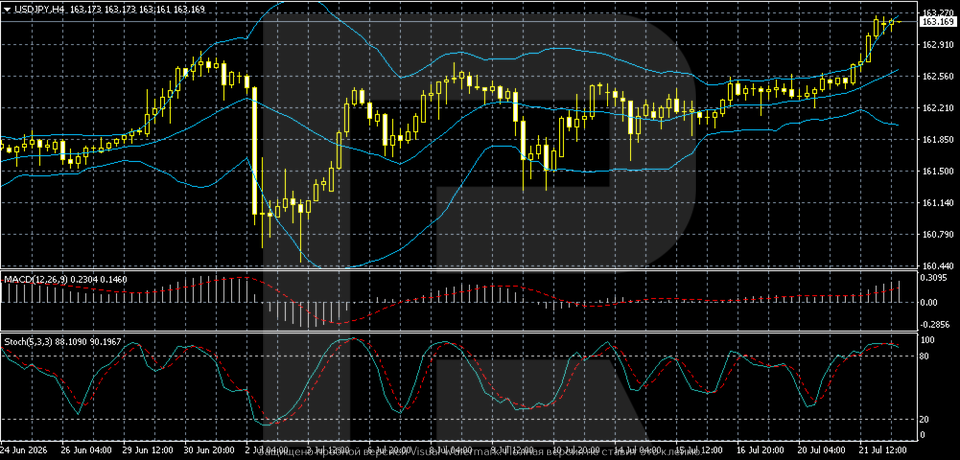
USDJPY trading scenarios for today
Main scenario (Buy Stop)
A breakout and consolidation above the 163.30–163.40 resistance zone would confirm continued strong upward momentum and create conditions for further USDJPY growth.
- Take Profit: 163.70
- Stop Loss: 163.10
Alternative scenario (Sell Stop)
A decline and consolidation below the 162.90 level would indicate a correction following the new multi-year high.
- Take Profit: 162.55
- Stop Loss: 163.15
Risk factors
The main risk to the USDJPY upside scenario remains currency intervention by the Japanese authorities amid further yen weakening. Additional pressure on the pair will come from lower oil prices, a de-escalation of the conflict in the Middle East, or falling US Treasury yields. As long as the price remains above 162.90, buyers will have the upper hand.
Summary
The USDJPY pair reached another multi-year high. The USDJPY forecast for today, 22 July 2026, does not rule out a new upside target at 163.70.
Editors’ picks
 EURUSD forecast 2026–2027: technical analysis, price levels & predictions
EURUSD has pulled back from the 2026 high of 1.1915 and is now trading near 1.1450 — below both EMA65 and EMA200 — with the active scenario shifting from bullish to bearish. The ECB raised rates to 2.40%, but the Fed holds at 3.75%, and US inflation (3.5%) continues to outpace the eurozone (2.8%). A confirmed break below 1.1280 opens the next downward wave toward 1.1080. We break down the key levels, three trading scenarios with entry triggers, and what Deutsche Bank, Morgan Stanley and UBS are forecasting for EURUSD in 2026.
 Gold (XAUUSD) forecast 2026: predictions based on fundamental and technical analysis
Gold has corrected over 25% from its all-time high of 5,597 USD and is now trading near 4,100 USD — testing a critical support zone. Is this the bottom, or will the downtrend continue? We break down the key levels (support 3,920 USD, breakout trigger 4,500 USD), three trading scenarios with entry levels, and what J.P. Morgan, Goldman Sachs and Deutsche Bank are forecasting for gold in 2026.
Forecasts presented in this section only reflect the author’s private opinion and should not be considered as guidance for trading. RoboForex bears no responsibility for trading results based on trading recommendations described in these analytical reviews.