
USDJPY rises as the yen outlook deteriorates further
The USDJPY pair continues to rise and is currently trading near 163.76, with the yen having little chance of recovering. Find more details in our analysis for 28 July 2026.
USDJPY forecast: key takeaways
- The USDJPY pair is rising due to the interest rate differential between the Federal Reserve and the Bank of Japan
- The BoJ is likely to leave its interest rate unchanged on Friday
- USDJPY forecast for 28 July 2026: 164.05
Fundamental analysis
The USDJPY rate climbed to 163.76 on Tuesday. The Japanese yen remains near a four-decade low, pressured by a resilient US dollar and expectations that the Federal Reserve could raise interest rates as early as this week.
The Bank of Japan is expected to leave its interest rate unchanged on Friday while keeping the door open to further policy tightening. This is intended to curb the yen’s depreciation.
Verbal interventions by the Japanese authorities have provided little support for the national currency. At the same time, the Bank of Japan has offered no clear guidance on the timing or pace of future rate hikes, maintaining uncertainty in the market.
The yen also received no significant support after Donald Trump’s statement about good talks with Iran. Hopes that the conflict may end pushed oil prices lower and slightly reduced inflation risks, but fundamental pressure on the Japanese currency remains strong.
The USDJPY outlook is moderately bullish.
Technical outlook
On the H4 chart, the USDJPY pair maintains an upward structure and is trading near 163.77. The price remains above the middle Bollinger Band and is gradually approaching the indicator’s upper boundary, so buyers remain in control.
The nearest resistance lies in the 164.00–164.05 area. A breakout above this zone would allow the pair to reach new local highs. Support levels are located at 163.55 and 163.10. As long as the price remains above 163.55, the baseline scenario suggests continued growth.
MACD is in positive territory, although the upward momentum is gradually losing strength. The Stochastic Oscillator has moved into overbought territory, so a pause or short-term correction is possible near the 164.00 resistance level. The baseline scenario remains movement within the 163.55–164.05 range with a moderately bullish bias.
USDJPY overview
- Asset: USDJPY
- Timeframe: H4 (intraday)
- Trend: bullish
- Key resistance levels: 164.05 and 164.55
- Key support levels: 163.55 and 163.10
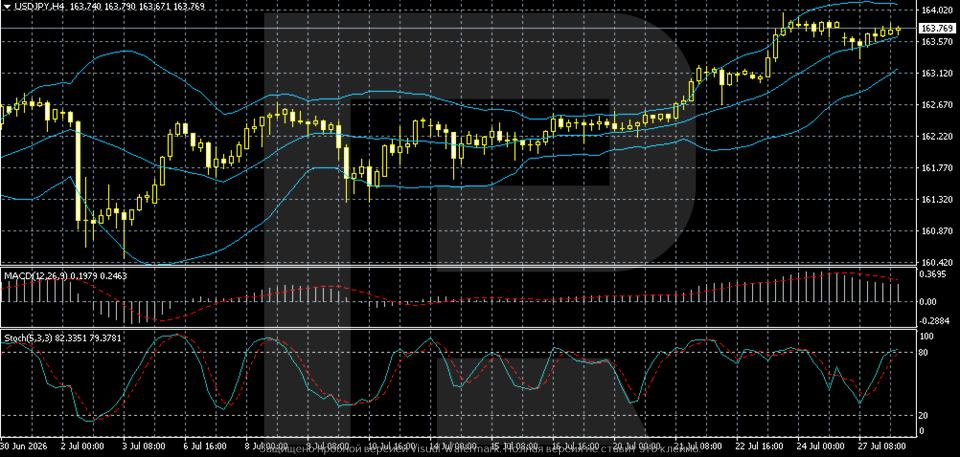
USDJPY trading scenarios for today
Main scenario (Buy Stop)
A breakout and consolidation above the 164.05 resistance level would confirm continued upward momentum and create conditions for a further rise in the USDJPY pair.
- Take Profit: 164.55
- Stop Loss: 163.80
Alternative scenario (Sell Stop)
A breakout and consolidation below the 163.55 support level would indicate weakening buying pressure and a short-term correction.
- Take Profit: 163.10
- Stop Loss: 163.80
Risk factors
The main risk to the USDJPY bullish scenario remains potential currency intervention by the Japanese authorities. Additional pressure on the pair could come from more hawkish signals from the Bank of Japan, lower US Treasury yields, or US dollar weakness following the Federal Reserve meeting. As long as the price remains above 163.55, buyers retain the advantage.
Summary
The USDJPY pair continues to rise, with too few factors providing real support for the yen. The USDJPY forecast for today, 28 July 2026, suggests a move towards 164.05.
Editors’ picks
 EURUSD forecast 2026–2027: technical analysis, price levels & predictions
EURUSD has pulled back from the 2026 high of 1.1915 and is now trading near 1.1450 — below both EMA65 and EMA200 — with the active scenario shifting from bullish to bearish. The ECB raised rates to 2.40%, but the Fed holds at 3.75%, and US inflation (3.5%) continues to outpace the eurozone (2.8%). A confirmed break below 1.1280 opens the next downward wave toward 1.1080. We break down the key levels, three trading scenarios with entry triggers, and what Deutsche Bank, Morgan Stanley and UBS are forecasting for EURUSD in 2026.
 Gold (XAUUSD) forecast 2026: predictions based on fundamental and technical analysis
Gold has corrected over 25% from its all-time high of 5,597 USD and is now trading near 4,100 USD — testing a critical support zone. Is this the bottom, or will the downtrend continue? We break down the key levels (support 3,920 USD, breakout trigger 4,500 USD), three trading scenarios with entry levels, and what J.P. Morgan, Goldman Sachs and Deutsche Bank are forecasting for gold in 2026.
Forecasts presented in this section only reflect the author’s private opinion and should not be considered as guidance for trading. RoboForex bears no responsibility for trading results based on trading recommendations described in these analytical reviews.