
USDJPY: interventions are over, a turbulent week lies ahead
The USDJPY pair starts the week near 157.75. The key question is whether this round of interventions has ended or whether more is to come. Find out more in our analysis for 3 August 2026.
USDJPY forecast: key takeaways
- The USDJPY rate fell sharply following interventions
- It remains unclear whether the liquidity injections into the market have ended
- USDJPY forecast for 3 August 2026: 157.47
Fundamental analysis
The USDJPY rate starts the week near 157.75.
Japan is preparing to officially confirm coordinated action with the US to support the yen. According to Reuters sources, Finance Minister Satsuki Katayama is expected to state on Monday that Tokyo and Washington coordinated operations in the foreign exchange market to stop the yen from falling to 40-year lows. One source noted that the operation is still ongoing. Both sides intend to counter excessive weakness in the Japanese currency.
This would mark the first joint intervention by Japan and the US since 2011. Market participants estimate that the Japanese authorities purchased yen with US dollars during New York trading, and Bank of Japan data suggests that the volume of operations may have reached up to 58.97 billion USD. The USDJPY pair then retreated sharply from highs above 164, although the market attributes some of the move to repeated interventions following the Bank of Japan meeting.
The regulator itself left interest rates unchanged on Friday but indicated that further hikes remain likely. The authorities are seeking to demonstrate that their foreign exchange and monetary policies are aligned: Japan’s top currency diplomat, Atsushi Mimura, said there was close coordination with the Bank of Japan. An additional signal came from the US, where the Treasury, according to Reuters, warned banks of possible further operations and urged them to be prepared for additional action.
The market is also paying particular attention to a rare English-language statement from Japan’s Ministry of Finance referring to a broad range of instruments available to maintain liquidity. This includes access to the Federal Reserve’s repo facility, which allows Japan to obtain US dollars without directly selling US government bonds. This is important, as prolonged interventions funded by selling Treasuries could increase pressure on the US debt market and push yields higher.
For the yen, this means that the authorities have moved from verbal warnings to tougher action. However, sustained currency appreciation will depend not only on further interventions but also on the Bank of Japan’s willingness to continue raising interest rates. As long as the yield gap between the US and Japan remains wide, interventions may trigger sharp movements, but their effect could prove temporary without support from monetary policy.
The USDJPY outlook is mixed.
Technical outlook
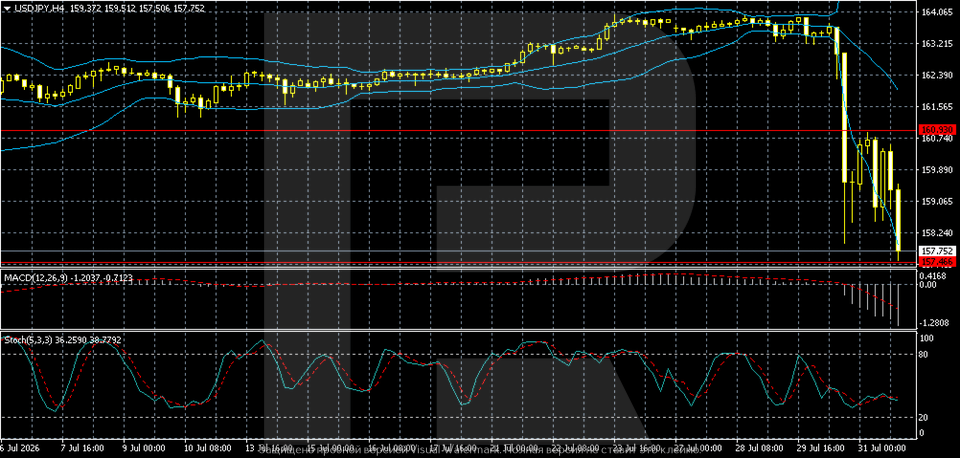
On the H4 chart, the USDJPY pair formed a sharp downward momentum after reversing from the 164.00 area. The pair plunged to 157.75, moving well below the middle Bollinger Band and testing the indicator’s lower boundary. The bands have widened sharply, confirming increased volatility and a clear advantage for sellers.
The key support level is located at 157.47. A breakout below this mark would strengthen the downward move and create a risk of further losses. The nearest resistance lies in the 159.05–159.90 area, with the key level for a recovery remaining at 160.93. As long as the price stays below 160.93, any upward attempts are likely to be corrective.
MACD has moved deep into negative territory, while bearish momentum continues to build. The Stochastic Oscillator remains near the lower part of the range but has yet to provide a strong reversal signal. The baseline scenario remains movement within the 157.47–160.93 range, with a negative bias and a risk of another test of the support level.
USDJPY overview
- Asset: USDJPY
- Timeframe: H4 (intraday)
- Trend: bearish
- Key resistance levels: 159.90 and 160.93
- Key support levels: 157.47 and 155.02
USDJPY trading scenarios for today
Main scenario (Sell Stop)
A breakout and consolidation below the 157.47 support level would confirm continued selling pressure and create conditions for a further decline in USDJPY.
- Take Profit: 155.02
- Stop Loss: 158.20
Alternative scenario (Buy Stop)
A breakout and consolidation above the 159.90 resistance level would indicate weakening bearish momentum and a corrective recovery in the pair.
- Take Profit: 160.93
- Stop Loss: 159.20
Risk factors
The main risk to the USDJPY bearish scenario is the end of the joint interventions by Japan and the US, after which the wide interest rate differential could once again support the US dollar. Further yen purchases by the authorities and more hawkish signals from the Bank of Japan could add to pressure on the pair. As long as the price remains below 160.93, sellers retain the advantage.
Summary
The USDJPY pair has undergone large-scale interventions. The USDJPY forecast for today, 3 August 2026, does not rule out a move towards 157.47.
Editors’ picks
 EURUSD forecast 2026–2027: technical analysis, price levels & predictions
EURUSD has pulled back from the 2026 high of 1.1915 and is now trading near 1.1450 — below both EMA65 and EMA200 — with the active scenario shifting from bullish to bearish. The ECB raised rates to 2.40%, but the Fed holds at 3.75%, and US inflation (3.5%) continues to outpace the eurozone (2.8%). A confirmed break below 1.1280 opens the next downward wave toward 1.1080. We break down the key levels, three trading scenarios with entry triggers, and what Deutsche Bank, Morgan Stanley and UBS are forecasting for EURUSD in 2026.
 Gold (XAUUSD) forecast 2026: predictions based on fundamental and technical analysis
Gold has corrected over 25% from its all-time high of 5,597 USD and is now trading near 4,100 USD — testing a critical support zone. Is this the bottom, or will the downtrend continue? We break down the key levels (support 3,920 USD, breakout trigger 4,500 USD), three trading scenarios with entry levels, and what J.P. Morgan, Goldman Sachs and Deutsche Bank are forecasting for gold in 2026.
Forecasts presented in this section only reflect the author’s private opinion and should not be considered as guidance for trading. RoboForex bears no responsibility for trading results based on trading recommendations described in these analytical reviews.