
USDJPY holds the 155.85 support level after large-scale currency operations
The USDJPY rate is recovering after a sharp decline amid intervention by the US and Japanese authorities, with the rate currently at 157.64. For more details, see our analysis for 4 August 2026.
USDJPY forecast: key takeaways
- The Bank of Japan reported currency operations totalling approximately 5.33 trillion yen on Friday
- BoJ Governor Kazuo Ueda stated the need to maintain heightened focus on inflation
- The Bank of Japan remains prepared to adjust monetary policy depending on future inflation trends
- USDJPY forecast for 4 August 2026: 155.15
Fundamental analysis
The USDJPY rate entered a correction phase after four consecutive trading sessions of declines triggered by coordinated action from the US and Japanese authorities to stabilise the currency market. Buyers managed to hold the key support level near 155.85, allowing the pair to begin a recovery.
According to BoJ data, Tokyo spent around 5.33 trillion yen on currency operations on Friday. This followed reports of a record one-day intervention a day earlier, worth approximately 8.45 trillion yen, aimed at supporting the Japanese currency.
Earlier, the Bank of Japan kept its interest rate unchanged, fully in line with market expectations. At the same time, the regulator noted persistent inflation risks associated with rising prices amid geopolitical tensions in the Middle East and robust domestic demand.
BoJ Governor Kazuo Ueda stressed the need to remain highly attentive to inflation risks, indicating the regulator’s readiness to continue closely monitoring price movements and adjust monetary policy if necessary.
Technical outlook
The USDJPY rate is developing a corrective move while forming a Wedge reversal pattern. Buyers gained a foothold above the EMA-65, signalling increased bullish pressure. However, today’s USDJPY forecast suggests that the downward move could resume towards 155.15.
Indicator analysis confirms the potential for a further decline in the USDJPY rate. The Stochastic Oscillator has reached overbought territory and is testing a descending resistance line, which may indicate a new bearish momentum. A confident breakout below the 157.05 support level would further confirm continued downside, indicating a breakout out of the Wedge reversal pattern.
At the same time, the risk of a continued bullish correction remains. A breakout above the upper boundary of the descending channel and consolidation above 158.35 would signal a further increase in buying pressure and invalidate the current bearish scenario.
USDJPY overview
- Asset: USDJPY
- Timeframe: M15 (intraday)
- Trend: bearish
- Key resistance levels: 158.15 and 158.65
- Key support levels: 157.15 and 156.10
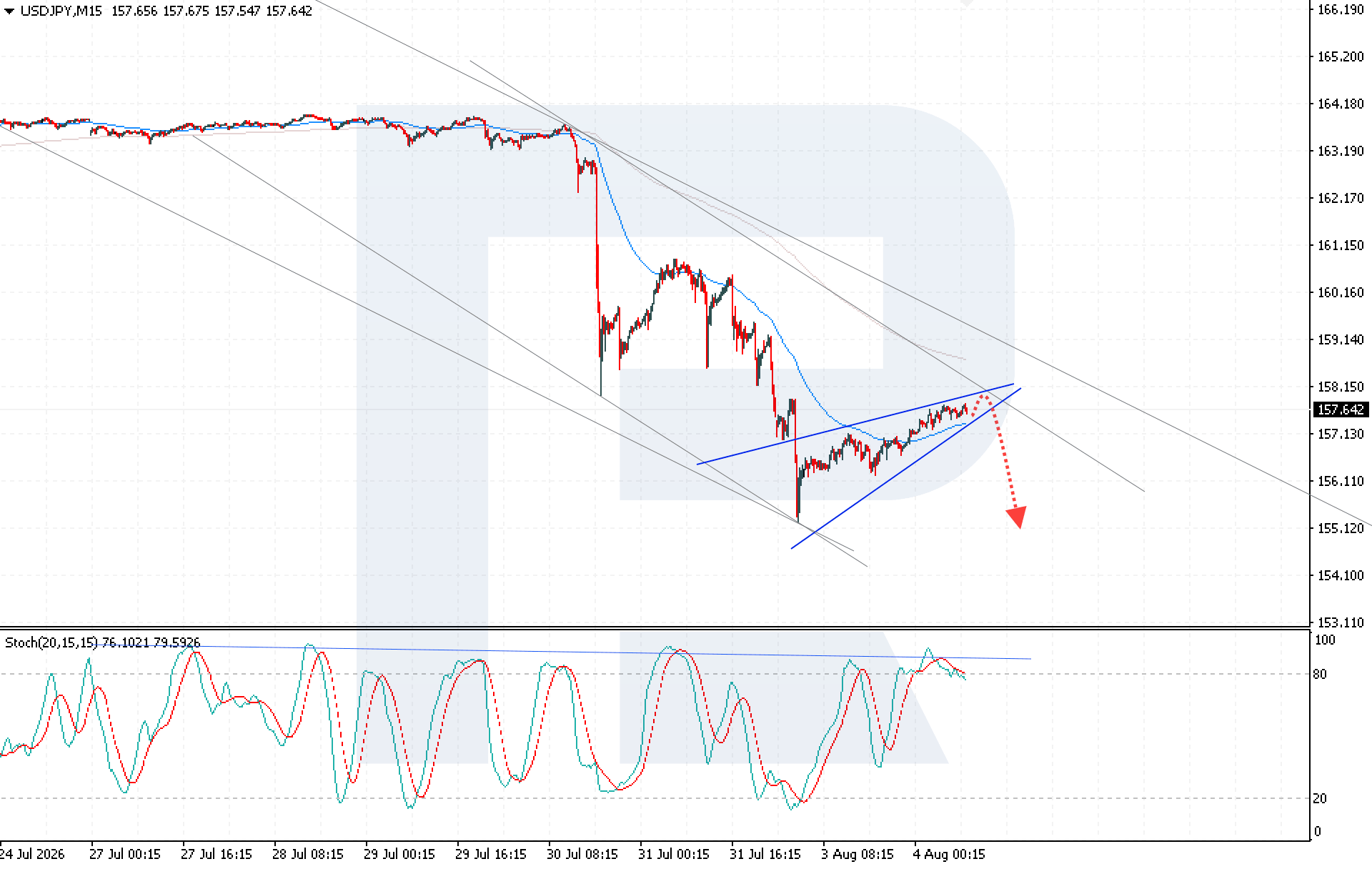
USDJPY trading scenarios for today
Main scenario (Sell Stop)
A breakout below the lower boundary of the Wedge reversal pattern, followed by consolidation below 157.15, would indicate increased selling pressure and a renewed decline.
- Take Profit: 155.15
- Stop Loss: 158.45
Alternative scenario (Buy Stop)
A breakout above the upper boundary of the descending channel, followed by consolidation above 158.35, would invalidate the Wedge reversal pattern and signal continued growth.
- Take Profit: 160.25
- Stop Loss: 157.95
Risk factors
The main risk to the USDJPY bearish scenario remains sustained buying pressure following currency interventions and consolidation above key resistance levels. A breakout above the 158.35 area and an exit from the descending channel could invalidate the bearish scenario and extend the upward correction.
Summary
The USDJPY rate retains the potential for a further decline after the corrective recovery is complete, with a breakout below the 157.05 support level serving as the key signal for sellers.
Editors’ picks
 EURUSD forecast 2026–2027: technical analysis, price levels & predictions
EURUSD has pulled back from the 2026 high of 1.1915 and is now trading near 1.1450 — below both EMA65 and EMA200 — with the active scenario shifting from bullish to bearish. The ECB raised rates to 2.40%, but the Fed holds at 3.75%, and US inflation (3.5%) continues to outpace the eurozone (2.8%). A confirmed break below 1.1280 opens the next downward wave toward 1.1080. We break down the key levels, three trading scenarios with entry triggers, and what Deutsche Bank, Morgan Stanley and UBS are forecasting for EURUSD in 2026.
 Gold (XAUUSD) forecast 2026: predictions based on fundamental and technical analysis
Gold has corrected over 25% from its all-time high of 5,597 USD and is now trading near 4,100 USD — testing a critical support zone. Is this the bottom, or will the downtrend continue? We break down the key levels (support 3,920 USD, breakout trigger 4,500 USD), three trading scenarios with entry levels, and what J.P. Morgan, Goldman Sachs and Deutsche Bank are forecasting for gold in 2026.
Forecasts presented in this section only reflect the author’s private opinion and should not be considered as guidance for trading. RoboForex bears no responsibility for trading results based on trading recommendations described in these analytical reviews.