
Yen under threat again: USDJPY consolidates before the trend resumes
Taken together, the published US inflation data has made the fundamental backdrop for the USDJPY pair moderately negative, with the rate currently standing at 159.30. For more details, see our analysis for 17 August 2026.
USDJPY forecast: key takeaways
- US PPI in July was unchanged month-on-month, compared to a forecast of +0.2%, following a revised 0.1% decline a month earlier
- US CPI slowed from 3.5% to 3.4% year-on-year in July
- The risk of intervention remains
- USDJPY forecast for 17 August 2026: 160.65
Fundamental analysis
Fundamental analysis for 17 August 2026 shows that the yen is completing a correction following the Bank of Japan’s intervention.
US consumer inflation slowed from 3.5% to 3.4% year-on-year in July, fully matching the forecast, while the core CPI declined to 2.5%. The PPI proved more important for the currency market: producer prices were unchanged month-on-month compared to a forecast of +0.2%, after a revised decline of 0.1% a month earlier. The likelihood of a Federal Reserve rate hike in September fell to around 35%.
This has a direct impact on the USDJPY pair due to the interest rate differential between the US and Japan. At its July meeting, the Federal Reserve kept the target range at 3.50–3.75%, although three FOMC members voted for a 25-basis-point hike. On 31 July, the Bank of Japan kept its short-term rate at around 1.0%, with one board member already voting to raise it to 1.25%.
Following the intervention, the pair recovered to around 159.3–159.5, although Japanese officials continue to signal their readiness to intervene again if the yen sharply weakens.
The USDJPY forecast for 17 August 2026 is moderately bearish for the yen. The CPI alone is not a strong negative signal for the dollar, as the reading fully matched the forecast and inflation at 3.4% remains well above the Federal Reserve’s target. However, a weak PPI significantly reinforces the importance of the CPI data: the lack of growth in producer prices reduces the likelihood of renewed inflationary pressure.
Technical outlook
On the H4 chart, the USDJPY pair has formed a sideways channel, with the resistance level at 159.55 and support at 158.60. On the D1 chart, resistance has formed at 163.95, while the support level is located at 155.20. Further strengthening of the JPY towards 156.65 is the most likely scenario.
In an alternative scenario, if the USDJPY pair continues to correct, the price could break above the H4 resistance level and rise towards 160.85.
USDJPY overview
- Asset: USDJPY
- Timeframe: H4 (intraday)
- Trend: bearish
- Key resistance levels: 159.55 and 163.95
- Key support levels: 158.60 and 155.20
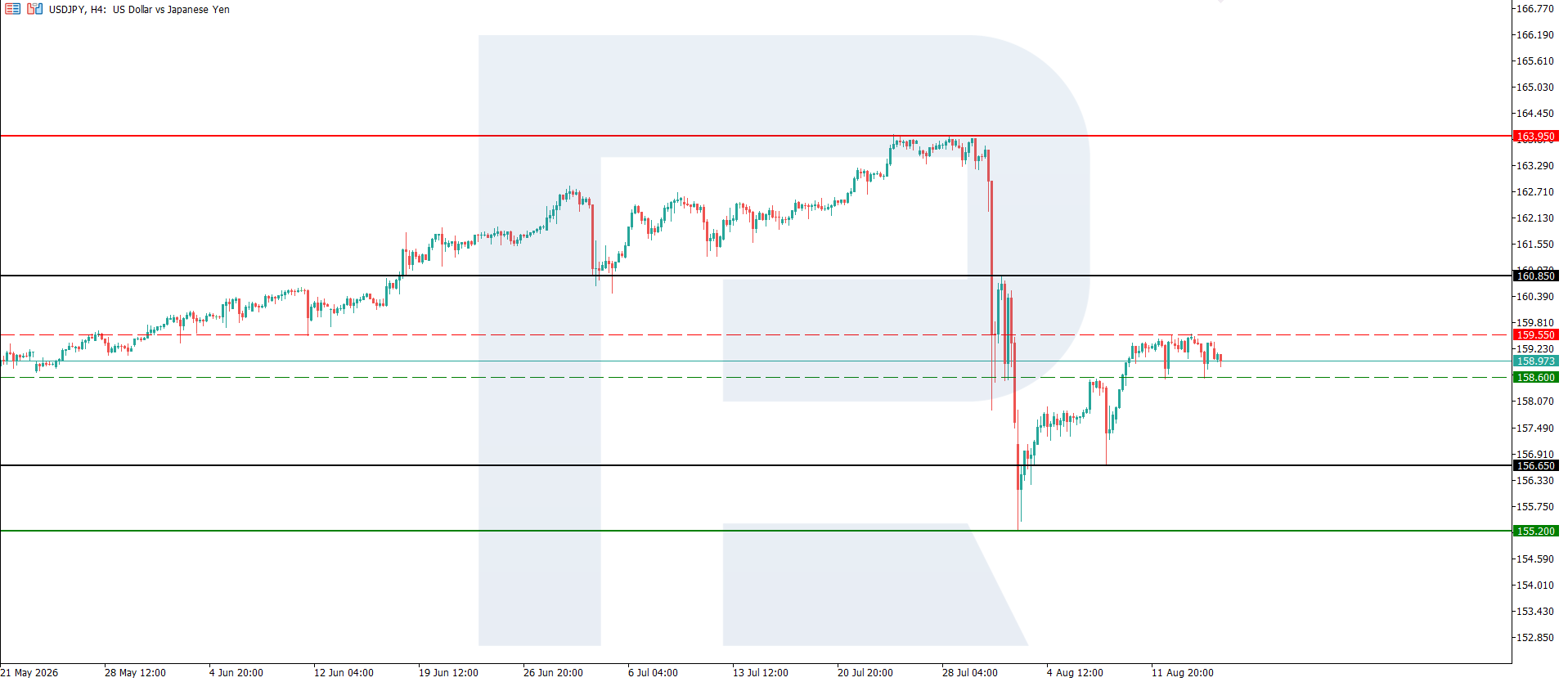
USDJPY trading scenarios for today
Main scenario (Sell Stop)
A breakout and consolidation below the 158.60 support level would confirm sellers’ strength and signal continued downward momentum.
- Take Profit: 156.65
- Stop Loss: 158.10
Alternative scenario (Buy Stop)
A test of the 159.55 resistance level followed by a breakout would indicate a deeper correction.
- Take Profit: 160.85
- Stop Loss: 159.15
Risk factors
The USDJPY pair retains upside potential despite the recent currency intervention and expectations of further monetary tightening by the Bank of Japan. However, the likelihood of further intervention by the Japanese authorities in the foreign exchange market remains a significant risk factor.
Summary
The yen continues to trade sideways, although the broader downtrend remains dominant. USDJPY technical analysis suggests a corrective decline towards 156.65.
Editors’ picks
 EURUSD forecast 2026–2027: technical analysis, price levels & predictions
EURUSD has pulled back from the 2026 high of 1.1915 and is now trading near 1.1450 — below both EMA65 and EMA200 — with the active scenario shifting from bullish to bearish. The ECB raised rates to 2.40%, but the Fed holds at 3.75%, and US inflation (3.5%) continues to outpace the eurozone (2.8%). A confirmed break below 1.1280 opens the next downward wave toward 1.1080. We break down the key levels, three trading scenarios with entry triggers, and what Deutsche Bank, Morgan Stanley and UBS are forecasting for EURUSD in 2026.
 Gold (XAUUSD) forecast 2026: predictions based on fundamental and technical analysis
Gold has corrected over 25% from its all-time high of 5,597 USD and is now trading near 4,100 USD — testing a critical support zone. Is this the bottom, or will the downtrend continue? We break down the key levels (support 3,920 USD, breakout trigger 4,500 USD), three trading scenarios with entry levels, and what J.P. Morgan, Goldman Sachs and Deutsche Bank are forecasting for gold in 2026.
Forecasts presented in this section only reflect the author’s private opinion and should not be considered as guidance for trading. RoboForex bears no responsibility for trading results based on trading recommendations described in these analytical reviews.