
Yen on the rise: USDJPY continues to decline within the broader trend set by the Bank of Japan
Following the US retail sales data, the fundamental backdrop for USDJPY has turned negative, with the rate currently hovering at 158.30. Discover more in our analysis for 20 August 2026.
USDJPY forecast: key takeaways
- The US Treasury is doubling the volume of its long-term bond buyback operations
- Japan's GDP grew by 0.3% in Q2 2026
- The risk of intervention remains
- USDJPY forecast for 20 August 2026: 156.95
Fundamental analysis
Fundamental analysis for 20 August 2026 shows that the yen resumed strengthening following the US Treasury's decision.
The US Treasury announced that from 9 September it will at least double the maximum size of long-term Treasury buyback operations, from 2 billion USD to at least 4 billion USD per operation. The changes will affect bonds with maturities of 10–20 and 20–30 years and will remain in effect at least until 4 November. The Treasury's official aim is to improve liquidity at the long end of the government bond market.
The USDJPY forecast for 20 August 2026 remains bearish for the US dollar. Following the announcement, the yield on 30-year Treasuries fell by almost 10 basis points to around 5.19%, while the 10-year yield declined by approximately 4.6 basis points to 4.66%. At the same time, the US Dollar Index fell by around 0.7%.
The pair is traditionally sensitive to the difference in interest rates and yields between the US and Japan. Lower long-term US rates make dollar-denominated assets less attractive and weaken the economic incentive to buy the dollar against the yen.
At the same time, it is important not to interpret the Treasury's decision as a full-scale quantitative easing programme. It is not equivalent to direct asset purchases by the Federal Reserve. The program's primary objective is to maintain normal market liquidity, with the Treasury required to finance the buyback operations through other borrowings.
Technical outlook
On the H4 chart, the USDJPY rate continues to decline. The resistance level has formed at 159.70, while support lies at 158.05. On the D1 chart, the resistance level has formed at 163.95, with support at 155.20. A further strengthening of the JPY towards 156.95 is the most likely scenario.
In an alternative scenario, if the USDJPY correction continues, quotes could break above the H4 resistance level and rise to 160.85.
USDJPY overview
- Asset: USDJPY
- Timeframe: H4 (intraday)
- Trend: bearish
- Key resistance levels: 159.70 and 163.95
- Key support levels: 158.05 and 155.20
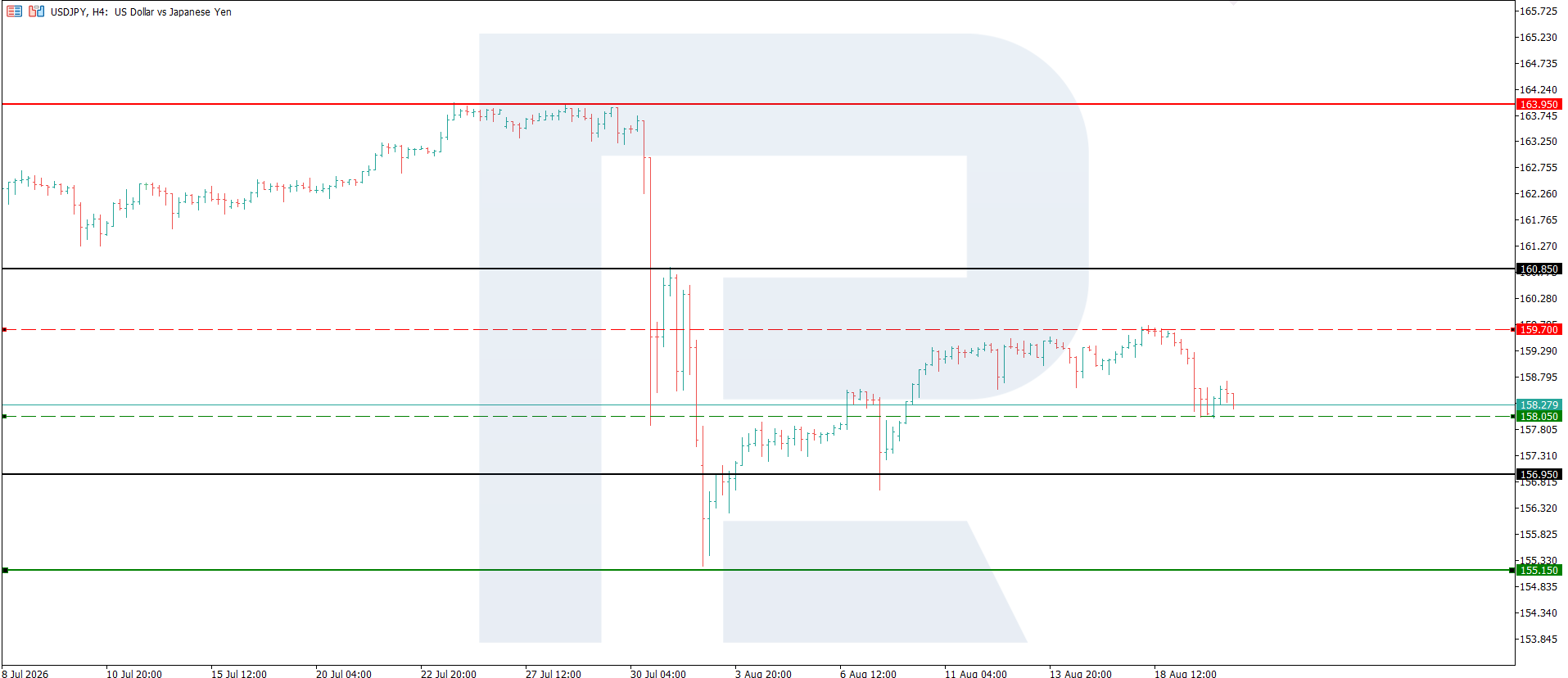
USDJPY trading scenarios for today
Main scenario (Sell Stop)
The price is poised to break below the 158.05 support level, with a high probability of further decline.
- Take Profit: 156.95
- Stop Loss: 158.25
Alternative scenario (Buy Stop)
A breakout above the 159.70 resistance level would lead to renewed yen weakness.
- Take Profit: 160.85
- Stop Loss: 159.55
Risk factors
The main risks for the USDJPY pair are associated with falling US bond yields and a potential interest rate hike by the Bank of Japan, which supports the yen. The risk of further currency intervention by Japan is adding to pressure on the pair. At the same time, a hawkish Federal Reserve policy and a recovery in US yields could restore support for the dollar.
Summary
The yen continued to strengthen within the downtrend. USDJPY technical analysis suggests a corrective decline towards 156.95.
Editors’ picks
 EURUSD forecast 2026–2027: technical analysis, price levels & predictions
EURUSD has pulled back from the 2026 high of 1.1915 and is now trading near 1.1450 — below both EMA65 and EMA200 — with the active scenario shifting from bullish to bearish. The ECB raised rates to 2.40%, but the Fed holds at 3.75%, and US inflation (3.5%) continues to outpace the eurozone (2.8%). A confirmed break below 1.1280 opens the next downward wave toward 1.1080. We break down the key levels, three trading scenarios with entry triggers, and what Deutsche Bank, Morgan Stanley and UBS are forecasting for EURUSD in 2026.
 Gold (XAUUSD) forecast 2026: predictions based on fundamental and technical analysis
Gold has corrected over 25% from its all-time high of 5,597 USD and is now trading near 4,100 USD — testing a critical support zone. Is this the bottom, or will the downtrend continue? We break down the key levels (support 3,920 USD, breakout trigger 4,500 USD), three trading scenarios with entry levels, and what J.P. Morgan, Goldman Sachs and Deutsche Bank are forecasting for gold in 2026.
Forecasts presented in this section only reflect the author’s private opinion and should not be considered as guidance for trading. RoboForex bears no responsibility for trading results based on trading recommendations described in these analytical reviews.