
Rate hike fails to support the yen: USDJPY targets 159.17
USDJPY maintains upward momentum after the Bank of Japan's decision to raise interest rates as markets assess the Federal Reserve outlook. The current price is 156.84. Find out more in our analysis for 21 September 2026.
USDJPY forecast: key takeaways
- The Bank of Japan raised the interest rate by 25 basis points to 1.25%, the highest level since April 1995
- Two board members opposed the rate hike
- The gap between the expected rate paths of the Federal Reserve and the BoJ continues to support the dollar
- USDJPY forecast for 21 September 2026: 159.17
Fundamental analysis
USDJPY starts the week near 156.84. Earlier, the yen hit a two-week low after the Bank of Japan raised interest rates in line with expectations. As the decision had been almost fully priced in beforehand, the rate hike itself failed to provide sustained support for the Japanese currency.
The Bank of Japan raised its key interest rate by 25 basis points to 1.25%, the highest level since April 1995. The regulator continues to respond to persistent inflation and additional price risks associated with high energy costs and tensions in the Middle East.
The decision was not unanimous. Board members Toichiro Asada and Ayano Sato opposed the increase, indicating resistance to a faster tightening cycle. This heightened market doubts about how quickly the BoJ will be able to continue raising rates.
The yen later recouped some of its losses following comments from Kazuo Ueda. The Bank of Japan governor reaffirmed the bank's readiness to continue raising rates and adjust the degree of monetary stimulus depending on developments in the economy, prices, and financial conditions.
Nevertheless, USDJPY remains supported by the divergence in expectations for US and Japanese monetary policy. Following the Federal Reserve's hawkish rate hike earlier in the week, market participants believe the US regulator could move faster than the BoJ. This preserves the yield advantage in favour of the dollar.
The USDJPY outlook remains moderately positive.
Technical outlook
On the H4 timeframe, USDJPY maintains strong recovery momentum after reversing from the 153.30 area. The pair broke above the descending trendline and moved above the middle Bollinger Band, approaching the key resistance level at 158.08.
MACD is above the zero line, while the indicator line remains above the signal line, confirming that positive momentum persists. At the same time, the Stochastic Oscillator has turned lower after approaching the overbought zone, so a local correction is possible before another attempt to rise.
For USDJPY to continue moving higher, the pair needs to consolidate above 158.08. In this case, the next target would be the 159.17 area, followed by 159.76. The alternative scenario would become relevant if the pair falls below 156.25, increasing the probability of a correction towards 155.08.
USDJPY overview
- Asset: USDJPY
- Timeframe: H4 (Intraday)
- Trend: bullish
- Key resistance levels: 158.08 and 159.17
- Key support levels: 156.25 and 155.08
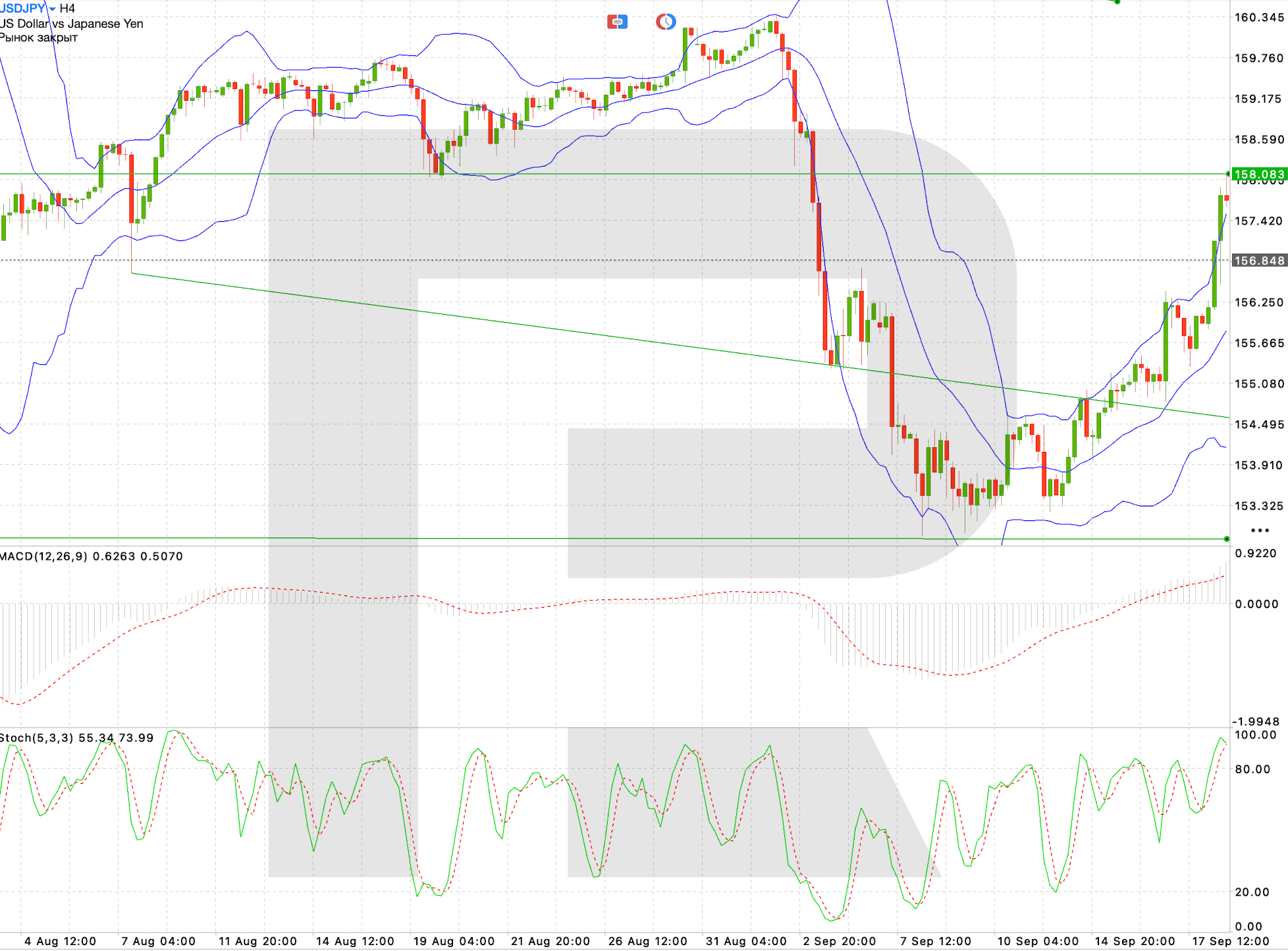
USDJPY trading scenario for today
Trading scenario (Buy Stop)
A move above the 158.08 resistance level, followed by consolidation, would confirm the continuation of bullish momentum after the breakout above the descending trendline and create conditions for opening long positions.
- Current price: 156.84
- Entry level: 158.10
- Take Profit: 159.17
- Stop Loss: 157.55
- Risk-to-reward ratio: 1:2
The trade idea is valid until 08:00 AM on 22 September 2026 (server time, UTC+3).
Risk factors
The main risk to the bullish USDJPY scenario would be a further strengthening of the Bank of Japan's hawkish rhetoric. If the market begins to price in a faster rate-hike cycle in Japan, the yen could receive additional support. A technical risk is the Stochastic Oscillator turning lower after reaching the overbought zone. A decline below 156.25 would increase the probability of a deeper correction towards 155.08.
Summary
USDJPY maintains upward momentum following the Bank of Japan's decision, although a local correction is possible near resistance. Today's USDJPY forecast for 21 September 2026 does not rule out further gains towards 158.08 and then 159.17.
Editors’ picks
 EURUSD forecast 2026–2027: technical analysis, price levels & predictions
The EURUSD outlook for 2026 and 2027: key levels on the daily chart, three trading scenarios and the policy gap between the Fed and the ECB that drives the pair.
 Gold (XAUUSD) forecast 2026: technical analysis, price levels & predictions
Where gold could trade in 2026: key levels, three trading scenarios with entry triggers and the forecasts from J.P. Morgan, Deutsche Bank and Goldman Sachs.
Forecasts presented in this section only reflect the author’s private opinion and should not be considered as guidance for trading. RoboForex bears no responsibility for trading results based on trading recommendations described in these analytical reviews.