
DE 40 forecast: the index is trading sideways
The DE 40 stock index remains in a global uptrend, but is trading locally within a channel. The DE 40 forecast for today is negative.
DE 40 forecast: key takeaways
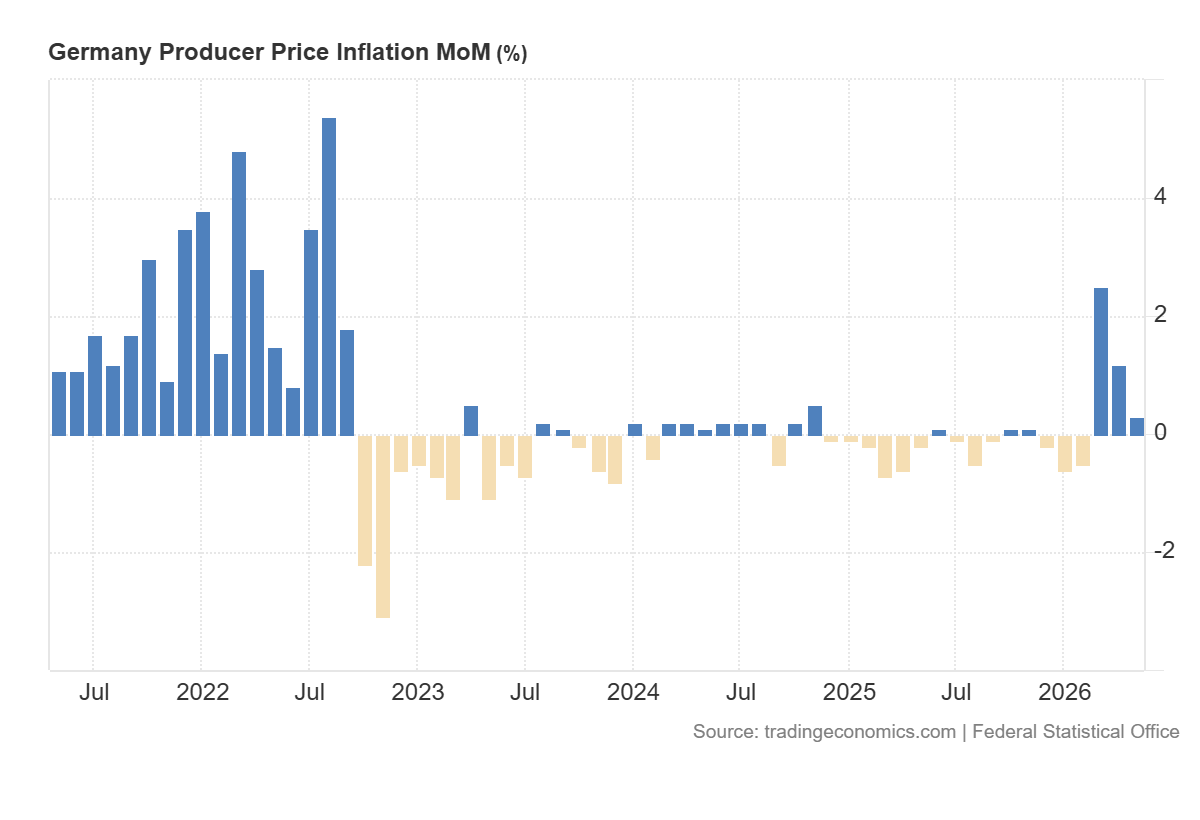
- Recent data: Germany’s PPI rose by 0.3% in May
- Market impact: the data creates a positive backdrop for the German stock market
DE 40 fundamental analysis
Germany’s actual PPI reading came in softer than expected: monthly growth was 0.3%, below the forecast of 0.7% and the previous reading of 1.2%. For the DE 40 index, this is a moderately positive signal, as the market receives confirmation that producer inflation has started to slow after a sharp increase. Weaker-than-expected producer price growth reduces pressure on German companies’ margins and partially lowers the risk of tighter monetary policy in the eurozone.
For the DE 40, the publication could support demand for shares of companies that are highly sensitive to interest rates and production costs. If investors conclude that inflationary pressures have peaked, this may improve share valuations, especially in industry, technology, real estate, and certain consumer segments. As an index of the 40 largest and most liquid German companies, the DE 40 primarily reflects the country’s large corporate sector, so the reaction will depend not only on the PPI itself but also on expectations for the ECB.
DE 40 technical analysis
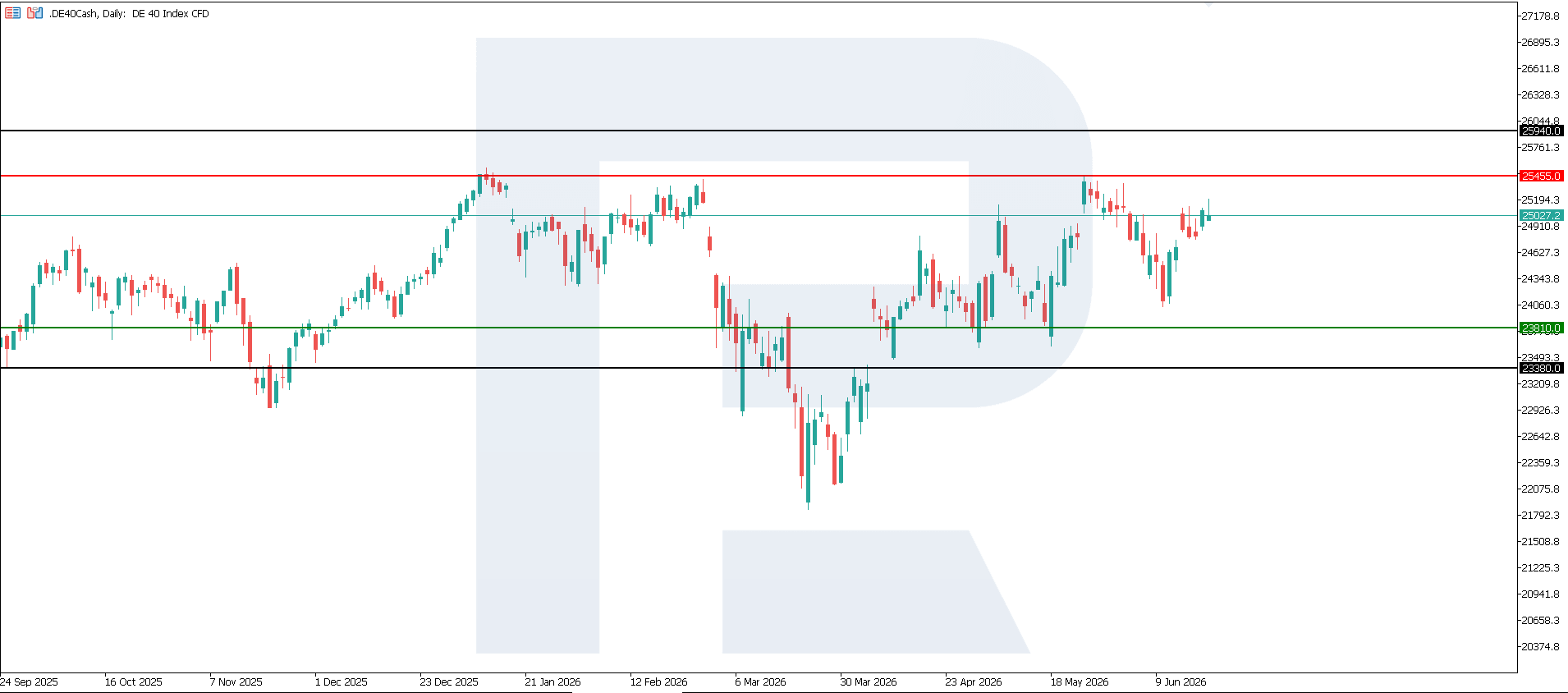
The DE 40 index has formed the nearest resistance level at 25,455.0, while a key support level is currently located at 23,810.0. The index continues to trade sideways, while a broader uptrend remains intact. If buying activity recovers, quotes may move into a new growth phase, with the nearest upside target at 25,940.0.
The DE 40 price forecast outlines the following scenarios:
- Pessimistic DE 40 scenario: a breakout below the 23,810.0 support level could push the index down to 23,380.0
- Optimistic DE 40 scenario: a breakout above the 25,455.0 resistance level could drive the index up to 25,940.0
Summary
Overall, this release appears moderately positive for the DE 40 index, but not strong enough to sustain the index’s independent growth. It reduces concerns about accelerating producer inflation, but does not change the fact that annual price pressure in Germany remains noticeable. The most favourable reaction is likely in technology companies, real estate, industry, and consumer stocks, while chemicals, automotive, energy, and banking could see a more subdued or mixed reaction. The nearest upside target remains 25,940.0.
Editors’ picks
 EURUSD forecast 2026–2027: technical analysis, price levels & predictions
The ECB holds rates at 2.15% while the Fed stays at 3.75% — and that divergence is the central driver of EURUSD in 2026. The pair is range-bound between 1.1400 and 1.1915, with Deutsche Bank targeting 1.2500 and Morgan Stanley calling for 1.3000 by year-end. We analyse the technicals, break down the macro factors, and outline three trading scenarios with specific entry levels.
 Gold (XAUUSD) forecast 2026: predictions based on fundamental and technical analysis
Where is gold headed after pulling back from the all-time high of 5,597 USD? XAUUSD is consolidating near 4,518 USD between key levels 4,220 USD and 4,855 USD, with major banks targeting 5,243–6,200 USD by year-end. Read our comprehensive gold forecast: technical analysis across three timeframes, trading scenarios with specific entry levels, Fed policy and central bank demand outlook, and institutional predictions for 2026 and beyond.
Forecasts presented in this section only reflect the author’s private opinion and should not be considered as guidance for trading. RoboForex bears no responsibility for trading results based on trading recommendations described in these analytical reviews.