
JP 225 forecast: the index declined by 15%
The JP 225 stock index returned to last year’s levels as part of the downtrend. The JP 225 forecast for today is negative.
JP 225 forecast: key takeaways
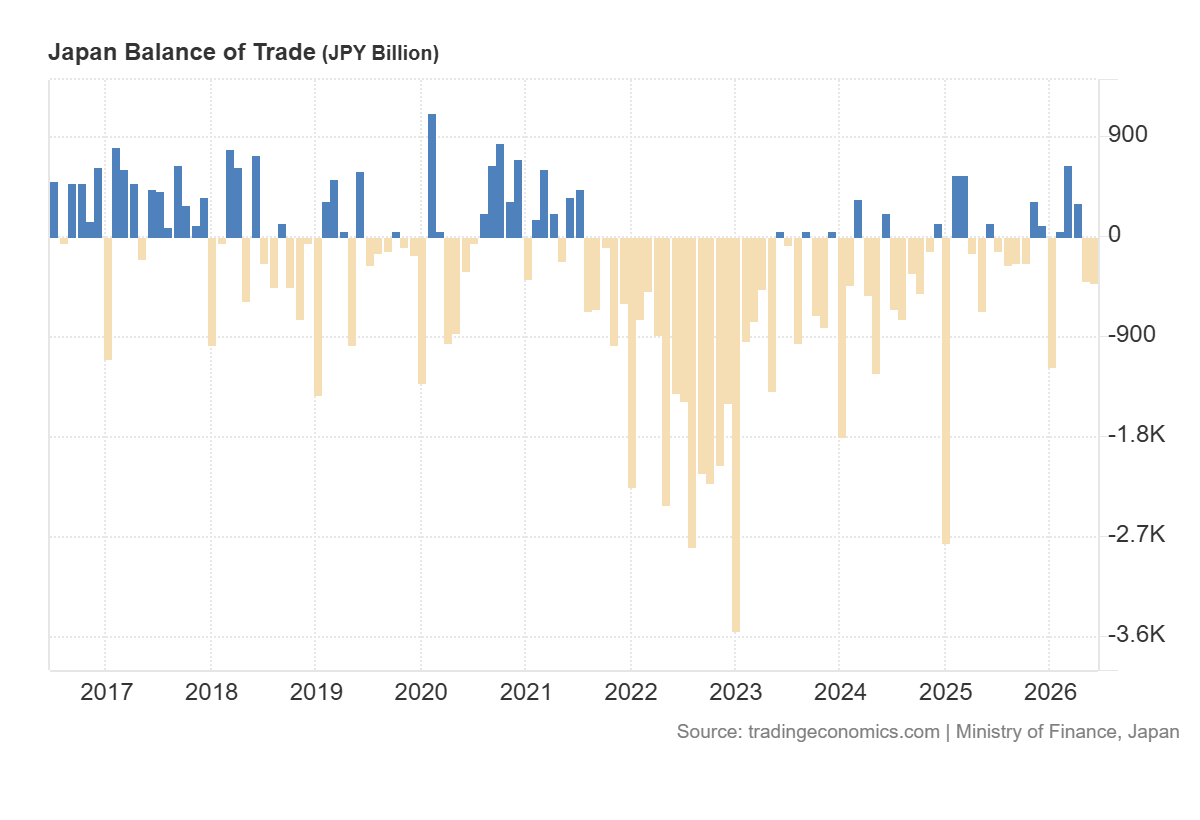
- Recent data: Japan’s trade balance for June stood at −406.9 billion JPY
- Market impact: the effect on the Japanese stock market is mixed
JP 225 fundamental analysis
The release of Japan’s foreign trade data may have a moderately negative impact on the JP 225 index, as the trade deficit reached 406.9 billion JPY compared to a projected deficit of only 120 billion JPY. The negative balance was also slightly larger than the previous reading. Such a significant deviation from expectations shows that the country’s import costs are rising faster than its export revenues. In June, Japanese exports increased by 19.3% year-on-year, while imports rose by 25.4% and reached a record 11.3 trillion JPY. The main reasons were higher oil prices and a weaker national currency, which make foreign goods and raw materials more expensive for Japanese companies.
For the JP 225 index, the result is mixed. On the one hand, the widening trade deficit raises concerns about higher production costs, accelerating inflation, and a potential decline in households’ real incomes. This may negatively affect companies focused on the domestic market. In addition, persistently high import inflation may increase the likelihood of further monetary policy tightening by the Bank of Japan. Higher interest rates could raise borrowing costs and reduce the appeal of shares in companies whose valuations depend heavily on expectations of future profit growth.
JP 225 technical analysis
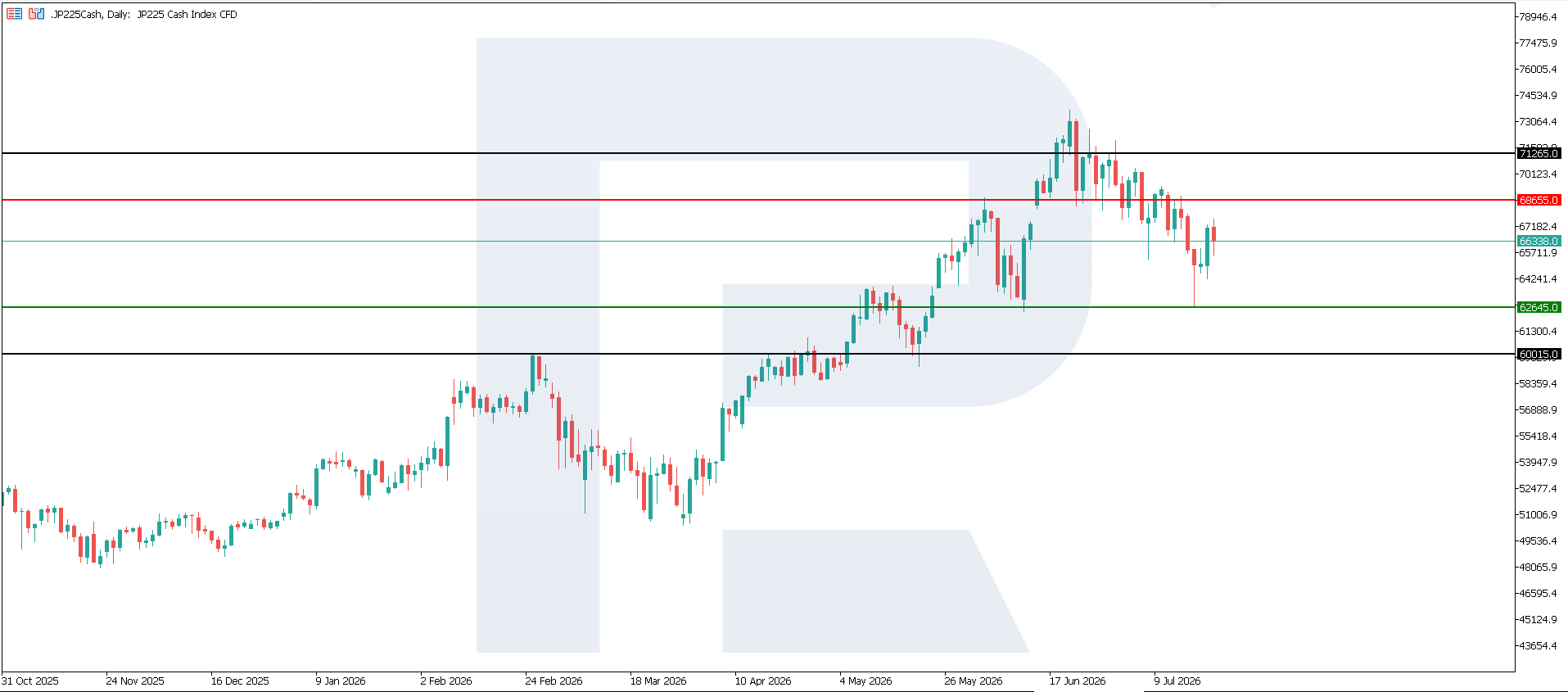
The JP 225 index continued to decline. A new support level formed at 62,645.0, while the nearest resistance level is located at 68,655.0. The pace of decline is slowing, but a trend reversal is still not expected. If the decline continues, the next target could be 60,015.0.
The JP 225 price forecast considers the following scenarios:
- Pessimistic JP 225 scenario: a breakout below the 62,645.0 support level could send the index down to 60,015.0
- Optimistic JP 225 scenario: a breakout above the 68,655.0 resistance level could push the index up to 71,265.0
Summary
Overall, the trade balance data creates a moderately negative backdrop for the JP 225. However, strong export growth and the significant share of technology and internationally oriented companies in the index could prevent a large-scale decline. In the short term, the index’s reaction will largely depend on further movements in the yen and oil prices. Continued weakness in the Japanese currency may support exporters and the index itself, but at the same time, it will intensify inflation and worsen conditions for import-dependent companies. The next downside target for the JP 225 could be 60,015.0.
Editors’ picks
 EURUSD forecast 2026–2027: technical analysis, price levels & predictions
EURUSD has pulled back from the 2026 high of 1.1915 and is now trading near 1.1450 — below both EMA65 and EMA200 — with the active scenario shifting from bullish to bearish. The ECB raised rates to 2.40%, but the Fed holds at 3.75%, and US inflation (3.5%) continues to outpace the eurozone (2.8%). A confirmed break below 1.1280 opens the next downward wave toward 1.1080. We break down the key levels, three trading scenarios with entry triggers, and what Deutsche Bank, Morgan Stanley and UBS are forecasting for EURUSD in 2026.
 Gold (XAUUSD) forecast 2026: predictions based on fundamental and technical analysis
Gold has corrected over 25% from its all-time high of 5,597 USD and is now trading near 4,100 USD — testing a critical support zone. Is this the bottom, or will the downtrend continue? We break down the key levels (support 3,920 USD, breakout trigger 4,500 USD), three trading scenarios with entry levels, and what J.P. Morgan, Goldman Sachs and Deutsche Bank are forecasting for gold in 2026.
Forecasts presented in this section only reflect the author’s private opinion and should not be considered as guidance for trading. RoboForex bears no responsibility for trading results based on trading recommendations described in these analytical reviews.